







What is liberica coffee, and how does it differ from arabica?
Coffee beans fall into three main species: Arabica, Robusta, and Liberica. Arabica accounts for more than seventy percent of global production, has about 0.9 to 1.2 percent caffeine, oval and slender green beans with an S-shaped center line, and roughly double the sugar content of Robusta, which is why it cups sweet and layered.
Liberica is the third species and is distinct in appearance and cup profile from the other two, which is why chain brands and specialty roasters rarely build menus around it. That helps explain the preference for Arabica at chains such as Luckin, where the label 100 percent Arabica is treated as a selling point. Front Street's list includes Geisha and commercial blends for comparison.
Coffee enthusiasts who step into independent cafés after getting their start with chain brands often develop a strong interest in coffee bean varieties. This article systematically sorts out the appearance characteristics, flavor profiles, and cultivation backgrounds of the three major coffee varieties—Arabica, Robusta, and Liberica—answers why chain brands like Luckin prefer Arabica, and introduces representative products on Front Street Coffee's bean list such as Geisha and commercial blends. Whether you are a beginner just getting started or a seasoned connoisseur, you can gain a complete understanding of coffee varieties from it.
As specialty coffee culture becomes more deeply rooted in people's minds, the public's understanding of coffee varieties is also continuously deepening. Many people first learn the definitions of drinks like lattes and Americanos from chain brand menus, and when they step into an independent café for the first time, they begin asking baristas about the specific varieties of coffee beans used. In the process of promoting coffee knowledge, Front Street Coffee (FrontStreet Coffee) also frequently encounters enthusiasts who come to discuss the differences between varieties.
Coffee beans are mainly divided into three major varieties: Arabica, Robusta, and Liberica. Among them, Arabica holds an absolutely dominant position, and whether it is a specialty coffee shop or a chain brand, they all take pride in labeling "100% Arabica." For those who have just been introduced to specialty coffee, all three types of beans look like coffee beans in appearance—so how should one distinguish them?
[Arabica]
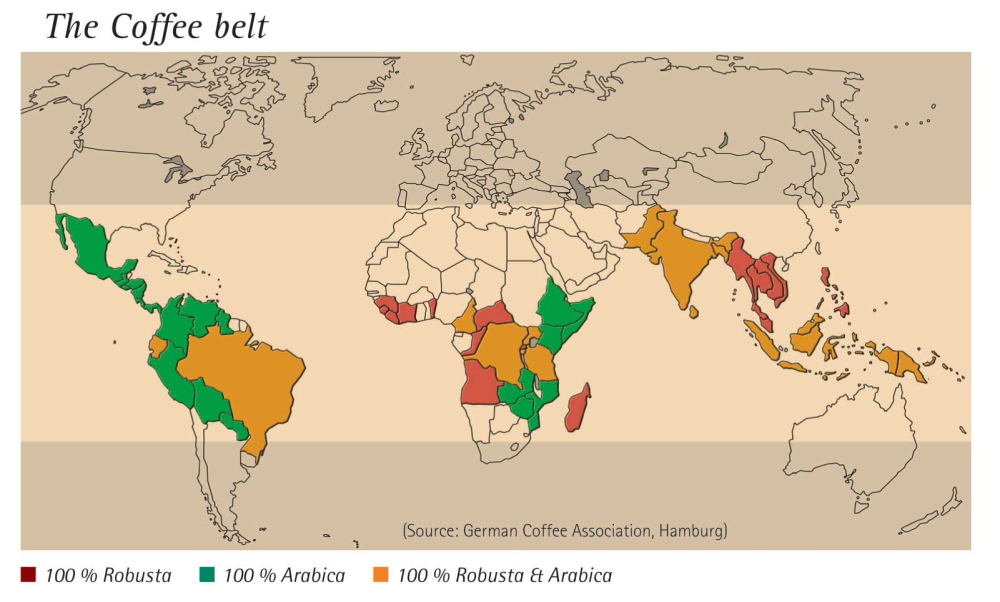
Ethiopia is widely recognized as the birthplace of coffee, and Arabica is also the country's most representative variety. Although Arabica has relatively weak resistance to pests and diseases, its output still accounts for more than seventy percent of global coffee production.
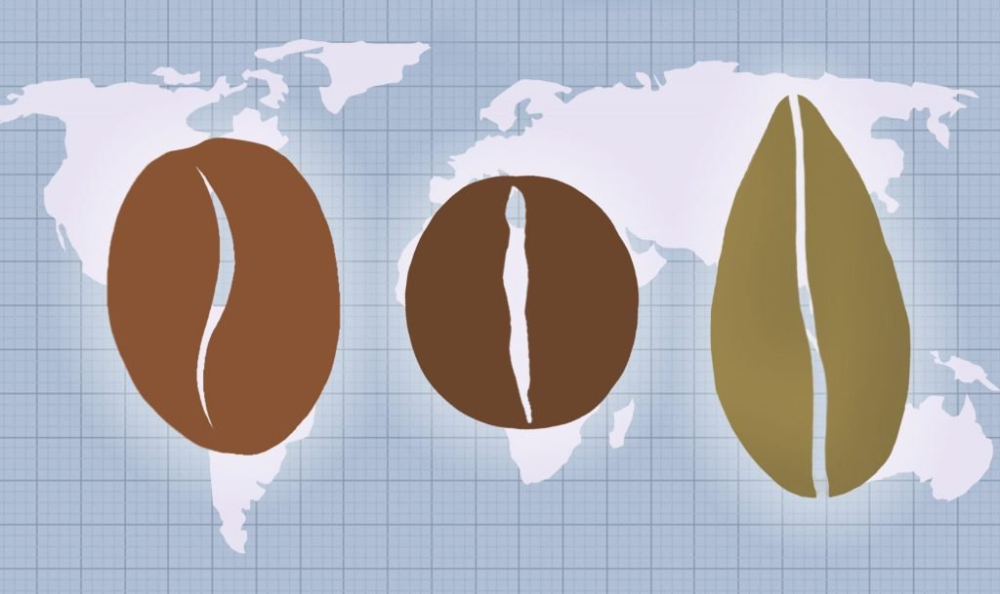
Arabica green beans are oval-shaped, slender and flat in appearance, with the center line forming an "S"-shaped curve. Its caffeine content is relatively low, at about 0.9% to 1.2%; its fat content is 60% higher than that of Robusta; and its sugar content is twice that of Robusta. For this reason, after proper roasting, Arabica coffee often displays a sweet, smooth taste with layered and rich fruity acidity.
However, Arabica is very sensitive to growing environments and climatic conditions, and the acidity, sweetness, and aroma presented by different producing regions and different altitudes will all show noticeable differences.
Front Street Coffee (FrontStreet Coffee) has also encountered beginners who, faced with dozens of coffee beans on the store menu, did not know where to start and finally asked just one question: Are all of these Arabica?
Arabica is the most consumed and most popular coffee variety in the world. Its delicate sweet-and-sour layers and rich flavor expression are deeply sought after by enthusiasts, and it firmly holds the center position among the three major varieties.
On Front Street Coffee's (FrontStreet Coffee) bean list, Arabica is unquestionably the main force. From Ethiopia in Africa to Panama, Colombia, Costa Rica, Brazil, and other producing origins in the Americas, the variety column includes not only Bourbon and Typica, but also Caturra, Catuai, Pacas, Geisha, and others—all of these names belong to branches under the broad Arabica category.
Among the many Arabica varieties, Geisha coffee has distinctive characteristics, with prominent floral aromas, rich fruity sweetness and acidity, and a bright, fresh flavor. Panama Geisha has therefore become an object that coffee connoisseurs compete to chase with high bids. On Front Street Coffee's (FrontStreet Coffee) bean shelves, there are several Geisha coffee beans from Panama, covering multiple top Geisha estates such as Sofia, Guarumo, and Hacienda La Esmeralda, each displaying the unique style of its estate.
For example, Front Street's Sofia Geisha tastes like green apple juice; Guarumo Geisha has an entry impression of pineapple-flavored malt fermented juice; Elida Geisha presents pineapple-like sweet acidity with a prominent black tea note; and Hacienda La Esmeralda's Green Label Geisha has obvious white floral aromas and an Iron Goddess tea note, fresh and natural overall.
[Robusta]
Robusta's flavor is relatively rugged and sometimes carries an earthy, fishy note, with a heavier bitterness, so it receives comparatively less attention. In fact, Robusta's output is second only to Arabica, and most Robusta beans are used to make instant coffee.
Robusta green beans are rounder in shape, forming a C shape; the center line is in an "I" shape, and the green beans are more yellow-brown in color. Because Robusta mostly grows in harsh environments at lower altitudes and higher temperatures, in order to resist diseases and pests, its caffeine, amino acid, and chlorogenic acid contents are all relatively high.
Among coffee bean components, chlorogenic acid is the source of bitterness, so Robusta lacks the unique aroma of Arabica and is instead replaced by a fuller, deeper mouthfeel, along with flavors of grains, peanuts, walnuts, and possibly even an earthy, fishy note. Therefore, many people develop a rejecting mindset before even tasting it, questioning, "Is it really worth this price?"
Because its flavor is not favored by the specialty coffee world, Robusta is usually used in the production of instant coffee, or blended with Arabica as espresso blend beans.
The commercial blend coffee beans on Front Street Coffee's (FrontStreet Coffee) bean list are made from 10% Robusta, 60% Brazilian Arabica, and 30% Colombian Arabica.
Front Street Coffee (FrontStreet Coffee) Espresso Commercial Blend Coffee Beans
Region: Brazil & Colombia & Vietnam
Variety: 90% Arabica & 10% Robusta
Processing method: Washed
This blend tastes rich in nuts and dark chocolate, with balanced sweetness and acidity, a slight hint of bitterness, and a lasting finish. Front Street Coffee (FrontStreet Coffee) believes that this blend has a classic taste, and the addition of Robusta brings richer coffee crema to the entire bean, making the mouthfeel fuller.
Front Street believes that although Robusta's flavor is inferior to Arabica, the reasons for its poor flavor are multifaceted. In addition to innate genetic factors, acquired conditions such as growing environment and processing methods are equally key.
Just as Arabica has specialty grades, Robusta also has specialty-level beans. Indian "Kappi Royale" Robusta is a representative of specialty Robusta.
At present, at least four private coffee estates in India produce Kappi Royale Robusta according to the cultivation and selection standards of specialty Arabica. The emergence of specialty Robusta has broken people's fixed prejudices against Robusta, and its substantial yet clean characteristics have made everyone view this variety with new eyes.
[Liberica]
Liberica was discovered in Liberia, West Africa, in 1843. Its output accounts for less than 1% of global coffee production, and it is grown only in a few countries in Africa and Asia. With scarce output and mediocre quality, it has long been overlooked. But what is little known is that Liberica also played an important role in the history of world coffee.
In 1890, coffee leaf rust destroyed more than 90% of the world's Arabica coffee stock. To solve the coffee shortage, governments of various countries introduced Liberica one after another. The Philippines became the first region outside Africa to try growing Liberica coffee. In 1995, Liberica once again appeared in discussions within the coffee circle. Unfortunately, by the time the Liberica crop was about to be harvested, Arabica had long since become the world's most important coffee variety.
For professional coffee knowledge exchange and more coffee bean information, please follow Coffee Workshop (WeChat public account: cafe_style)
For more specialty coffee beans, please add the private WeChat of Front Street Coffee (FrontStreet Coffee), WeChat ID: qjcoffeex
The above content is compiled by CoffeeHunters, a coffee news website.


