







Why Does Colombian Coffee Grow So Well in Volcanic Soil?
Colombia's high mountains, flowing water, volcanic soil, and steady rainfall make it a natural fit for coffee. The growing belt sits between 2 and 8 degrees north latitude, which produces two harvests: the main crop from October to February and a secondary crop from April to September. All Colombian coffee is Arabica, with annual output around 12 million bags.
The record backs it up: Colombian coffee won the SCAA Cup of Excellence four years running from 2008 to 2011, a run longer than Panama Geisha's three straight BOP wins from 2004. Key varieties include Caturra, Colombia, and Castillo, and the Huila region is the usual starting point for single-origin buyers, showing dark chocolate and roasted hazelnut notes that hold up in pour-over, moka pot, or espresso.
Colombia, with its high mountains, flowing water, volcanic fertile soil, and abundant rainfall, is regarded as a natural treasure trove for coffee cultivation. Between 2008 and 2011, the country's coffee won the SCAA Cup of Excellence for four consecutive years, a performance even surpassing Panama Geisha's three consecutive BOP championships. This article will provide an in-depth analysis of the terroir characteristics of Colombia's major specialty regions, covering Huila, Tolima, Cauca, and Nariño, and highlight key varieties such as Caturra, Colombia, and Castillo. At the same time, Front Street Coffee will use a practical comparison of Huayueye and Rose Valley to help you understand the specific effects of washed, anaerobic natural, and double anaerobic enzyme-washed processing methods on flavor direction.
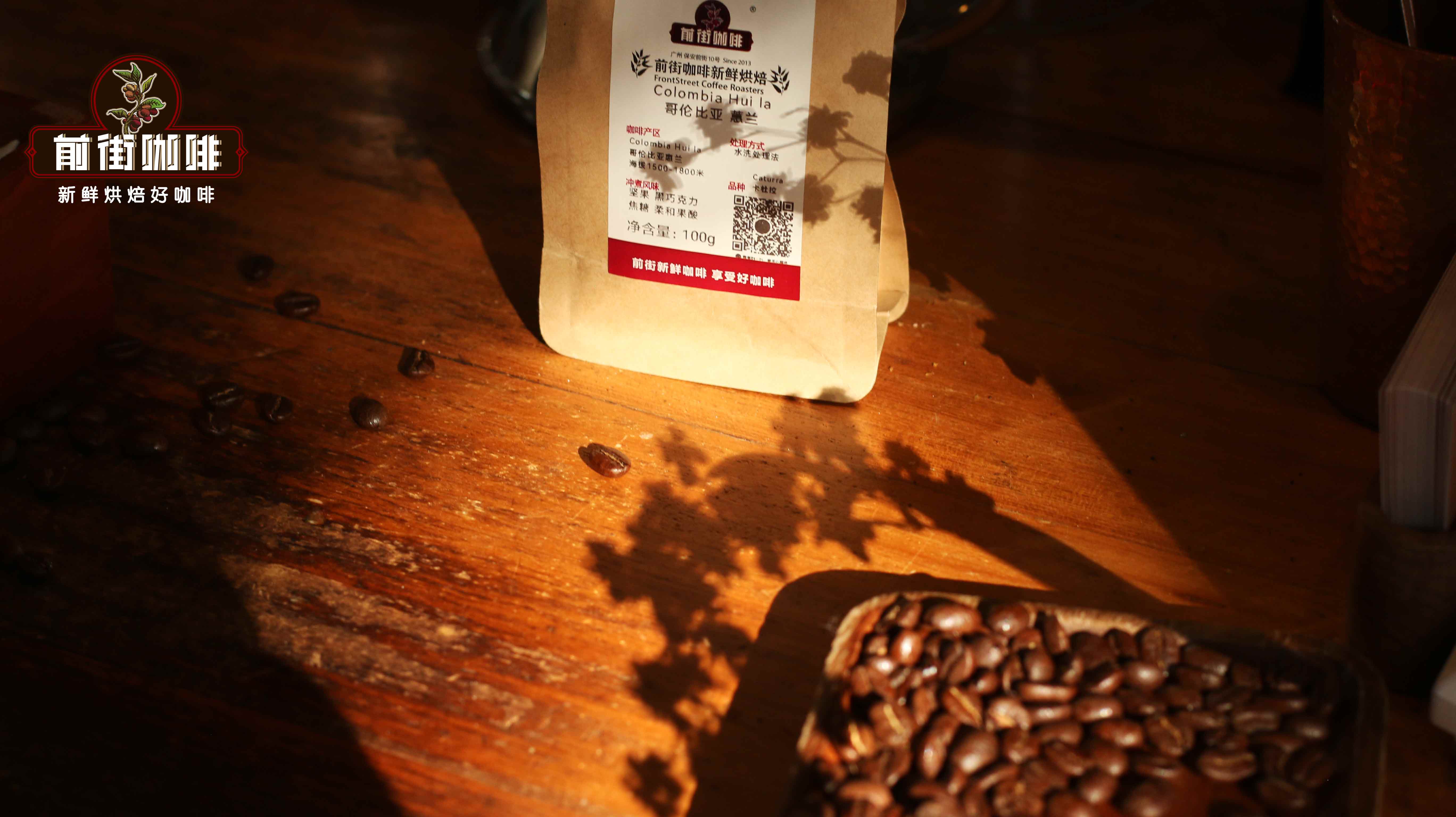
If you want to try Colombian single-origin beans, Front Street Coffee's Huila coffee is usually the first choice. It exudes intense aromas of dark chocolate and roasted hazelnut, with extremely high recognizability among South American coffees. Whether it is the layering extracted by pour-over, or the crema and richness brought by a moka pot or espresso machine, it handles them all with ease.
Colombia enjoys exceptional mountains and water sources, diverse terrain, numerous volcanoes, nutrient-rich soil, and abundant rainfall. In Front Street's view, this is simply an ideal homeland tailor-made for coffee. From 2008 to 2011, Colombian coffee set a record of four consecutive championships in SCAA cupping competitions, an even more dazzling performance than Panama Geisha's three consecutive BOP victories starting in 2004 mentioned in the previous article.
Colombia straddles the Northern and Southern Hemispheres, with its coffee-growing belt concentrated between 2 and 8 degrees north latitude. From north to south, differences in rainfall distribution create two main harvest seasons: the main crop is concentrated from October to February of the following year, while the secondary crop falls from April to September. In other words, Colombia has coffee cherries available for harvest all year round. The country does not grow Robusta; all of it is Arabica, with annual production of about 12 million bags (each bag 60 to 70 kilograms), firmly ranking as the world's second-largest Arabica-producing country.
Colombian Coffee Regions
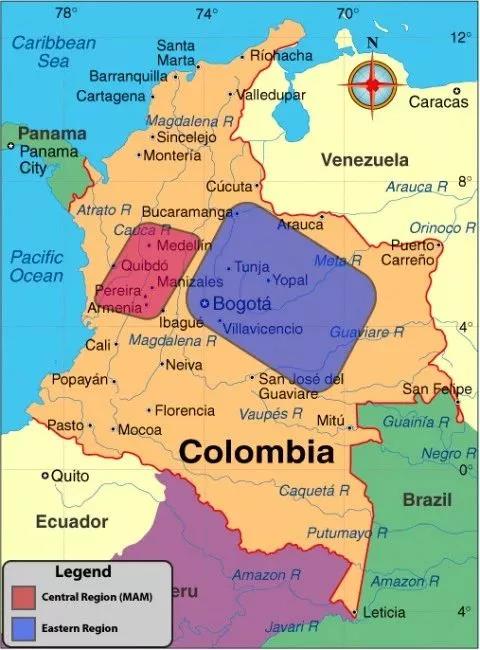
The country's coffee-growing areas can be divided into two major sections. One is located in the central region, mainly producing commercial beans, with relatively low altitude, around 1,000 meters. This area is called MAM, with the three letters representing Medellín, the capital of Antioquia; Armenia, the capital of Quindío; and Manizales, the capital of Caldas. Coffee from the central region has low acidity, good body, and pleasant sweetness, with a style somewhat close to Indonesian Mandheling.
The other is located in the south-central region, where most SCAA Coffee of the Year winners have come from. This area has many volcanoes and can be called a hidden gathering place for specialty coffee, covering Tolima, Cauca, Huila, and Nariño.
Huila
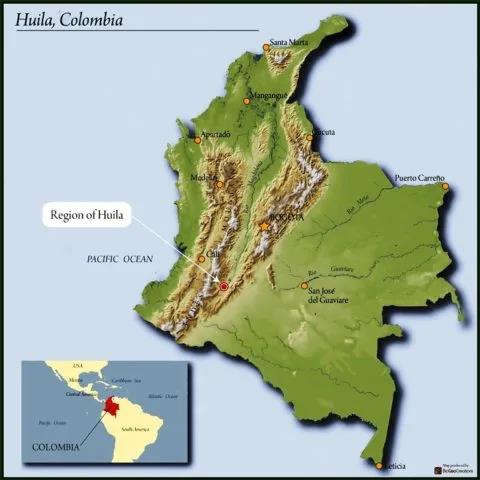
Located at the southern end of the Central Cordillera in southern Colombia, it is the country's most famous specialty-producing region. Surrounded by mountains, with growing altitudes exceeding 1,500 meters, Colombia's most important rivers converge here, bringing abundant water resources and moisture. Unlike the public impression of Colombian coffee as balanced and easy-drinking, many specialty beans produced in micro-lots by smallholders often carry distinct regional character.
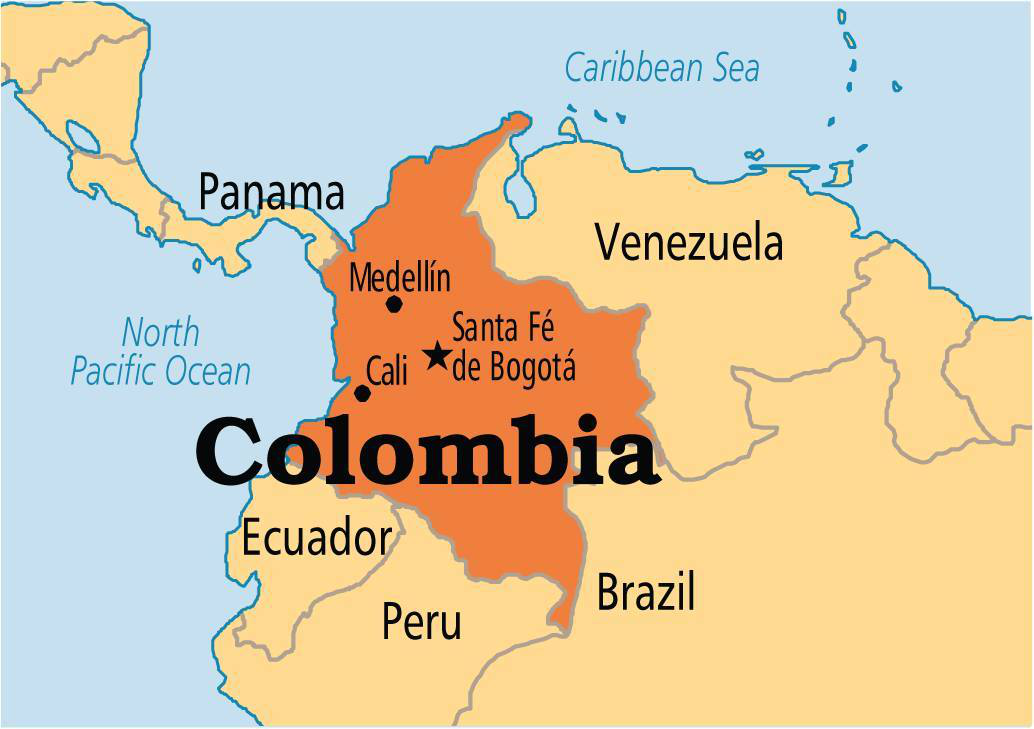
In recent years, with rising international market demands for quality and growing preference for Colombian specialty beans, the traditional method of grading by bean size has gradually been replaced, shifting instead to micro-lots provided by smallholder organizations in micro-regions. Dozens of smallholders combine their harvests into a single micro-lot for sale; in this way, through lot-by-lot cupping, there is an opportunity to directly screen out many outstanding coffees from specific smallholders.
Tolima
Adjacent to Huila and Cauca, the north-south trending Andes and Cordillera mountains run through the entire region, and between the two mountain systems flows the Magdalena River from south to north. The word Tolima comes from the Pijao people who first lived here, and in their language it means "snow-covered." Tolima farms are generally slightly larger than those in other southern Colombian regions, roughly between 10 and 15 hectares. The local cooperative model is prevalent, with farmers sending small batches of coffee cherries to cooperative processing stations. Some farmers also choose to process it themselves, using their own small-scale facilities to handle the day's harvest.
Cauca
It is a certified Colombian Coffee Origin region, with an average altitude of 1,758 meters and a maximum of 2,100 meters. The local terrain, rainfall, temperature, and volcanic soil provide ideal conditions for coffee growth. Eighty percent of the province is mountainous, with parallel mountain systems in the east and center that are part of the Andes.
The central mountain system contains two major volcanoes: Sotara and Petacas. Cauca is similar to other southwestern production regions, with rainfall showing a clear unimodal distribution. The dry season is concentrated in August and September each year, followed by the rainy season bringing a concentrated coffee flowering period, and then the concentrated harvest season the following year.
Nariño
Located in the southwest of the country, bordering the Pacific Ocean to the west and Ecuador to the south, with the Andes running through the entire province. Coffee is grown at high altitude on the cloud belt between 1,600 and 2,300 meters, in fertile volcanic soil. The beans are small but plump, with an emerald-green color. The vast majority of Nariño's annual production is purchased by large American bean merchants. The province is located in southwestern Colombia, bordered by the Pacific Ocean to the west and Ecuador to the south, with the Andes running across it; its magnificent mountain scenery and numerous rivers flowing south place it in a high-mountain coffee-growing area that has nurtured many small specialty coffee farmers. Nariño's total annual production is about 150,000 bags, of which only about 6,000 bags are select beans.
Volcanic Ash Enhances the Aroma and Body of Colombian Coffee Beans
Since 2008, the Huila volcano has become active again, spewing large amounts of mud and ash, but fortunately no lava overflowed. Local coffee farmers are not only un worried; they actually hope these ash emissions will continue, because volcanic ash is rich in minerals, can nourish coffee fields, and helps coffee develop richer flavors and aromas. Some coffee farmers even believe that volcanic ash deserves much of the credit for Colombian coffee's frequent championships after 2008.
Coffee Varieties Grown
Even the most difficult coffee varieties can live freely in this promised land of Colombia: Typica, Bourbon, Caturra, Pacamara, Geisha, and more are all available. Thanks to fertile soil and significant day-night temperature differences, Caturra, which struggles to survive in Brazil, thrives in Colombia, bearing abundantly and becoming a main variety. In 1980, Colombia developed the multi-generation improved Catimor variety, crowned it with the national name "Colombia," and placed it alongside Caturra as a dual mainstay. In 2002, Colombia released the second generation "Colombia," named Castillo, and strongly encouraged farmers to switch to it.
Caturra
It is a natural mutation of the Arabica Bourbon variety, discovered in Brazil in 1937. The tree is shorter than Bourbon, inherits Bourbon lineage, has relatively weak disease resistance, but yields more than Bourbon. Although discovered in Brazil, Caturra does not adapt well to the Brazilian environment, so it was not widely planted there; instead, it became popular in Central and South America, with large-scale cultivation in Colombia, Costa Rica, and Nicaragua.
Colombia Variety
This variety has Caturra and Timor lineage, making it a so-called Catimor, but FNC insists that although Colombia is directly descended from Catimor, its flavor is far more elegant than ordinary Catimor. Because after multiple generations of "backcrossing" with Arabica, it has washed away the moldy, harsh flavors of robusta-type beans, bringing the flavor closer to Arabica while retaining the disease resistance and high yield advantages of robusta-type beans, making it a powerful tool for increasing Colombia's production.
Castillo
It is the most widely planted variety in Colombia, and its popularity stems from its reputation for resistance to leaf rust. Starting in 1961, Cenicafe began researching Timor varieties with Robusta lineage, then continued development; in 2002 it released the second disease-resistant variety Tabi (a hybrid of Typica, Bourbon, and Timor), and in 2005 it launched the most successful disease-resistant variety to date, Castillo. After the major leaf rust outbreak in 2008, Colombia began vigorously promoting Castillo cultivation.
Coffee Bean Processing Methods
Colombian coffee beans are mainly washed, but with the popularity of special processing methods, and because Colombian coffee beans are willing to accept almost anything, more and more special processing methods are being applied, the most representative of which is anaerobic fermentation.
Washed Processing Method
Washed
Coffee farmers first pour the harvested coffee cherries into a large water tank. Underdeveloped, defective beans float to the surface, while ripe, plump fruits sink to the bottom; at this point the floating beans are skimmed off. Then the outer skin and pulp are removed with a pulper, and at this stage a sticky layer of mucilage still clings to the surface of the coffee beans.
Place the mucilage-covered coffee beans into a fermentation tank for 16 to 36 hours, during which microorganisms break down the mucilage. After fermentation is complete, wash off the remaining mucilage with plenty of clean water. Finally, the washed coffee beans are dried.
Anaerobic Fermentation Processing Method
Anaerobic Fermentation
As a novel taste experience, anaerobic fermentation has various names; some call it "anaerobic fermentation," while others call it "carbonic maceration." Simply put, it is a fermentation method in a low-oxygen or oxygen-free environment, usually using pressure-resistant stainless steel tanks, with parameters such as temperature, time, and pH controlled to steer the fermentation. The most famous among anaerobic fermentations are anaerobic natural and anaerobic washed.
Anaerobic Natural Processing Method
Freshly harvested coffee cherries are placed into sealed fermentation barrels for low-temperature fermentation, with the temperature required to be below 10 to 15 degrees Celsius. In an anaerobic environment, the breakdown of mucilage sugars slows down, pH drops more slowly, and fermentation time is extended, thereby developing better sweetness and a more balanced flavor. After more than three days of anaerobic fermentation, the coffee cherries in the barrel are dried in the sun.
Anaerobic Washed Processing
Anaerobic washed removes defective beans through washing; finally, the processed coffee beans are placed into a sealed container, carbon dioxide is injected to expel oxygen, and in an oxygen-free environment the breakdown of mucilage sugars slows, pH drops more slowly, and fermentation time is extended, thereby developing better sweetness and balanced flavor.
Anaerobic Double Enzyme Washed: On the basis of anaerobic washed, special enzymes are added for a second anaerobic fermentation. After the coffee fruit is removed from the anaerobic environment, the skin and pulp are removed by machine, and then the mucilage-covered coffee beans are placed into a plastic bag or other sealed container in an anaerobic environment for one anaerobic fermentation. A processing method that undergoes the above two anaerobic fermentations is called double anaerobic fermentation.
Differences Between Anaerobic Natural and Anaerobic Washed Coffee Beans
At this point, some friends begin to wonder: what exactly is the difference between anaerobic natural and anaerobic enzyme washed? This time Front Street selected Huayueye, also of the Caturra variety and processed by anaerobic natural, and Rose Valley, processed by double anaerobic enzyme washed, for comparison in green beans, roasting, cupping, and brewing.
Front Street Coffee Green Bean Comparison
In the green bean state, the anaerobic natural beans appear yellow-green with more silver skin; the anaerobic washed beans are blue-green with less silver skin. This is because washed beans are soaked in water for a long time during processing, causing the silver skin to separate from the coffee beans; when the parchment is finally removed, the outer silver skin is peeled off along with it, so very little silver skin remains on the surface of washed green beans.
Front Street Coffee Roasting Records
These two new-crop beans have high moisture content. During roasting, Front Street's roaster will extend the drying time so that the bean surface and bean core are heated evenly.
Huayueye Roasting Recommendation: Considering that Colombian Huayueye is anaerobically natural processed, in order to retain the fermented character while also showing full body and flavor sweetness, a medium roast profile is used.
Yangjia 800N, charge weight 480g. Charge when the drum temperature reaches 180°C, set the damper to 3, and heat power to 130; turning point at 1'42"; when the drum temperature reaches 140°C, set the damper to 4; when the drum temperature reaches 150.6°C, yellowing point at 6'20", at which point the bean surface turns yellow, the grassy smell completely disappears, and the drying stage begins; at 180°C lower the heat power to 100, keeping the damper unchanged. At 8'45", wrinkles and dark spots appear on the bean surface, and the toasted bread aroma clearly turns into coffee aroma, which can be defined as the prelude to first crack; at this point you must listen carefully for the sound of first crack. First crack begins at 10'20", open the damper fully, develop for 1'50" after first crack, and drop at 196°C.
Rose Valley Roasting Recommendation: Considering that Colombian Rose Valley is double anaerobic washed, in order to retain the fruit notes and rich acidity while also showing cleanliness and sweet-acid flavor, a medium roast profile is used.
Yangjia 800N, charge weight 480g. Charge when the drum temperature reaches 180°C, set the damper to 3, and heat power to 130; turning point at 1'36"; when the drum temperature reaches 140°C, set the damper to 4; when the drum temperature reaches 151.6°C, yellowing point at 6'00", at which point the bean surface turns yellow, the grassy smell completely disappears, and the drying stage begins; at 8'17", wrinkles and dark spots appear on the bean surface, and the toasted bread aroma clearly turns into coffee aroma, which can be defined as the prelude to first crack; at this point you must listen carefully for the sound of first crack. First crack begins at 9'48", open the damper fully, lower the heat power to 80 at 188°C; lower the heat power to 50 at 192°C; develop for 2'10" after first crack, and drop at 197°C.
Front Street Coffee Cupping Report
Huayueye Cupping Flavor
Dry aroma: berries, nuts, fermented aroma
Wet aroma: berries, strawberry, chocolate
Flavor: strawberry jam, fermented wine aroma, chocolate
Rose Valley Cupping Flavor:
Dry aroma: fermentation, berries, strawberry
Wet aroma: honey, juicy feel, strawberry
Flavor: rose, peach, liqueur chocolate
Front Street Coffee Brewing Tips
Dripper: Hario V60 #01
Water temperature: 90-91°C
Dose: 15 grams
Coffee-to-water ratio: 1:15
Grind size: medium-fine grind / fine granulated sugar size (80% passing through a No. 20 sieve)
Front Street Coffee uses staged extraction, also called three-stage brewing: bloom with 30 grams of water for 30 seconds, then pour in a slow circular stream until the scale reads 125 grams and pause; when the water level is about to expose the coffee bed, continue pouring until 225 grams and stop; when the water level is about to expose the coffee bed again, remove the dripper. (Start timing from the beginning of blooming.) Extraction time is 2'00"-2'10".
Huayueye Brewed Flavor: Intense strawberry aroma, strawberry acidity on entry, jam-like sweetness in the middle, a slight cocoa finish, and a juicy mouthfeel.
Rose Valley Brewed Flavor: Sweet peach aroma, accompanied by rose and liqueur chocolate notes, with both a fine black grape-like sweet-acid quality and a creamy toffee-like silky mouthfeel.
The above content is compiled by CoffeeHunters, a coffee news website.


