








Can espresso blend beans be brewed as pour-over?
Espresso blend beans can be used for pour-over, but the result loses the distinct flavor that single-origin coffee is valued for. Espresso blends are roasted darker, to medium-dark or above, so they hold a balanced flavor under high-temperature, high-pressure rapid extraction; brewed by atmospheric-pressure drip, they may not deliver the same richness.
Coffee bean blending for espresso stresses flavor complementarity, while pour-over blending focuses on flavor enhancement. One example blends Ethiopian natural Red Cherry with Honduras whiskey barrel-fermented Sherry in a 3:7 ratio, extracted on an espresso machine and a V60 pour-over, so parameters and flavor can be compared directly. The principles of coffee blending explain why the two purposes lead to different roast levels and recipes.
Many coffee enthusiasts are curious: can the blend beans normally used for espresso also be used for pour-over? The answer is yes, but doing so will lose the pure flavor of single-origin beans, and the overall taste will be more complex. Espresso blends and pour-over blends differ noticeably in purpose, principles, and roast level—the former seeks flavor complementarity, while the latter emphasizes flavor enhancement. This article sorts out in detail the similarities and differences between the two, the blending principles, and takes Front Street Coffee's Ethiopian natural Red Cherry blended with Honduras Sherry as an example, extracting and comparing it with an espresso machine and a V60 pour-over, explaining everything from parameters to flavor.

Friends often ask Front Street Coffee: can espresso blend coffee beans be used for pour-over? The answer is yes. However, in doing so, the most core charm of single-origin coffee—the flavor distinctiveness unique to single-origin beans—is basically lost. The reason is that espresso blend beans generally have a darker roast level, and their flavor layers also appear relatively complex. This type of bean was originally designed as a raw material for espresso, with the aim of still allowing a shot of espresso to maintain a balanced flavor performance under the environment of high-temperature, high-pressure rapid extraction; if switched to the atmospheric-pressure drip pour-over method, it may not necessarily show the same rich taste.
The differences and commonalities between espresso blend beans and pour-over blend beans
The core pursuit of blended coffee beans is stable flavor, ensuring that different batches of beans can achieve a consistent flavor balance. But the two have different emphases: espresso blending stresses flavor complementarity, while pour-over blending focuses on flavor enhancement.
Espresso blend beans pursue mutual complementarity in flavor, usually selecting coffee beans from different origins and different varieties to make up for each other's shortcomings, while adopting a roast level of medium-dark or above to enhance the coffee's overall body. For example, one blend used in Front Street Coffee stores is a mixture of Ethiopian natural Red Cherry and Honduras whiskey barrel-fermented Sherry in a 3:7 ratio. When Front Street developed this bean, it hoped the extracted espresso would carry whiskey aroma, while using natural Red Cherry to make up for this bean's lack of acidity and sweetness. The final blended coffee beans present a clear whiskey aroma, soft berry-like acidity, and a nutty cocoa-like finish, which is impressive.
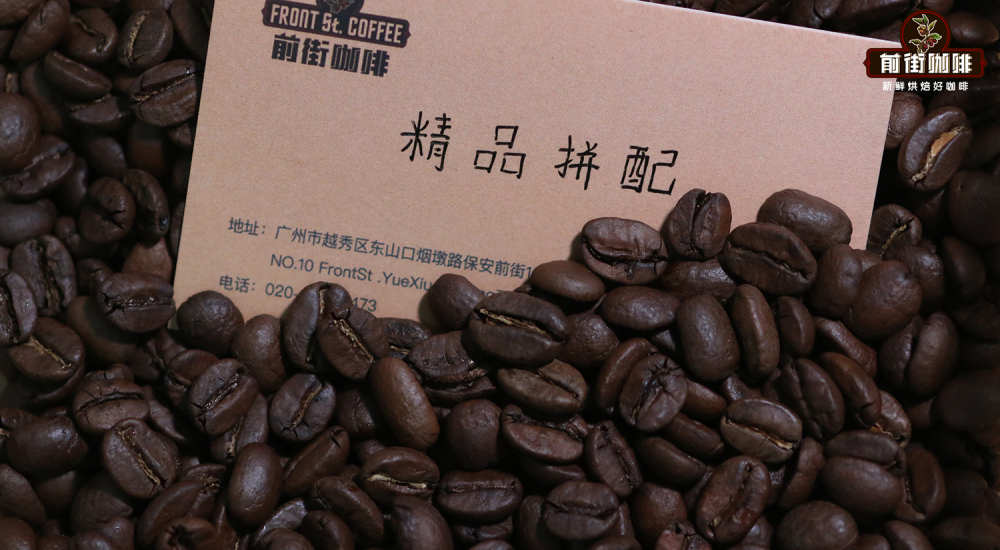
Here we share the blending principles for espresso coffee beans:
1. The raw beans used for blending should each have their own characteristics; avoid choosing beans with similar flavors, such as coffee beans with the same processing method, the same origin, or similar flavors.
2. Regarding the blending ratio, every coffee shop will blend different ratios according to its own characteristics. Generally, a 1:1 ratio is not used, because the same ratio will cause their unique flavors to suppress each other. When blending, there must be a primary-secondary distinction in order to create a taste better than single-origin coffee.
3. Blending and roasting methods are divided into raw blending and roasted blending. Raw blending is mixing raw beans in proportion before roasting; roasted blending is mixing after roasting in proportion. Which one to choose depends on the desired flavor effect.
4. The flavor principle of blending is balanced acidity and sweetness, usually using 2 to 6 kinds of coffee beans. No matter what beans are chosen or what roast level is used, too many types will make it difficult for the coffee's unique flavor to show.
The blending approach for pour-over coffee is completely different; its purpose is to make the coffee's own flavor more prominent. For example, if Front Street has a Colombian coffee bean on hand and wants its nutty flavor to be more distinct, it will consider adding Brazilian beans. By leveraging the similarity of origin flavors, a certain coffee flavor is amplified. Generally speaking, pour-over blend coffee beans use a medium or medium-light roast, so the coffee's flavor will be cleaner.
Here we also share the blending principles for pour-over coffee beans:
1. Try to choose coffee beans with similar styles and tones for blending. Pour-over blending is a process of "strengthening," not a process of "complementing." It is best not to use two or three beans with completely opposite styles to blend espresso, otherwise the result may not necessarily combine strengths but may very likely have no personality at all. For example, using dark-roasted Mandheling with slightly medium-roasted washed Yirgacheffe does not produce an ideal effect in practice, with no main keynote to speak of. If beans with similar styles and tones (at least not opposite directions) are chosen for blending, it will be relatively safer, often strengthening flavors in the same direction and making the personality more distinct.
2. Try to choose coffee beans with similar roast levels for blending. Espresso coffee blending includes roasted blending and raw blending; in the case of roasted blending, beans with different roast levels can be mixed. But this is not very suitable for pour-over coffee bean blending, because the extraction method of pour-over differs greatly from espresso. If beans with different roast levels are combined, it may very likely lead to poor extraction during pour-over, and the coffee as a whole will not be clean enough.
So, how will the flavor perform when espresso blend coffee is extracted respectively by an espresso machine and by pour-over? This time Front Street will use the previously mentioned Ethiopian natural Red Cherry blended with Honduras Sherry to make a comparison.
Front Street uses a "Lelit Bianca" coffee machine, and the extraction parameters are as follows:
Pressure: 9 bar
Temperature: 94 degrees Celsius
Time: 25~30 seconds
Coffee-to-water ratio: 1:2
Dose: 20g (double espresso)
Extracted espresso amount: 40ml (double)
After this espresso blend bean is extracted under pressure by the espresso machine, the flavor has clear fruit acidity, a faint berry aroma lingering, rich whiskey aroma and chocolate flavor, and a comfortable sweet aftertaste.
Because this bean uses a medium-dark roast, in order to make the flavor cleaner and more layered, Front Street will use a water temperature of 88 degrees Celsius and brew with a V60 dripper.
Dripper: V60
Dose: 15g
Coffee-to-water ratio: 1:15
Water temperature: 88 degrees Celsius
Grind size: medium-coarse grind (73% passing through a No. 20 sieve)
Front Street Coffee uses a staged extraction method: first use 30g of water to fully wet the coffee bed, and after it forms a "hamburger" shape, let it bloom for 30 seconds; when the timer reaches 30 seconds, pour the second stage until 125g, then wait for the water level to drop to 2/3 of the coffee bed before pouring the third stage; when the timer reaches 1 minute 45 seconds, pour water until 225g, and after the coffee liquid has completely dripped, the total extraction time is 2 minutes 02 seconds. After extraction is complete, gently swirl to make the coffee liquid fully uniform before tasting.
When this espresso blend bean is extracted by pour-over drip method, the flavor has an obvious whiskey aroma, soft acidity, and a nutty finish, but the mouthfeel is not so clean and is mixed with some woody notes.
For professional coffee knowledge exchange and more coffee bean information, please follow Coffee Workshop (WeChat public account: cafe_style)
For more specialty coffee beans, please add the private WeChat of Front Street Coffee: qjcoffeex
The above content is compiled by CoffeeHunters, a coffee news website.


