







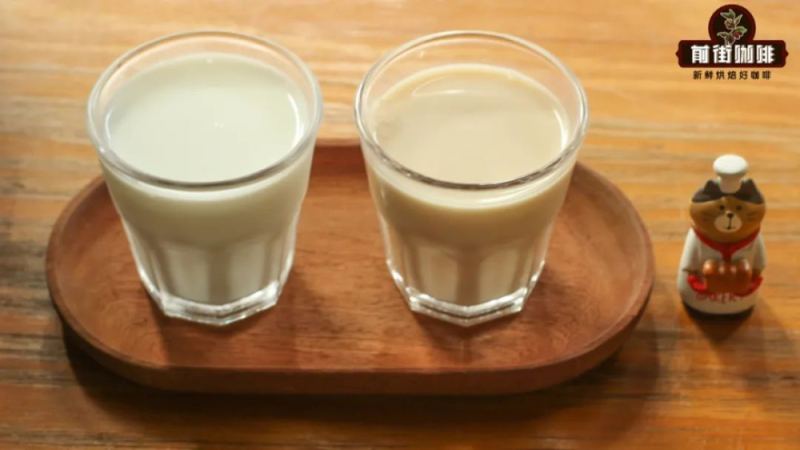
In recent years, many customers who come into the shop ask whether we have oat milk lattes, or ask for advice on how to steam fine microfoam with oat milk. Although the milk coffee drinks produced by Front Street Coffee have always used whole milk, in order to respond to everyone's curiosity, today we'll talk about what makes oat milk lattes unique, as well as the techniques to note when steaming milk foam and pouring latte art with oat milk. This article will start with the composition of oat milk, compare it with fresh milk in terms of flavor and texture, and explain in detail the key points of operating oat milk during steaming and latte art, to help coffee lovers better master the method of making plant-based milk coffee.
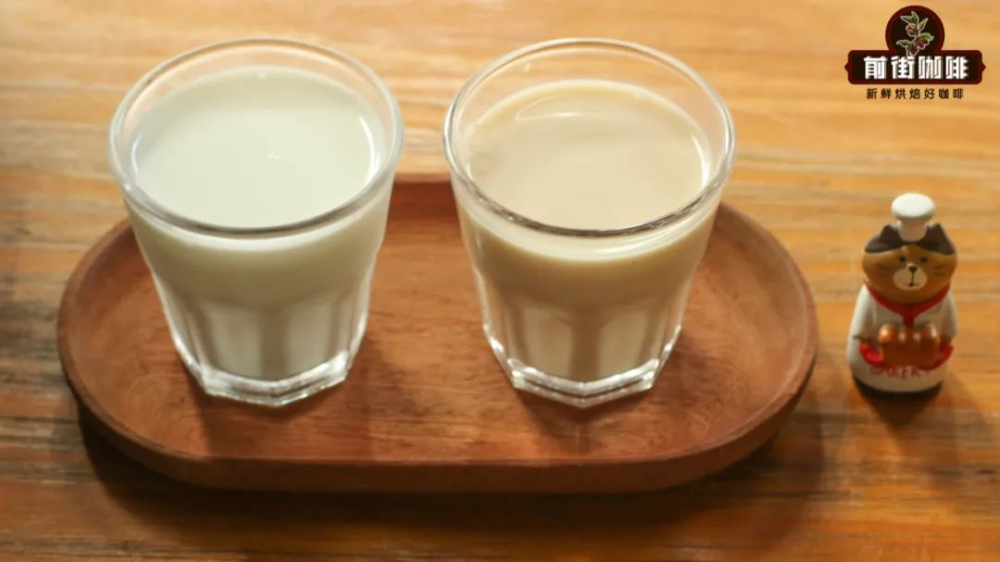
(Fresh milk on the left, oat milk on the right)
Perhaps out of concern that drinking milk may upset their stomach, recently customers often ask as soon as they walk in whether Front Street Coffee has oat milk lattes, or leave messages in the background: how can you steam thick, velvety microfoam with oat milk? The various milk coffee drinks produced by Front Street Coffee have always been made with whole milk, but driven by curiosity, today let's talk about the characteristics of oat milk lattes, as well as the techniques for steaming milk foam and pouring latte art with oat milk.
What exactly is oat milk?
When mentioning oat milk, the first thing to clarify is a concept: although there is the word "milk" in the name, it actually has little to do with fresh milk. Specifically, oat milk contains no milk ingredients at all; instead, oats are ground with water into an oat slurry, then fats, thickeners, and stabilizers are added in certain proportions to adjust the taste, mouthfeel, and texture, and finally it is made into a plant-based milk beverage through high-temperature sterilization. Because it contains no lactose, it is friendlier to people who are lactose intolerant.
Compared with regular fresh milk, oat milk has a lighter texture, but compared with other plant milks such as almond milk and soy milk, its mouthfeel has more layers. There are now many oat milk brands on the market, and here at Front Street Coffee we use OATLY. If you taste it directly, you can feel that this oat milk has both the grain aroma of oats and a creamy, mellow smoothness. (Oat milk will separate and settle after standing for a long time, so it is best to shake it well before pouring it out.)
(You can shake it like this when unopened!!)
Also a hot milk coffee, what is the difference in taste between an oat milk latte and a fresh milk latte?
Whole fresh milk is a dairy product and is rich in components such as lactose, fat, and protein.
Precisely because of its high lactose content, whole fresh milk tastes sweet when drunk, especially when heated above 30°C, when lactose is broken down by lactase into galactose, glucose, and others, some of which are sweeter than lactose; this is also why the sweetness of fresh milk becomes more obvious after heating. When heated fresh milk is mixed with espresso, besides the dilution effect, against the backdrop of milky sweetness, the coffee presents a balanced and full-bodied taste.
In terms of flavor, the interaction between oat milk and coffee is similar to that of milk coffee: it can balance the bittersweetness of espresso and bring the light sweetness of grains, while also pairing with certain aromatic substances in coffee beans to produce complex flavor expressions.
In order to avoid burnt bitterness and sourness in the coffee, we need to use the medium-roast Front Street Coffee Black Cocoa Blend, the espresso coffee bean recommended by many baristas - Front Street Coffee Black Cocoa Blend. It combines the nutty cocoa aroma of Brazil Red Bourbon with the slight fruity acidity of Yunnan small-batch beans. The overall taste is soft, and after blending with heated oat milk, the coffee as a whole presents the sweetness of maltose as well as the rich aroma of black cocoa and caramel, smooth and delicate, with a slight fibrous feel in the finish.
Of course, there are also some brands of oat milk that, because they use a proportion with a heavier oiliness when blended, overemphasize a heavy nutty note and mask the lighter flavors in the coffee. When choosing, you might as well compare for yourself which oat milk is more suitable for the espresso made from your own espresso beans.
What techniques are needed for latte art with oat milk?
Friends with relevant homemade experience should know that if you steam plant-based milk according to the operation for milk lattes, you will find that the milk foam they produce easily has common problems such as not being fine, being difficult to pour patterns with, and dissipating quickly. The key reason among these is protein.
Because oat milk has a relatively low protein content, and its types are also different from ordinary whole fresh milk, these plant milks often need thickeners and stabilizers to help wrap and hold air, so as to form a stable structure similar to that in milk foam. Therefore, when steaming milk foam, you need to introduce as much air as possible at the beginning. In actual operation, you can observe the changes in the liquid level in the pitcher. Fresh milk generally needs to be steamed to about 1–2 cm, while oat milk foam can be steamed as thick as 2–2.5 cm.

Correspondingly, oat milk is less strict about steaming temperature than milk, and even at conditions as high as 65°C it can still perform well. In this way, to obtain a smoother milk foam texture and a stable structural layer, so as to create clear pattern lines and maintain a stable latte art shape, we need to use the vortex and appropriately extend the heating and texturing process until it is completely hot to the touch.
When integrating, Front Street Coffee suggests first pouring a small portion of oat milk into the coffee cup and gently swirling the cup. The purpose is to let them mix fully first, which can avoid separation while also maintaining a cleaner surface for latte art. When it comes to the pouring stage, we should keep the stream of released flow as small as possible and make the movements gentler, because too large a flow not only makes it difficult to blend evenly into the crema, but may also break through the surface due to the "reverse flow" rolling upward, thereby ruining the pattern that was first pushed out.
The above content is compiled by CoffeeHunters, a coffee news website.


