








What Grind Size and Beans Does a Moka Pot Need?
A moka pot brews by a distillation-style method with a heated base, a principle it shares with La Pavoni's first commercial espresso machine from 1905. It was invented by Alfonso Bialetti in 1933, and it remains the most affordable and common espresso device in Italian homes.
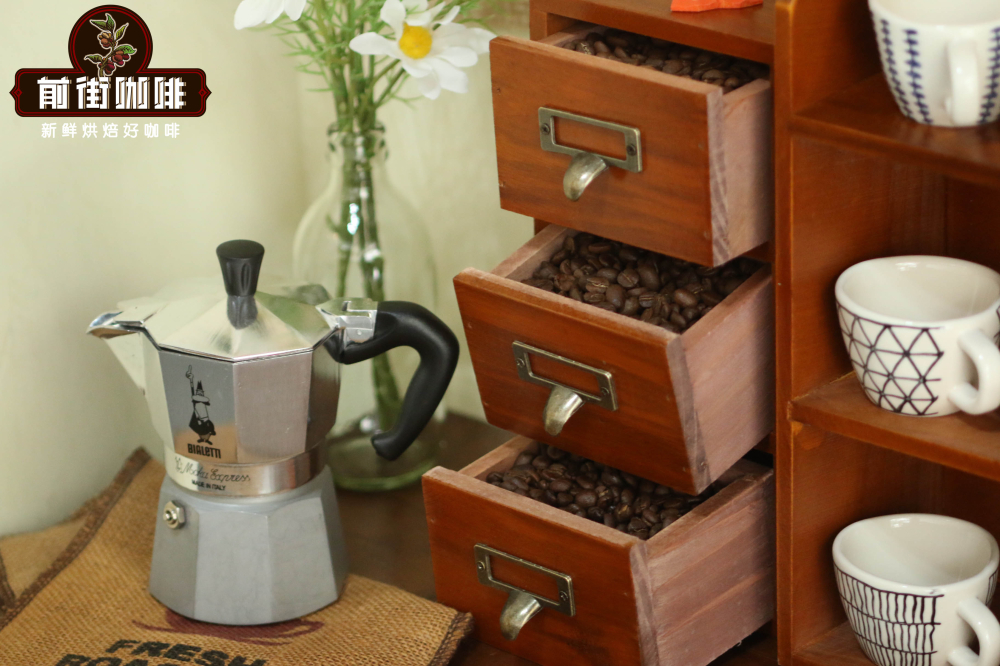
In Italy, households usually buy coffee grounds already matched to the moka pot in roast level and grind size, since few keep a grinder at home. For home brewing, medium-dark roasted espresso blends are recommended over light roasts, which can give thin crema and sharp acidity. Front Street baristas also suggest suitable single-origin beans.
As the most accessible choice among espresso coffee equipment, the moka pot is found in nearly every Italian household. It was invented by Alfonso Bialetti in 1933 and uses a distillation-style principle with a heated base, sharing a brewing approach quite similar to that of the first commercial espresso machine launched by La Pavoni in 1905. This article covers what coffee beans and ground coffee to use with a moka pot, how to gauge the grind size, and the complete brewing process, while also drawing on the experience of Front Street baristas to recommend several espresso blends and single-origin beans suitable for the moka pot, helping enthusiasts brew rich, well-balanced espresso at home.
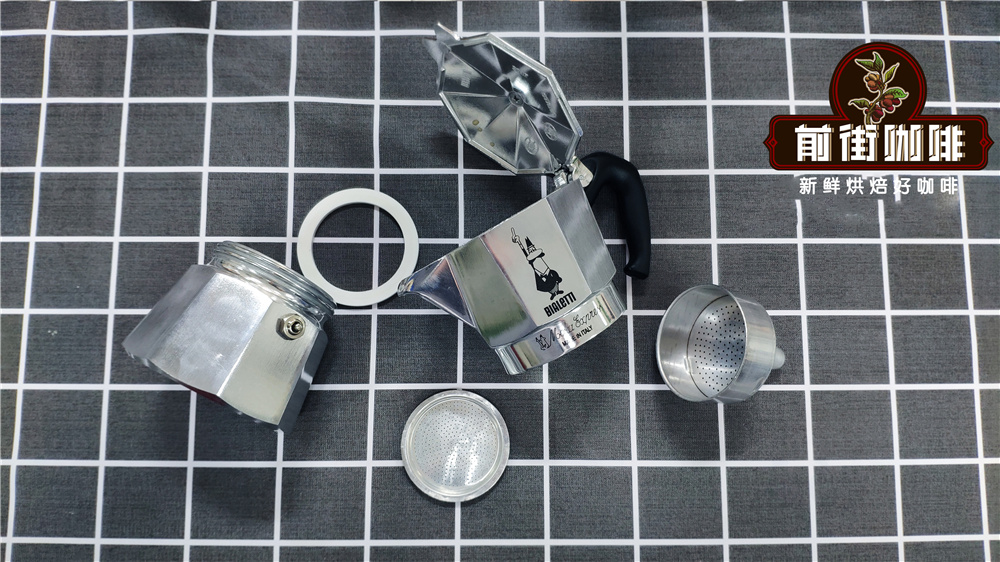
Among the wide variety of espresso coffee equipment, the moka pot is the most down-to-earth and affordable, used in almost every Italian household. It was born in 1933, invented by the Italian Alfonso Bialetti, and relies on a heated base to complete extraction, essentially a distillation-style brewing method. In principle, the moka pot shares much in common with the first commercial espresso machine designed and produced by La Pavoni in 1905.
What coffee beans (ground coffee) pair best with a moka pot?
After all, the moka pot is a household appliance, and its main appeal is convenience and ease of use.
In Italy, it's uncommon for households to keep a coffee grinder on hand; people usually just go to large supermarkets to buy coffee grounds specifically made for moka pots. These special grounds are simply products whose roast level and grind size have been matched to the moka pot. Ordinary housewives don't need to study professional coffee knowledge to brew a cup of aromatic coffee with a moka pot.
In China, it's not easy to find coffee grounds specifically designed for moka pots, so you have to put together your own blend. Fortunately, China's specialty coffee market has developed well, and beans from virtually every recognizable producing region in the world are available. Coffee brewed with a moka pot is high in concentration and strong in taste; if you use light-roast beans, the result will be quite odd—thin crema and sharp acidity. So medium-dark roast coffee beans are more recommended.
Front Street's baristas first recommend espresso blend beans. The advantage of a blend is that the recipe already takes flavor balance and mouthfeel harmony into account, making the taste more acceptable to most people. For example, Front Street Specialty Espresso Blend Coffee Beans combines Brazilian beans with Colombian beans, presenting full nutty, creamy, and white chocolate aromas, with a sweet and smooth entry, a hint of gentle acidity, rich nutty notes, and excellent crema.
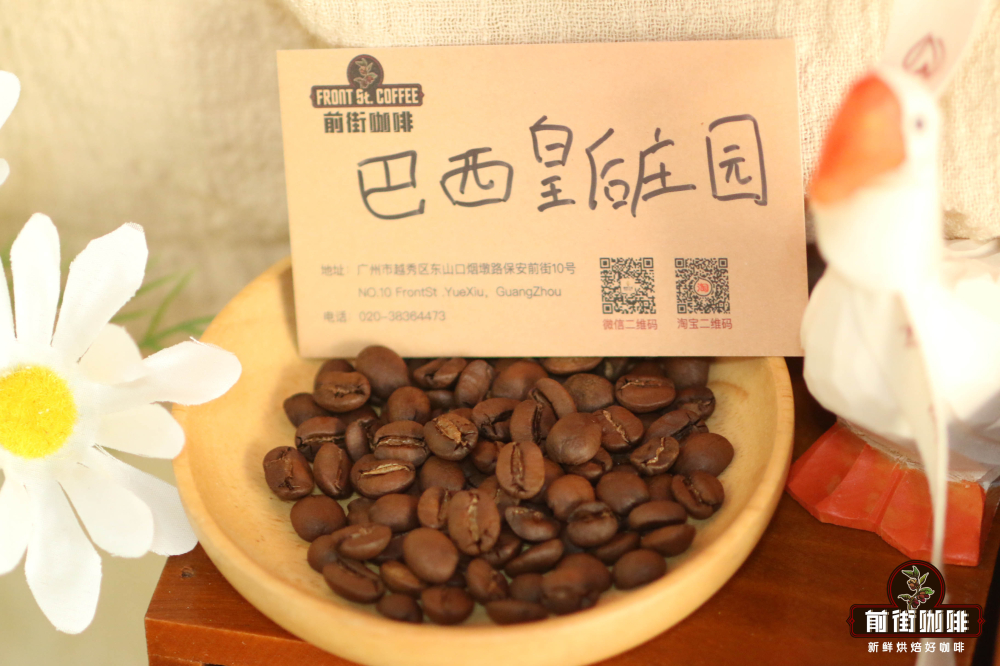
If you want to experience more distinctive regional flavors, among medium-roast single-origin beans, Front Street suggests trying Front Street Queen's Estate and Front Street Bird of Paradise Estate coffee beans. What these two single-origin beans share is balance, rich nutty notes, and a fruity-sugar-like sweetness in the finish.
For those seeking more intense aroma and flavor, you can go for a darker roast, such as Front Street Indonesia Front Street PWN Golden Mandheling Coffee Beans, which carries a unique herbal fragrance and works well with a moka pot.
If you don't want the coffee flavor to be too one-dimensional, you can also choose beans with pleasant floral and fruity notes, such as Front Street Strawberry Candy Espresso Coffee Beans, where grape, rose, dried blueberry, and fruit gummy flavors are all pronounced. The key point is that Front Street Strawberry Candy Espresso also has rich crema, making it ideal for brewing with a moka pot.
How fine should the coffee grounds be for a moka pot?
Many friends want to use coffee brewed with a moka pot to replace what an espresso machine produces, but the two are completely different brewing tools, so the parameters naturally can't be copied over. Customers often ask Front Street's baristas: when brewing coffee with a moka pot, should the grounds be ground as fine as for espresso?
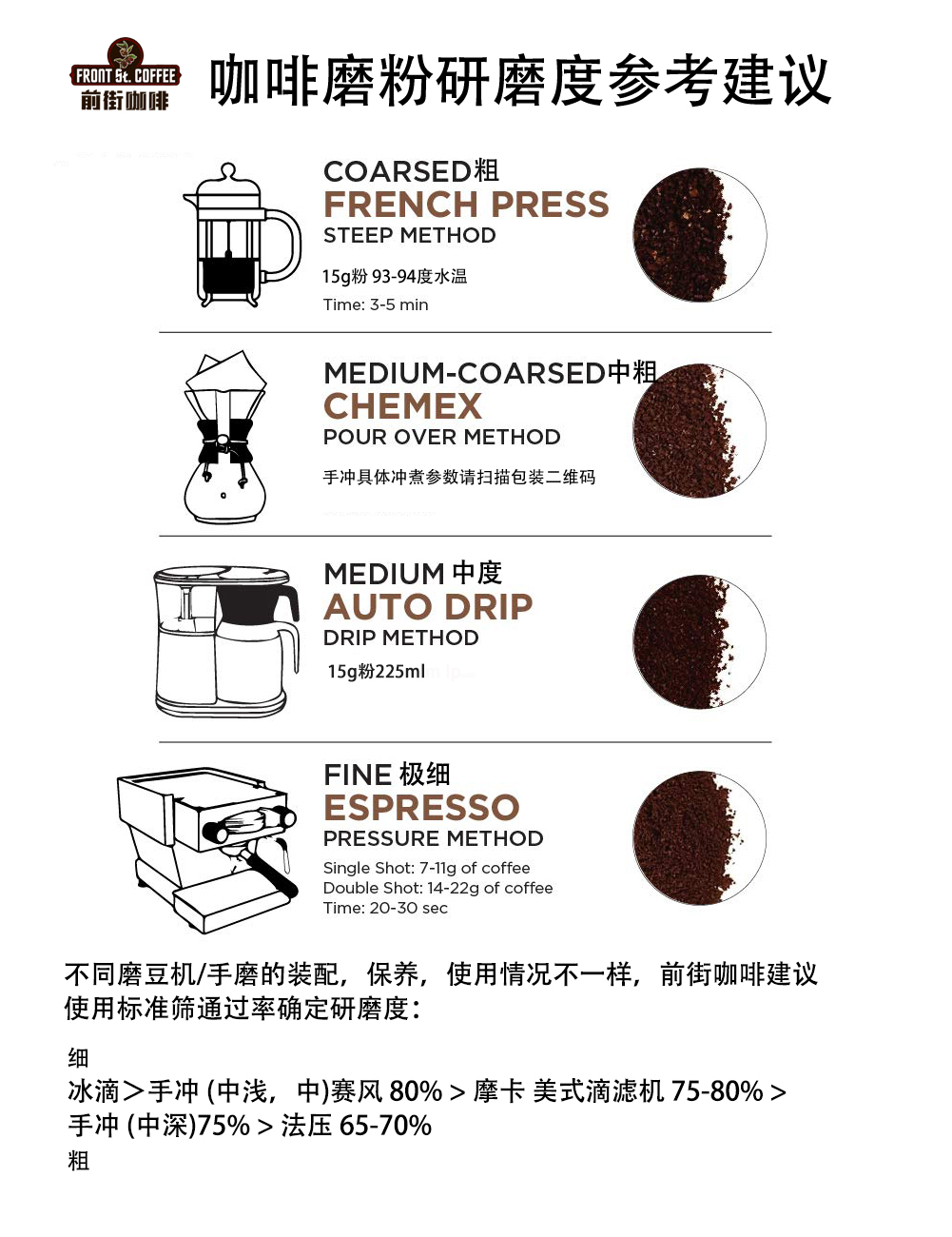
Actually, when brewing coffee with a moka pot, the grind should be slightly coarser than for espresso. You can refer to the size of the gaps in the filter screen of the basket to make sure the coffee particles won't fall through into the lower chamber. But it also shouldn't be too coarse, otherwise sufficient pressure won't form, crema won't come out, and it may even spurt due to too little resistance.
1. Grind size is proportional to extraction time: grind size directly affects extraction time and extraction yield. The finer the grind, the longer the extraction time and the higher the extraction yield; the coarser the grind, the shorter the extraction time and the lower the extraction yield.
2. Darker roasts slightly coarser, lighter roasts slightly finer: the darker the roast, the more the coffee's fibrous structure is broken down, making it easier to extract; grinding too fine will make it bitter, so a slightly coarser grind is suitable. Light-roast beans are the opposite.
3. Grind size can control bitterness: the finer the grind, the higher the extraction yield, and the easier it is to draw out larger-molecule bitter substances such as chlorogenic acid, quinic acid, and caffeine. Conversely, if ground too coarse, high-molecular-weight bitter compounds are not easily extracted, but medium-molecular-weight sweet and aromatic components also remain in the spent grounds due to under-extraction, which is truly a pity. Therefore, baristas must pay attention to whether the grind size is normal and what grind setting suits each bean.
Coffee particle size typically ranges from 0.3 mm to 0.55 mm. But not everyone can distinguish a one- or two-millimeter difference with the naked eye. The easiest way is to measure with a grind size ruler, or use moka-pot-specific grounds as a reference. You can also just try it by hand: if the grind is too fine, you'll hear a humming sound of boiling water but see no coffee liquid rising—at this point, it's best to turn off the heat immediately; if the grind is too coarse, the coffee liquid may gush out like a fountain.
Steps for brewing coffee with a moka pot
1. Pour purified water into the lower chamber of the moka pot, keeping the water level about 0.5 cm below the pressure relief valve.
2. Slowly pour the coffee grounds into the basket, tapping gently to distribute them evenly. Once the grounds form a small mound, level the surface by distributing the grounds.
Filling the basket with grounds is to avoid extracting off-flavors. The more uniform the density of the coffee grounds in the basket, the more you can prevent some grounds from being over-extracted and others under-extracted, thus avoiding uneven flavor or bitterness.
3. Place the basket into the lower chamber, screw the top and bottom halves of the moka pot tightly together, and place it on an electric ceramic stove over high heat.
4. When the moka pot has heated to a certain point and emits a clear whistling sound, turn the electric ceramic stove to low heat and open the lid of the upper chamber.
5. When about half of the coffee liquid has risen into the upper chamber, turn off the electric ceramic stove. The residual heat and remaining pressure in the moka pot will continue to "push" the rest of the coffee liquid into the upper chamber.
6. Once all the coffee liquid has been extracted into the upper chamber, you can pour it into a cup and enjoy. Coffee brewed with a moka pot is very rich and can even produce Crema. You can also add an appropriate amount of water or milk to balance it, for an even better flavor.
The above content is compiled by CoffeeHunters, a coffee news website.


