







How Has Coffee Production in Yunnan Changed for Small-Bean Beans?
Yunnan small-bean coffee no longer deserves its old reputation for weak taste. Earlier plantings were managed extensively, and most beans went to instant coffee production lines, so green bean processing stayed basic. Today, with government support and the specialty coffee wave, areas such as Baoshan produce washed Catimor at altitudes above 1,200 meters with plum, nut, caramel, and tea notes.
The Baoshan washed Catimor used by Front Street Coffee goes through fine washed fermentation and medium roasting, which reduces the variety's greenish astringency. Roasting and brewing decide how much sweetness and cleanliness reaches the cup. This guide covers origin background, green bean traits, the roasting curve, and three-stage pour-over parameters. Thinking about st helenan coffee beans shows how origin handling shapes flavor.
Many people's impression of Yunnan coffee remains stuck at the "not good enough in taste" stage, which is actually related to the extensive planting methods of earlier years and the fact that the beans were mainly supplied to instant coffee production lines. Today, with the support of local governments and the push of the specialty coffee wave, Yunnan coffee has undergone a qualitative leap from cultivation to post-processing, and production areas such as Baoshan have already shown a unique regional flavor interwoven with plum, nut, caramel, and tea notes. The Baoshan washed Catimor small-bean coffee selected by Front Street Coffee is grown at an altitude above 1,200 meters. Through fine washed fermentation and medium roasting, it effectively weakens the greenish astringency of the variety itself, allowing the sweetness and cleanliness of Yunnan coffee to be fully expressed. This article will provide a complete analysis, from the origin background of this Front Street daily-drinking bean, green bean characteristics, roasting curve, to the three-stage pour-over parameters, of how to properly open a cup of Yunnan small-bean coffee.
For a long period in the past, Yunnan coffee did not receive very high praise in people's minds. The reasons were, on the one hand, the lack of scientific and systematic management methods in early cultivation, and on the other hand, the fact that the coffee beans produced in Yunnan at that time were mainly supplied to Nestlé for instant coffee production, so the green bean processing stage naturally could not be called refined.
However, the situation is now completely different. With strong support from local governments, the industry's research on Yunnan coffee cultivation has continued to deepen, and together with the spread of specialty coffee culture, Yunnan coffee has received unprecedented attention from field cultivation to green bean processing, and the quality improvement in recent years is obvious to all. Through the joint efforts of all parties, Yunnan coffee has developed its own regional flavor label: plum, nut, caramel, and tea notes.
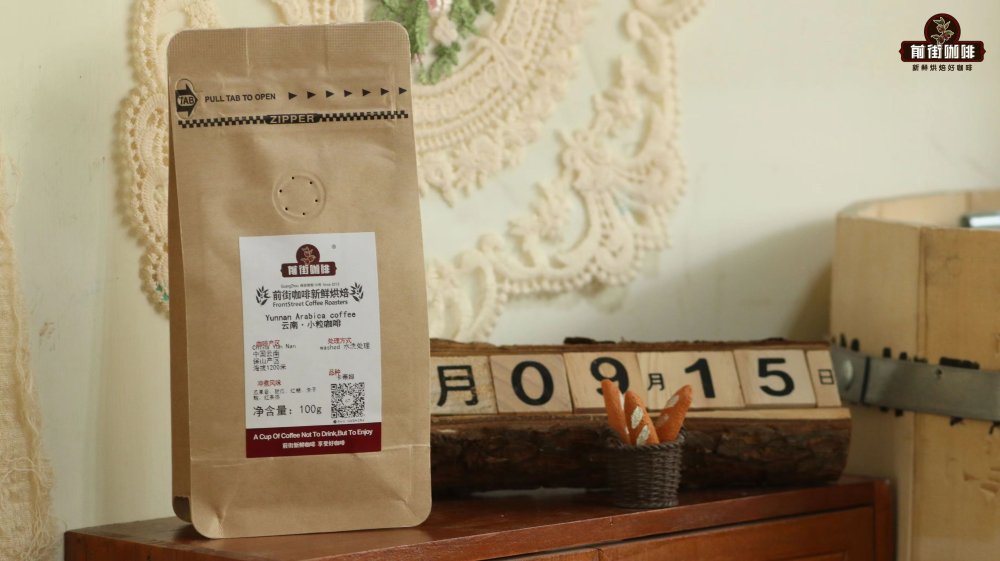
In FrontStreet Coffee's daily-drinking bean product line, the bean representing the Yunnan production area comes from Baoshan and is a washed Catimor coffee bean. The reason for choosing the Baoshan production area is that the local altitude and mild climate conditions are suitable for specialty coffee cultivation. Generally speaking, 1,200 meters is the dividing line between commercial coffee beans and specialty coffee beans. The higher the planting altitude, the more outstanding the coffee flavor performance tends to be.

The bean selected by FrontStreet Coffee is grown in the Baoshan area above 1,200 meters in altitude and uses the washed processing method, fermenting in a water tank for 18 to 36 hours after depulping. This process enhances the bright acidity of the coffee beans and also makes the overall mouthfeel cleaner, allowing a more direct perception of the quality of the bean itself and the flavor characteristics of the Yunnan production area.
When FrontStreet Coffee received this Yunnan Catimor small-bean green coffee, it observed that the beans were uniform in size and greenish in color. When smelled up close, a faint grassy note and a plum-like acidic aroma could be detected.
Because the Catimor variety is an Arabica with a small amount of Robusta genes, its greenish astringency is slightly more prominent than that of other pure Arabica varieties. In order to make this bean's greenish astringency as unnoticeable as possible while retaining the distinctive flavor of the Yunnan production area, FrontStreet Coffee decided to roast it to a medium level, with the bean surface showing a cinnamon-like color.
The roasting equipment is a Yangjia 800N, with a 300-gram charge: into the drum at 190°C, heat set to 120, and airflow opened to 3; the turning point appeared at 1 minute 40 seconds, and when the drum temperature reached 145°C the airflow was adjusted to 4 while the heat remained unchanged; when the drum temperature rose to 166°C the bean surface turned yellow, the grassy smell completely dissipated, and the dehydration stage began; when the drum temperature reached 188°C, the heat was lowered to 60 and the airflow adjusted to 5;
At 8 minutes 37 seconds, wrinkles and dark patchy streaks appeared on the bean surface, and the toasted-bread smell clearly changed into coffee aroma, which can be regarded as the prelude to first crack. At this point, it is necessary to carefully distinguish the timing of the first crack sound. First crack began at 9 minutes 00 seconds, the airflow was kept unchanged, and after first crack development continued for 3 minutes, dropping at 198°C.
The Agtron bean color value is 63.1 (upper image), the Agtron粉 value is 70.4 (lower image), and the Roast Delta value is 7.3.
FrontStreet Coffee Yunnan small-bean brewing recommendation:
Dripper: hario v60
Dose: 15g
Water temperature: 90°C
Grind size: 75% passing a No. 20 sieve
Water-to-coffee ratio: 1:15
Use a three-stage pour: first wet the coffee bed with water weighing twice the coffee grounds, and after a dome forms, bloom for 30 seconds; then pour in a small stream in circles from the inside outward, pausing to divide the stages at 125g; when the coffee bed drops to half the height of the dripper, continue pouring the third stage with the same fine stream to 225g, and after all the coffee liquid has drained, remove the dripper. The total time is about 2 minutes.
The above content is compiled by CoffeeHunters, a coffee news website.


