








How Long to Froth Milk for Latte Art Beginners?
A clean white heart pattern needs two things first: a properly extracted espresso with golden crema, and milk foam textured for pouring rather than stiff peaks. The big white heart looks basic but tests technique, because the pour point and injection speed decide whether the shape stays crisp or spreads into a blob.
For anyone asking how do I froth milk for a latte, the foam should be glossy and fluid so it flows into the crema instead of sitting on top. Freshly roasted beans with strong crema performance make the base easier to work with. Practicing incorporation and pattern formation separately builds control faster than attempting a finished design every time.
Latte art is one of the techniques that many coffee enthusiasts most want to master after stepping into the world of espresso. Common patterns include the big white heart, multi-layer heart, swan, tulip, and leaf, among which the big white heart is regarded as the most basic yet most skill-testing design. Based on Front Street Coffee's latte art teaching experience, this article systematically explains the two major prerequisites for making a big white heart—a qualified espresso and milk foam suitable for drawing—and breaks down in detail the key steps such as the amount of milk used for incorporation, the pouring point for pattern formation, and the injection technique. At the same time, it introduces how espresso beans such as Front Street Classic Blend perform in latte art practice, helping beginners stably extract espresso with golden crema at home and laying a solid foundation for subsequent latte art.

For more specialty coffee knowledge, please follow: Front Street Coffee (Frontsteet Coffee)
Recently, the number of friends asking about latte art techniques in Front Street's back end has clearly increased, so it seems another large group of new friends is entering the world of coffee. Therefore, Front Street decided to pick up this series again, and the latte art mini-class is officially starting. The latte art patterns everyone is familiar with usually include the big white heart, multi-layer heart, swan, tulip, leaf, and so on, and today we will talk about the most basic one among them—the "big white heart."
Of course, to learn latte art well, two conditions must first be met. The first is extracting a qualified espresso, which not only affects the taste of the coffee but also directly relates to whether a clear pattern can be presented afterward. A standard espresso cannot be achieved without fresh-roasted high-quality beans. The choice commonly used in coffee shops is the Front Street espresso bean series, among which those with outstanding crema performance include Front Street Classic Blend, the highly cost-effective Front Street Black Cocoa Basic Blend, the nutty Front Street Specialty Blend, and the Front Street Commercial Blend suitable for cafe use.
The most popular among these beans is Front Street Classic Blend, which is especially suitable for beginners, for practicing latte art, and also for specialty coffee shops with a more high-end positioning. If you want to practice latte art at home, buying Front Street Classic Blend is the right choice. This is a medium-dark roasted espresso recipe composed of three origins, with a design concept derived from the early popular "Mamba" combination, that is, Mandheling plus Brazil. To enhance aroma and crema, Front Street Classic Blend also adds a small portion of Robusta, making the flavor intensity higher, so beginners can easily extract espresso with golden crema at home.
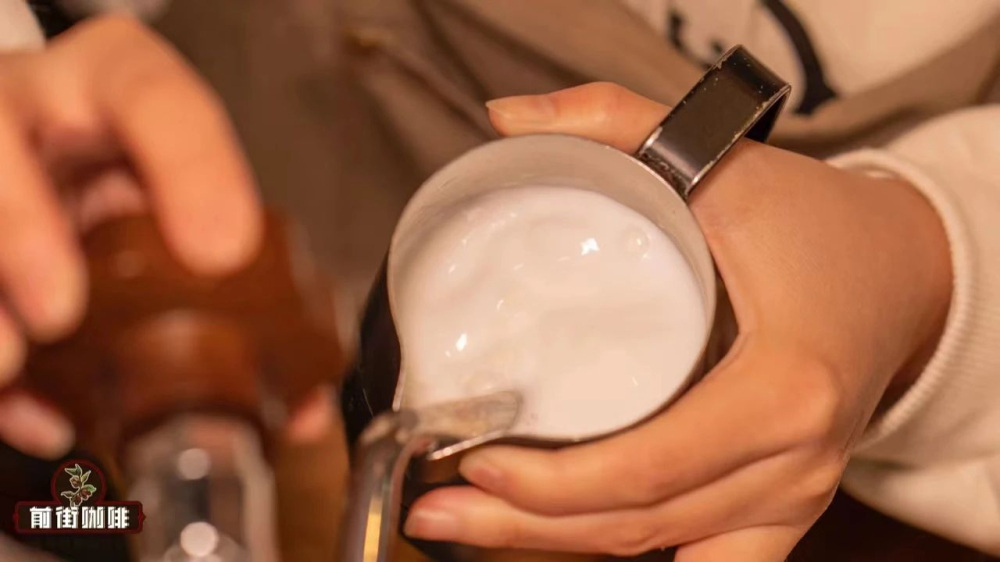
The second condition is being able to produce a qualified milk foam suitable for latte art. You can't expect the milk to become sensible on its own and automatically turn into latte-art-worthy milk foam, right?
Although the big white heart is a basic pattern, that is only true for beginners. When you practice seriously and become a latte art expert, you will instead discover that you actually can't make a big white heart! Every time you want to pour a heart shape, your hand always shakes a few times uncontrollably, and the white heart turns into a multi-layer heart. So from another perspective, the big white heart can also be considered an advanced pattern. Next, we will enter Front Street's big white heart production tutorial, starting with the key points of production.
Milk Foam Requirements
Many patterns have relatively high requirements for milk foam. If the thickness does not meet the standard, it is difficult to make the corresponding pattern. The big white heart, however, is relatively tolerant of milk foam, requiring only that the foam be fine and have good fluidity. There are not many restrictions on thickness; whether it is the extremely thin milk foam of a flat white or the thick milk foam of a cappuccino, both can be used to make a white heart (the thinner it is, the more difficult it is). Therefore, it is a relatively friendly pattern for beginners and for friends who do not have a steam wand at home to froth milk.

Amount of Milk for Incorporation
Incorporation is the most critical step before making a pattern. The quality of incorporation directly affects the cleanliness of the latte art pattern and the difficulty of drawing. However, this time Front Street is sharing a big white heart latte art tutorial. Friends who want to understand how incorporation affects cleanliness can refer to the article "The Importance of Incorporation in Latte Art."
For the big white heart, the point to pay attention to during incorporation is the "amount of milk for incorporation." The more incorporation, the higher the milk level, and the weaker the convection generated during latte art; the less incorporation, the lower the milk level, and the stronger the convection during latte art. Different patterns have different requirements for convection during latte art. Patterns such as leaves and swans that need slight rippling require stronger convection to create the lines; while latte art such as wheat ears that needs reduced convection to stabilize the pattern requires increasing the amount of milk used for incorporation.
For the big white heart, a certain amount of convection is needed (relatively strong), but not too much. We only need to incorporate until the cup is six-tenths full. Too much incorporation will make the white heart too small, while too little incorporation will make the white heart too large or prone to shifting. This is a point to note.

Pouring Point for Pattern Formation
The big white heart emphasizes symmetry. This symmetry refers not only to the pattern itself but also to the position of the big white heart in the cup. Therefore, if you want to obtain a beautiful white heart pattern, it not only needs to be left-right symmetrical but also needs to be exactly in the center of the cup.
Therefore, when you have incorporated until the cup is six-tenths full, it is best to pour the milk foam from the quarter point beside the center of the cup (marked in the figure below). With the impact of convection, the white heart can be exactly in the center when the cup is full.
Practical Operation of Pattern Formation
Just like the large and small water flow in pour-over coffee, latte art also emphasizes the milk flow rate during pouring. The larger the amount of milk poured, the fuller the pattern. The big white heart is a relatively full pattern, so we need to use a relatively large milk flow for pouring and drawing.
While pouring, we also need to do two things at the same time. One is to push the latte art pouring point, gradually moving it from the original quarter point toward the center; the other is that the right hand holding the coffee cup needs to control the cup to gradually stabilize, avoiding coffee overflow.
Finally comes the finishing step. This action is crucial. Many friends, due to a mistake in this action, cause a pattern that should have been beautiful to turn into something unrecognizable.
Therefore, when our latte art process reaches nine-tenths full, we need to begin preparing to finish. Reduce the amount of milk being poured, while raising the height of the milk pitcher, and finally go straight along the center line to the bottom of the heart, then cut off the flow decisively. At this point, the big white heart is complete! Let's watch the complete process of making a white heart once!
It's just that simple. Have you learned it?
The above content is compiled by CoffeeHunters, a coffee news website.


