







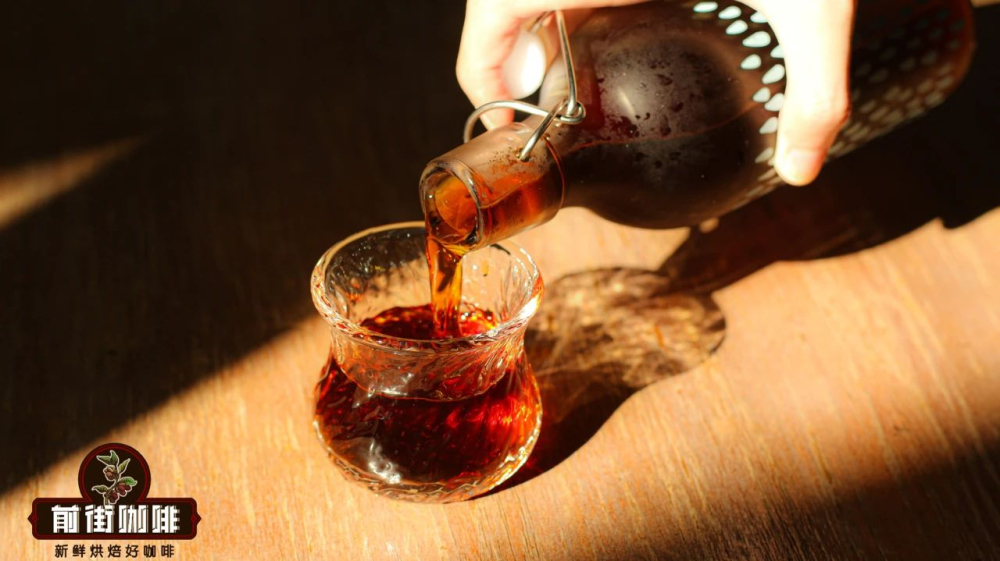
Coffee is being loved by more and more Chinese people, even somewhat catching up with fast-food tea drinks like milk tea, though the consumer groups for each have their own characteristics. When it comes to coffee, one must mention pour-over coffee and espresso. Pour-over coffee is most commonly associated with single-origin beans. The unadorned beauty of pour-over coffee—not rough, not concealing, not simple—is another, better interpretation of coffee. On the whole, pour-over is ultimately gentler. This is only in comparison to espresso.
On a solitary afternoon, coffee, a book, a soft chair—these simple combinations constitute a simple happiness, just like the beauty of pour-over single-origin coffee. With pour-over, you can see from extraction to the drop-by-drop falling of coffee in its most authentic form. Compared to espresso, with its extraction under 9 atmospheres of pressure, this is the second reason I call it gentle. It can be said that espresso also has such a stirring of the heart—you just haven't tasted it. That is perhaps the third reason single-origin coffee is so good: it more easily makes people who don't like coffee fall in love with coffee and enjoy its original form. Admittedly, compared to pour-over, espresso is more foolproof to make and more easily accepted by people, but perhaps it is precisely pour-over's maverick beauty that attracts so many people.
Let's look at the differences between pour-over coffee and espresso.
1. Different coffee beans
Pour-over coffee
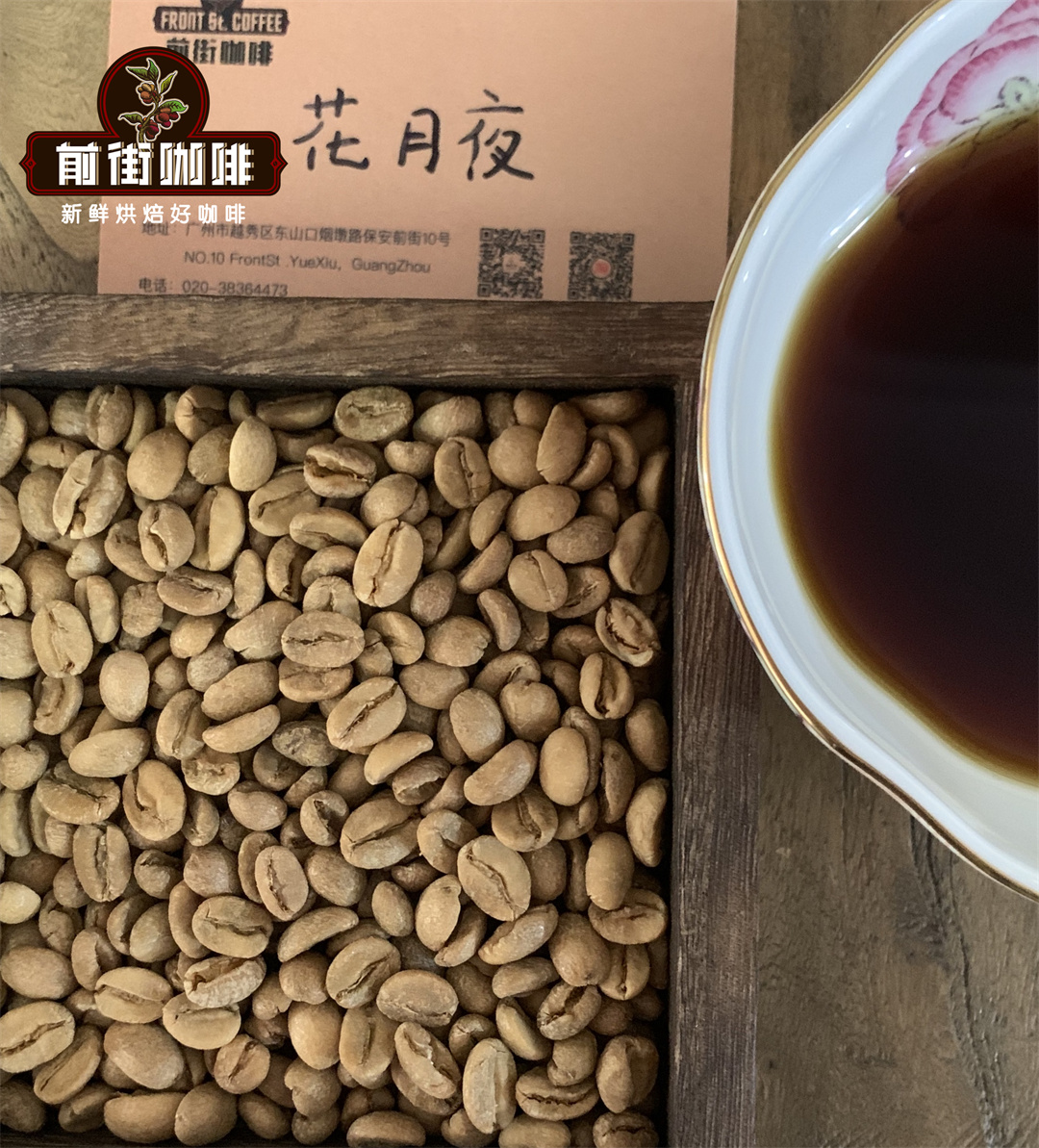
Pour-over coffee generally uses single-origin coffee beans as brewing material, with light and medium roasts being the main roast levels, though some people also like to use dark-roasted coffee beans.

Espresso
Espresso typically uses different single-origin coffees blended together, also called blend coffee beans, widely used for making espresso-based drinks such as cappuccino, Americano, and latte. Most are relatively dark-roasted to pair with milk and hot water. Making this kind of coffee can only be done using a professional espresso grinder, which is also the foundation and key to producing quality espresso.
2. Different production methods
Pour-over coffee
Basically, pour-over coffee mostly uses a dripper, meaning extraction occurs under normal atmospheric pressure. If using a moka pot or AeroPress, the extraction pressure can reach 3 bar (three atmospheres).
Espresso
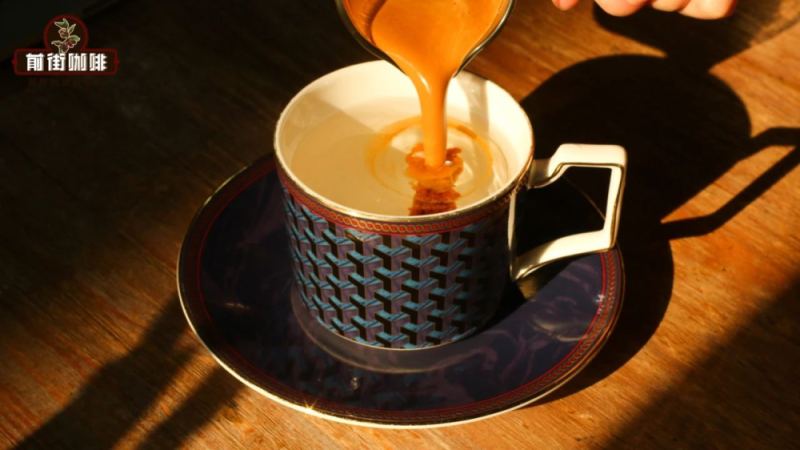
Using an espresso machine for extraction, the machine's pressure brings the extraction state to 9 bar (9 atmospheres). The puck in the portafilter bears 133 kilograms of pressure, causing it to release a large amount of coffee substances, including certain flavor compounds that are difficult to dissolve under normal pressure. Therefore, espresso has a thicker mouthfeel and is suitable for pairing with milk to make a latte, or adding water to make an Americano.

3. Different caffeine content
If the dose and grind size are the same, since caffeine is a water-soluble substance, the longer the brewing time, the more caffeine is released. Pour-over brewing time is usually 1–3 minutes, while espresso brewing time is usually 20–30 seconds. So under the same dose and grind size, pour-over coffee will have a higher caffeine content. From this we can see that cold brew coffee and iced drip coffee, which use long extraction times, will have much higher caffeine content than other coffees.
You can see that pour-over coffee and espresso have a huge difference in the concentration of the brewed liquid. After adding milk to single-origin coffee, the milk will mask the coffee's own aroma and flavor, so ordinary coffee shops do not recommend adding milk to pour-over coffee.

How to make espresso
Many coffee enthusiasts unknowingly equip their homes with lots of coffee gear, and those obsessed with espresso even stock up on espresso machines, ready to extract it themselves. Here at Front Street Coffee, using our store's espresso output as a reference, let me briefly explain how to make an Espresso.
The coffee machine at Front Street Coffee's store is a commercial single-head "Lelit Bianca," which can adjust extraction by changing pressure, with a maximum pressure of 11 bar. A home espresso machine only needs to reach 9 bar of pressure to satisfy the functions of extraction and steaming milk foam, paired with an espresso grinder.

Front Street Coffee uses a double-shot portafilter capacity, with a dose of about 18–20 grams; Front Street Coffee uses 20 grams of coffee powder when producing. Usually the ratio of coffee powder to coffee liquid is 1:1.5 to 1:2.5. Front Street Coffee's extraction ratio is 1:2, meaning 20 grams of coffee powder extracts 40 grams of coffee liquid. Time is related to the flow rate of the coffee powder; generally a single extraction is controlled within 20–35 seconds, because within 20 seconds the coffee usually tastes thin, while exceeding 35 seconds tends to over-extract and produce a burnt, bitter taste. Front Street Coffee's espresso mostly falls within the 28–30 second range.

Front Street Coffee first wipes the portafilter basket dry, turns on the grinder, grinds out a double shot's worth of coffee powder, places it on an electronic scale to adjust up or down until it reaches 20 grams. Then use a tool to distribute the grounds evenly, and tamp the coffee puck firmly to ensure more stable extraction. Then turn on the extraction switch to release water, moistening the group head while washing away stuck coffee grounds, gently lock the portafilter onto the group head, and begin the extraction. When the electronic scale shows 40 grams of coffee liquid extracted, at about 30 seconds, you can turn off the extraction switch. Pour the coffee liquid into an Espresso cup and enjoy.
The taste and mouthfeel of Espresso depend on the coffee beans used. The espresso served at Front Street Coffee's store uses Front Street Coffee's Sunflower Warm Sun blend. It is blended from Honduras Sherry coffee and Ethiopia natural Red Cherry at a 7:3 ratio. Made into Espresso, it has rich crema, a very pronounced whisky aroma, with vanilla cookie and berry acidity on the entry, solid flavor, and after drinking, the entire mouth is filled with various aromas.

Espresso can also be diluted with water, which is the common Americano on menus, fragrant and refreshing. Add milk and it becomes a latte, presenting the sweet deliciousness of chocolate and cream.
How to make pour-over coffee
To make pour-over coffee at home, we need the following equipment: gooseneck kettle, dripper, server, grinder, filter paper, electronic scale, thermometer. Here the Yirgacheffe is a high-altitude coffee bean with a medium-light roast. Front Street Coffee hopes to extract more rich aromatic substances, so we choose a grind size with 80% passing through a No. 20 standard sieve, corresponding to a setting of 10 on the store's EK43s grinder. In addition, lightly roasted coffee needs a higher water temperature to bring out the aroma, so we use 91–93°C and extract with a resin V60 01 dripper.

On online media, we can see various pour-over pouring techniques, such as one-pour flow, three-stage, 4-6 method, and so on. Various techniques can bring out different flavor expressions in the cup. Based on past brewing experience, Front Street Coffee suggests that beginners just starting out use the three-stage pouring method. Three-stage extraction helps more fully dissolve flavor substances during extraction, increasing the layering of the mouthfeel, while avoiding overly long steeping that causes over-extraction.
If using 15 grams of coffee powder, a 1:15 coffee-to-water ratio, 225ml total water, the three-stage water amounts are divided as: 30ml, 95ml, 100ml, and the weight shown on the electronic scale is: 30g, 125g, 225g.

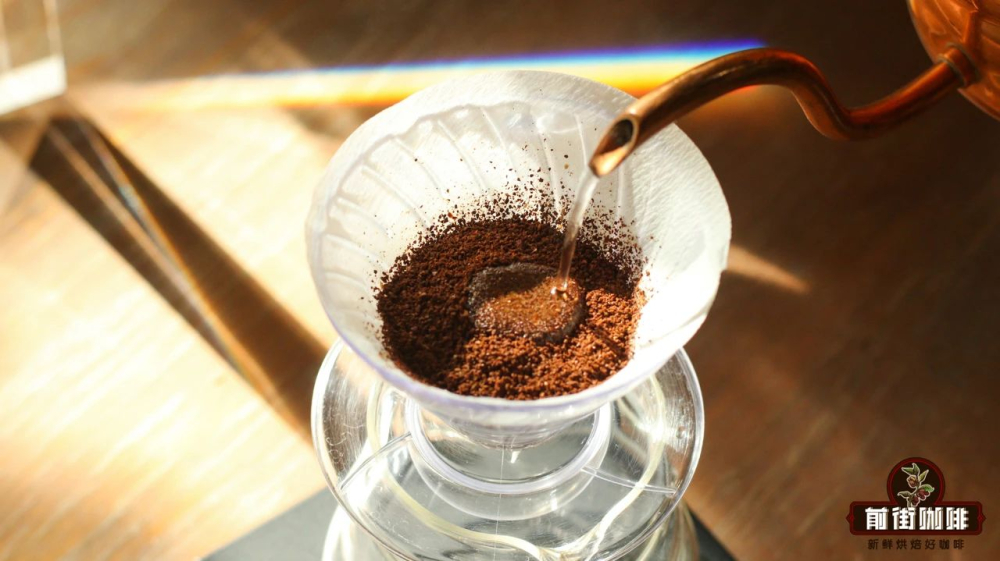
Fold the filter paper and fit it snugly into the dripper. Wet the filter paper with a small amount of water to make it fit better, and pour out the water in the lower pot. Then add the coffee powder and tap lightly to distribute the coffee bed evenly. For the first stage, gently pour 30 grams of water for blooming, with a blooming time of 30 seconds. For the second stage, pour to about 125 grams of water, circling outward evenly and steadily. Then wait for the coffee liquid to drop. When it drops to half, pour the final stage of water to 225 grams. Wait for all the coffee to drip through. The total extraction time is generally about 2 minutes.

The reason everyone loves pour-over coffee so much is that when we actively explore the extraction flavor expression of coffee, adjusting the brewing method according to different coffee bean varieties and roast levels, carefully selecting brewing vessels to feel the different appearances coffee takes on with different extraction methods, and regulating grind size, temperature, water flow rate, pouring technique, and other factors to adjust coffee extraction—every step can bring a different taste and olfactory experience. This is the charm of pour-over coffee.
The above content is compiled by CoffeeHunters, a coffee news website.


