







What Defines Yunnan Arabica Coffee Bean Quality?
Yunnan small-bean coffee is a coffee green bean grown mainly in the province's southwest, covering Lincang, Baoshan, Dehong, Simao, Pu'er, and Xishuangbanna. The region's Typica and Catimor lots cup differently, and grade classification reflects bean size, defect count, and cup quality. Washed and natural processing further separate the flavors.
Coffee reached Yunnan in 1904, when French missionary Tian Deneng planted a tree at Zhukula in Binchuan County; over thirty of those plants still fruit today. Later plantings spread through Baoshan in the 1930s and 1950s, and Nestlé's 1988 joint venture spurred large-scale farming. The coffee belt runs from 15°N to the Tropic of Cancer at roughly 1,000 to 2,000 meters.
Yunnan coffee has continued to heat up in the domestic specialty market in recent years, with small-bean coffee standing out in particular. This article provides a systematic overview of Yunnan small-bean coffee, covering its development history, main producing regions, variety composition, processing methods, and pour-over techniques layer by layer. It not only explains the flavor differences between Typica and Catimor, but also offers specific brewing recommendations and parameters based on Front Street Coffee's two Catimor beans currently on sale—Baoshan Washed and Natural. For those who want to understand Yunnan coffee's characteristics, the concept of grading, and pour-over flavor performance, this article provides a fairly complete reference.
In recent years, coffee produced in Yunnan has gained a great deal of attention domestically, and Yunnan small-bean coffee has frequently appeared in the specialty coffee scene. This Front Street article will walk you through the various characteristics of Yunnan small-bean coffee.
The Development of Yunnan Coffee
According to relevant historical records, in 1904, French missionary Tian Deneng went to Zhukula Village in Binchuan County, Dali, Yunnan to preach. While building a church, he planted the first coffee tree beside it. From that batch of seeds, more than thirty coffee plants are still flowering and fruiting in Binchuan County today.
In the 1930s, Mr. Liang Jinshan, an overseas Chinese, brought a batch of coffee to the Pupiao and Luoming areas of Baoshan, Yunnan for cultivation. In 1952, technicians from the Yunnan Academy of Agricultural Sciences distributed 80 kilograms of coffee seeds to farmers in Lujiangba, Baoshan for trial planting. The results showed good adaptability and excellent quality, and Yunnan's coffee cultivation gradually expanded from there. In 1988, Nestlé established a new joint venture in China and promoted coffee planting projects, and large-scale coffee cultivation in Yunnan rose again.
Yunnan Coffee Producing Regions
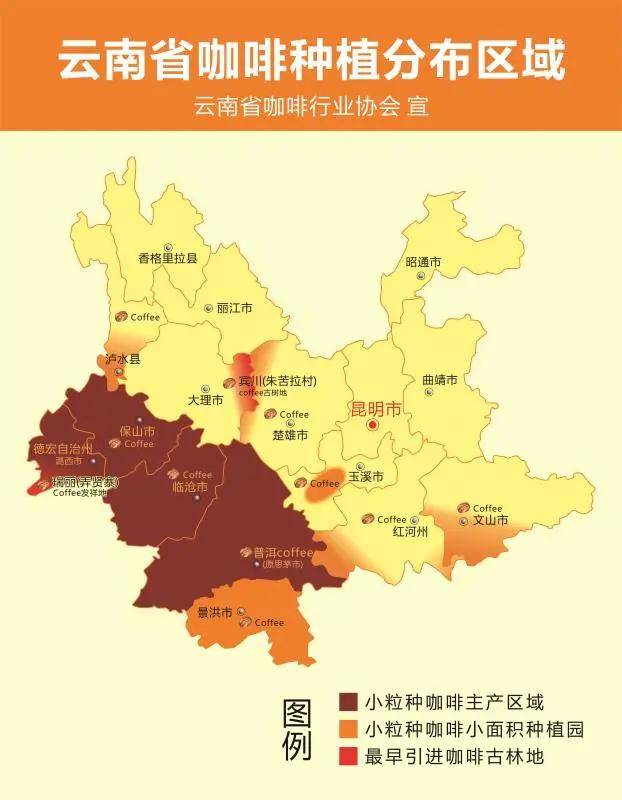
Looking at the map, Yunnan's coffee-growing areas are basically concentrated in the southwestern part of the province, with the most recognized quality Yunnan small-bean coffee coming from Lincang, Baoshan, Dehong, Simao, Pu'er, and Xishuangbanna.
Yunnan's coffee belt lies between 15°N and the Tropic of Cancer, at an altitude of about 1,000 to 2,000 meters, with most coffee trees planted on mountain slopes. Fertile soil, abundant rainfall and sunshine, and a large temperature difference between day and night make the fruit quality of Yunnan small-bean coffee more outstanding, with rich, intense acidity and sweetness.
The Baoshan producing region has a year-round temperature of roughly 21 to 40ºC and almost no frost, and is widely recognized as an ideal place for growing small-bean coffee. With increasing international trade exchanges, the small-bean coffee of Lujiangba, Baoshan has won recognition from coffee experts at home and abroad. Someone once evaluated Baoshan small-bean coffee this way: "Strong but not bitter, fragrant but not harsh, with a mellow aroma; rich in oils, with deep fruit acidity and a lasting sweet finish; this is a top-grade coffee."
Yunnan Small-Bean Coffee Varieties
Global coffee varieties can be grouped into three major categories: Arabica, Robusta, and Liberica. What Yunnan grows is precisely Arabica, which has the smallest beans, hence the name "small-bean coffee."
Among these, the two ancient varieties Typica and Bourbon were Yunnan's main early cultivated crops. In 1991, the Catimor variety was introduced from Kenya. It is a cross between Timor and Caturra, with stronger disease resistance and higher yield. At present, most coffee grown in Yunnan is Catimor, with only a small amount of Typica remaining.
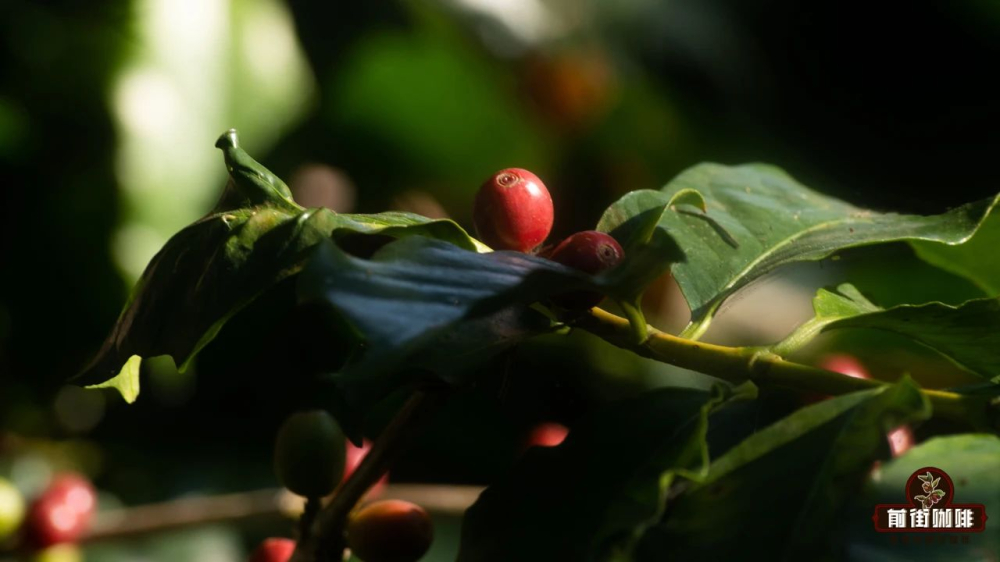
Catimor carries one-quarter Robusta lineage, produces large yields, and is relatively easy to cultivate. In early cupping evaluations, its performance was fairly ordinary, with a rather monotonous flavor, not as pure in aroma as the ancient Typica variety. However, with advances in cultivation management and green bean processing techniques, Yunnan Catimor has performed increasingly well in the international market, and its nutty, black-tea-like aroma along with plum-like sweet acidity is being accepted by more and more people.
As a representative of Yunnan coffee flavor, Front Street selected Catimor from Baoshan, allowing everyone to taste nutty aroma, brown sugar sweetness, soft plum-like acidity, and a black-tea-like finish at the lowest price. This bean uses washed processing, because Front Street believes washed processing better showcases the foundational flavor of the Yunnan producing region.
FrontStreet Coffee: Yunnan Small-Bean Coffee Daily Drinker Bean
Region: China, Baoshan
Altitude: 1200m
Processing: Washed
Variety: Catimor
Flavor: Nuts, brown sugar, berries
Processing Methods
Yunnan coffee green beans mainly use two classic processing methods: washed and natural.
Washed processing first removes the fruit skin, then places the fruit in a water tank to soak and ferment, with the aim of removing the pectin layer. Every step of washed processing can screen out defective beans, so the flavor is cleaner. Compared with the cumbersome steps of washed processing, the natural method is much simpler: after picking, remove defective ripe coffee cherries, then spread them directly in the sun to dry. Once the target moisture content is reached, they can be hulled and bagged. Front Street has also listed naturally processed Yunnan coffee beans, which compared with the washed version carry fermented fruity flavors.
FrontStreet Coffee: Yunnan Catimor Coffee Beans
Region: China, Baoshan, Lujiangba
Altitude: 1450-1550 meters
Processing: Natural
Variety: Catimor
Flavor: Nuts, honey, red berries, black tea
Pour-Over Recommendations
So how should this Yunnan small-bean coffee be brewed to taste good? Front Street believes that choosing freshly roasted coffee beans is crucial. Once the optimal flavor period is missed, the flavor and aroma will dissipate at an accelerated rate, and even the most precise brewing parameters cannot replicate the fresh state (the optimal flavor period refers to the stage after 3 to 7 days of resting when the coffee's flavor reaches its peak). All coffee sold by Front Street is roasted within 5 days, so it can be brewed directly upon arrival.
Yunnan coffee's flavor is not known for its acidity and is overall dominated by nutty notes. Therefore, Front Street's coffee uses a medium roast to preserve the herbal aroma and soft acidity of Yunnan beans, paired with a finer grind size and a higher water temperature, brewed using a V60 dripper. When pouring the ground coffee into the dripper, you can smell the herbal and nutty notes released by the beans.
Front Street has noticed that some customers do not have grinding equipment, so it offers a grinding service—just specify your brewing method at the time of purchase. Since ground coffee loses its aroma more easily, the optimal flavor period is correspondingly shortened, so it is still recommended to drink it as soon as possible. If you want a more complete aroma experience, Front Street recommends bringing your own grinding tool and grinding fresh right before brewing.
First bloom with 30g of water for 30 seconds, then pour 95g of water in a circular motion from the center outward, maintaining a thin stream throughout; when the coffee bed drops to half the height of the dripper, continue pouring 100g in a circular motion until the coffee liquid finishes draining, with a total time of about 2 minutes (within 10 seconds).
Dripper: V60
Water temperature: 90ºC
Grind size: 80% passing through a No. 20 standard sieve
Coffee-to-water ratio: 1:15
Coffee dose: 15 grams
After this Yunnan small-bean daily drinker is brewed, it enters with nutty and brown sugar sweetness. As the temperature drops, plum-like acidity can be felt, and a black tea aftertaste lingers in the finish, with an overall soft performance.
For professional coffee knowledge exchange and more coffee bean information, please follow Coffee Workshop (WeChat public account: cafe_style)
For more specialty coffee beans, please add the private WeChat of FrontStreet Coffee. WeChat ID: qjcoffeex
The above content is compiled by CoffeeHunters, a coffee news website.


