








During the dog days of summer, when it's too hot to delve into origins and extraction theory, Front Street Coffee might as well walk everyone through the vast and lively family of espresso. Starting from the most familiar Espresso, you'll find it has two very different brothers in Ristretto and Lungo, as well as Doppio, which uses double the dose to make a single shot. In addition, the difference in water volume between Americano and Long Black, the milk foam rivalry among Latte, Cappuccino, and Macchiato, the localized evolution of Flat White and Piccolo in Australia, and specialty members like Mocha, Affogato, Con Panna, and Caffè Corretto together form the rich lineage of espresso. This article breaks down each member's flavor characteristics and brewing logic category by category, helping you figure out exactly which one to order.
Once the dog days of summer arrive, the heat is overwhelming. Today Front Street Coffee won't talk about origins, won't discuss extraction curves, and certainly won't fuss over comparative experiments. Instead, let's switch to a lighter topic and properly take stock of espresso, this veteran family that has roamed the coffee world for years, and see just how many faces its Italian coffee members have.
The "Three Brothers" of Espresso
Espresso is the foundation of almost every espresso drink in a café—its status is beyond doubt. But if you step further into the Italian coffee system, you'll find it's not an only child; beside it stand its two brothers, Ristretto and Lungo.
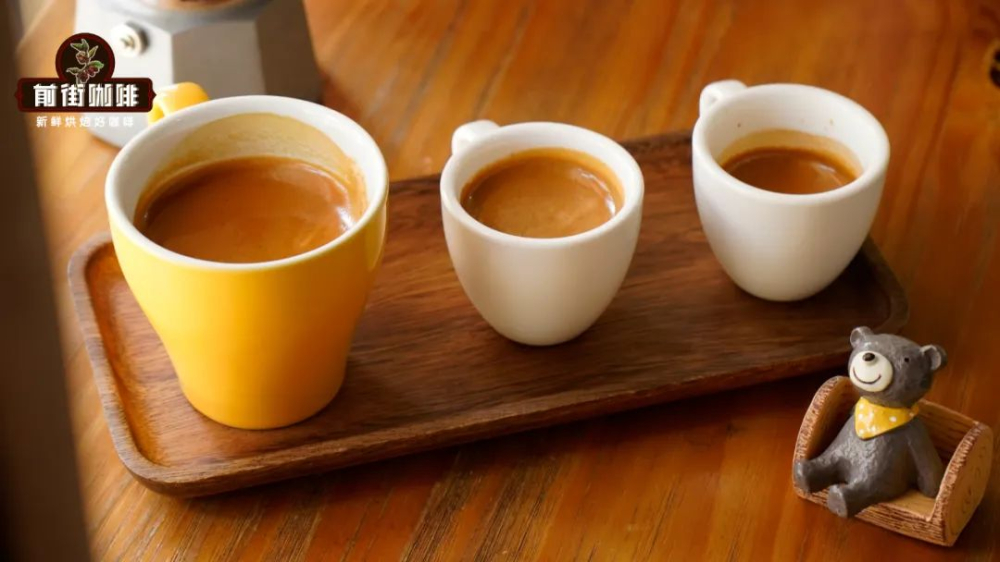
From left to right in the image: Lungo, Espresso, Ristretto
The brew ratio of regular Espresso is usually controlled between 1:1.5 and 1:2.5—for example, using 20 grams of coffee to extract 40 grams of liquid in 25 to 30 seconds. Ristretto only takes the early-to-middle portion of the extraction; with the same 20 grams of coffee, the ratio narrows to 1:1 to 1:1.5, yielding only about 28 grams of liquid and taking roughly 20 seconds. Lungo takes the opposite route, extending the extraction time to increase the liquid volume, widening the brew ratio to 1:4 to 1:5. With 20 grams of coffee, it can extract about 100 grams of liquid, approaching 1 minute.
Compared with standard Espresso, Ristretto has a more concentrated flavor, though unfortunately a shorter finish, and is often used as the base for a Flat White; while the "extra-long" extracted Lungo, diluted by a large amount of hot water, has a thin and bitter mouthfeel and can basically be classified as over-extracted.
Besides these three brothers, Italy also has a full-bodied espresso: Doppio. If you order a double espresso on its own, what you get is two normally extracted shots; but if you order a Doppio, the barista will use double the dose to make just one shot. More coffee, less liquid—naturally the concentration goes up another level.
Members of the Black Coffee Family
When it comes to black coffee, almost everyone knows Americano. Made with just Espresso and water, this drink known as "the American's coffee" has long held the top spot on Italian coffee menus thanks to its approachable character and its suitability for both hot and cold.
Australia also has a local coffee called Long Black, which is likewise made only of espresso and water. The key difference between Americano and Long Black lies in the water volume: when making a Long Black, the ratio of Espresso to water is usually 1:3, while Americano adds more water, about 1:5 to 1:8. As a result, Long Black tastes richer, and it can only be made hot.
Members of the Milk Coffee Family
To sort out the milk coffee family, we have to start with the globally popular Latte. Latte means milk in Italian; if you want a milk coffee, you need to say "Caffe latte" to the locals. Once outside Italy, Latte by default refers to latte coffee, with a ratio of espresso to milk of about 1:5 to 1:8.
In fact, before Latte became popular, what people meant by milk coffee was Cappuccino. When making it, coffee, milk, and milk foam are combined in a 1:1:1 ratio, and the top layer of foam is so thick it can spill over the rim of the cup—letting you enjoy both the rich foam and the intense coffee. There is also a milk-foam-topped strong coffee called Macchiato, made by adding a spoonful of delicate hot milk foam to espresso; because the amount of milk is very small, the taste is intense, placing it right between espresso and cappuccino.
Top: Cappuccino Bottom: Macchiato
Similar to Long Black, when Latte arrived in Australia, it adapted to local tastes by becoming thinner in foam and lower in milk volume, thus evolving into the Flat White. To waste less coffee when dialing in beans, Australian baristas also invented a smaller latte—the Piccolo Latte. The cup used for a Piccolo is only 3 ounces, with a single espresso mixed with a small amount of steamed milk. Compared with a Latte, the Flat White and Piccolo have a richer mouthfeel and highlight the beans' own flavors more, and both can only be made hot.
Left: Flat White Right: Piccolo
As for the "internet-famous" Dirty, it doesn't really count as traditional espresso—more like a later improved version of iced latte. Freshly extracted espresso is poured directly over cold milk to create layers. With its high visual appeal and rich aroma, it's no surprise it went viral all over the internet.
Members of Specialty Espresso Drinks
To make bitter, hard-to-swallow espresso acceptable to more people, people use whatever is on hand and add various ingredients to the coffee, trying to neutralize its intensity. Thus all kinds of specialty espresso drinks came into being.
Using latte as a base and adding a chocolate-containing flavoring makes the traditional Italian Mocha Cafe. Another Italian drink with chocolate flavor is caffè marocchino. The method is to first add a shot to a 60 ml cup, sprinkle a layer of cocoa powder, then pour in milk foam or cream, and finally sprinkle another layer of cocoa powder. The small cup size plus two layers of cocoa powder make the coffee's aroma even more intense.
There are also many specialty espresso drinks made directly with espresso as the base. Pouring espresso over ice cream gives you Affogato, which counts both as an espresso drink and as a dessert. Squeezing whipped fresh milk on top of espresso gives you Con Panna. Adding a small amount of high-proof liquor to a small cup of Espresso is called Caffè Corretto.
From left to right: Affogato, Con Panna, Caffè Corretto
Pour the coffee liquid into a shaker with ice cubes and a small amount of syrup, shake it, then strain out the ice and pour it into a martini glass—and a cup of European-style iced shaken coffee, Caffe shakerato, is complete. The aroma of the espresso is preserved, and a hint of sweetness plus the thick foam on top make it feel and look like drinking dark beer.
The above content is compiled by CoffeeHunters, a coffee news website.


