







How Do Old Instant Coffee Brands Compare in Flavor Today?
Instant coffee began in 1901, when Chicago chemist Satori Kato produced coffee powder by vacuum drying and patented it in 1903. Nestle improved the process in 1937 and launched Nescafe, and instant coffee spread worldwide after World War II. Many of those old instant coffee brands still sit on shelves, and their flavors differ mainly by processing method.
Freeze-dried coffee is a branch of instant coffee, not a separate category, which explains why some jars hold fine powder and others hold granular chunks. A hands-on comparison of several mainstream freeze-dried brands looks at how drying method, bean origin, and roast level affect aroma, body, bitterness, and cost.
For many office workers, a daily cup of coffee has become a necessity, but buying it out over the long term adds up, making home brewing a money-saving solution. There are many kinds of instant coffee—what's the difference between freeze-drying and spray-drying? What are their respective flavor characteristics? This article first sorts out the historical thread of instant coffee from its birth in 1901 to Nestlé's mass production, then analyzes how spray-drying and freeze-drying affect flavor, and finally presents Front Street Coffee's hands-on comparison of multiple instant products from five brands—Tim Hortons, Yongpu, Eagle Eye, Satunbal, and Lian Coffee—to help you find the one that suits your taste.
Today coffee has reached almost every corner of life, and relying on a cup of coffee to perk up has long been a daily routine for many office workers. But spending at cafés every day is hard on the wallet, so more and more people are turning their attention to their own kitchens. The question that follows: how do you cut costs, and are there instant coffees with good flavor worth trying?
Instant coffee on the market is a dazzling array—what exactly sets one apart from another? Front Street believes many people don't understand how instant coffee is made. The formal birth of this type of product, which we now take for granted, dates back to 1901—Satori Kato, a Japanese-American chemist in Chicago, and his team used vacuum drying technology to produce coffee powder from coffee solution and obtained a patent in 1903. Seizing the opportunity of World War I, instant coffee first opened up a market among American soldiers.
By the 1930s, the Great Depression combined with Brazil's coffee oversupply led the Brazilian Coffee Institute to seek cooperation with Nestlé to develop instant coffee products and stabilize the coffee market. In 1937, Nestlé improved the method of making instant coffee, and Nescafé was born. During World War II, instant coffee once again became popular among soldiers. Over the following decades, instant coffee spread across the globe.
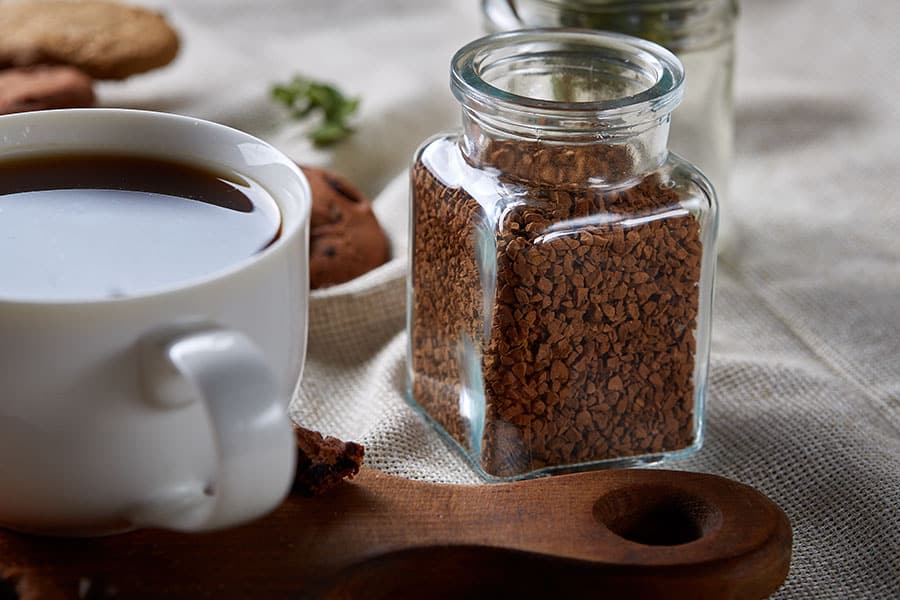
Front Street has noticed that some friends treat instant coffee and freeze-dried coffee as two different things. In fact, freeze-dried coffee itself is a branch of instant coffee. So why is some instant coffee powdery while some, like freeze-dried coffee, comes in granular chunks? The answer lies in the differences in the drying stage of instant coffee production.
To make instant coffee, the first step is to roast green beans to bring out the flavors and aromas in the coffee beans. The roasted beans are then ground into a fine powder and extracted with water.
The extracted coffee liquid is ultimately dried via one of two routes: using "spray drying" yields the familiar milk-powder-like instant coffee; using "freeze drying" yields granular instant coffee.
Spray drying works by forcing the coffee liquid through a nozzle into countless tiny droplets, which are sprayed into a high-temperature drying chamber where the water quickly evaporates, leaving behind powdery solid instant coffee. Because of the high-temperature treatment, much of the coffee's original flavor is lost, leaving only a bitter coffee taste. This process is relatively inexpensive, so it naturally became the mainstream method of instant coffee production.
Freeze-dried coffee, which has become popular in the past two years, looks premium and sells at a higher price, giving the impression of a new thing. But in fact, freeze-drying technology has existed in the coffee field for decades. The method is to freeze the extracted high-concentration coffee liquid at low temperature, crush it, and use the physical principle that lower pressure means a lower boiling point to heat it to 60°C in a vacuum environment until it is completely dried. Because the temperature stays low throughout, the pleasant flavor compounds in the coffee are preserved.
Instant coffee is popular not only because its flavor is richer than traditional 3-in-1, but also because its small packaging is easy to carry, capturing a large number of office workers and students. In the process of popularizing coffee knowledge, Front Street Coffee is often asked: are there any instant coffees worth recommending?
Ask and you shall receive. Front Street Coffee not only seeks out the ultimate coffee flavors from various regions but also tries every brand and category in the industry one by one. Instant coffee, as the starting point for many coffee novices, naturally cannot be left out.
Front Street previously selected five coffee brands with relatively high attention online and purchased multiple instant coffee products from each for a side-by-side comparison.
[Tim Hortons] Dark Roast Little Donut
The entry is intensely bitter with a slight herbal note, and after swallowing, a pronounced smoky sensation stands out. Even when cut with milk, the bitter, burnt taste remains clearly detectable.
Front Street believes this freeze-dried coffee is on the bitter side, making it very suitable for friends who are extremely sleepy and are willing to be hard on themselves. If you just need a daily pick-me-up, you might try the medium roast version.
[Yongpu] Cold Brew Flying Saucer
Even though the packaging colors differ, they all contain the same coffee inside.
Front Street used this instant coffee to make cold brew: the coffee flavor is clear, the taste is fairly balanced and full-bodied, and the overall mouthfeel is soft. When used to make a latte, the coffee flavor isn't overpowered by the milk, but it isn't as rich as a latte made in a café.
[Eagle Eye Coffee] Special Cold Brew Coffee Mixed Pack
Yunnan small-bean variety: quite heavily bitter
Little Jasmine Tea Coffee: noticeable tea astringency, with the jasmine tea flavor overpowering the coffee flavor
Colombia blend: the most normal performer in this mixed pack, a classic coffee flavor, but overall on the light side
Rose Oolong Coffee: compared to the previous jasmine flavor, the coffee taste is more prominent, but the tea flavor still overwhelms the coffee flavor
Rose Aroma: carries the scent of rose aromatherapy, the coffee flavor isn't obvious, and it's overall on the light side
[Satunbal]
This product has a simple packaging design, using three colors to correspond to three flavors.
Red: Front Street used it to make a latte—it tastes close to what a coffee shop serves, but is on the lighter side overall
Black: used to make cold brew, balanced and full-bodied overall
Gray: used to make an oat latte—the gray cup is slightly richer than the red cup
[Lian Coffee] Fresh Extract Espresso
This freeze-dried coffee powder is positioned as espresso and only dissolves in hot water. After adding hot water, you can see it recreate espresso's "crema," which can be used for latte art. Used to make a latte, the flavor is balanced and full-bodied, with a noticeable sauce-like and salty note in the finish.
The above is Front Street Coffee's review of instant products from five coffee brands. If you ask which is more aromatic, freeze-dried coffee or freshly ground coffee, Front Street's answer is of course freshly ground—freshly ground coffee lets you freely choose the bean's origin, variety, and processing method, and its aroma is beyond the reach of instant coffee, even freeze-dried coffee, which uses a more expensive and complicated process.
For more coffee bean information, please follow Coffee Workshop (WeChat public account cafe_style)
For professional coffee knowledge exchange, please add WeChat ID qjcoffeex
The above content is compiled by CoffeeHunters, a coffee news website.


