







What Does Each Coffee Bean Name Grade Actually Mean?
Labels such as G1, AA, AB and SHB are grade symbols set by each producing country, not variety names. Every origin builds its own system around local growing conditions and coffee varieties, so some grade by the count of defective beans, some by green bean size, and others by hardness or growing altitude. The same letters can therefore mean different things across origins.
Grading grew alongside the specialty coffee industry. Single-origin coffee must be Arabica traceable to one origin with a cupping score of 80 or above, and shops generally stock only beans that clear that threshold. Because not every cherry on a tree develops fully, producing regions began screening and sorting their arabica bean lots, which protects flavor quality and earns growers higher returns.
When purchasing single-origin coffee beans, labels such as G1, AA, and SHB often appear on the packaging. What exactly do these letters and numbers represent? They are actually coffee bean grade symbols established by each origin based on its own conditions. Due to differences in growing environments and varieties, each country's grading criteria vary—some look at the number of defective beans, some at green bean size, and others at hardness or altitude. In this article, Front Street Coffee will sort out the grading standards of major producing regions such as Ethiopia, Kenya, Indonesia, Central and South America, and Brazil, helping coffee enthusiasts understand the meaning behind these grades so they can more accurately select high-quality coffee beans that suit their taste.
To learn more about specialty coffee, follow our WeChat official account: Front Street Coffee.
When buying single-origin coffee beans, coffee enthusiasts often see labels like G1, G2, and SHB on the packaging, such as Ethiopian Yirgacheffe G1 coffee beans. What exactly do these letter-number combinations mean? In fact, they indicate the grade of the beans. The reason so many different grade symbols exist is that each producing country has established different grading systems based on its own growing conditions and coffee varieties. Below, Front Street Coffee will walk you through the common standards and characteristics of coffee bean grading.
What Are Coffee Bean Grading Standards?
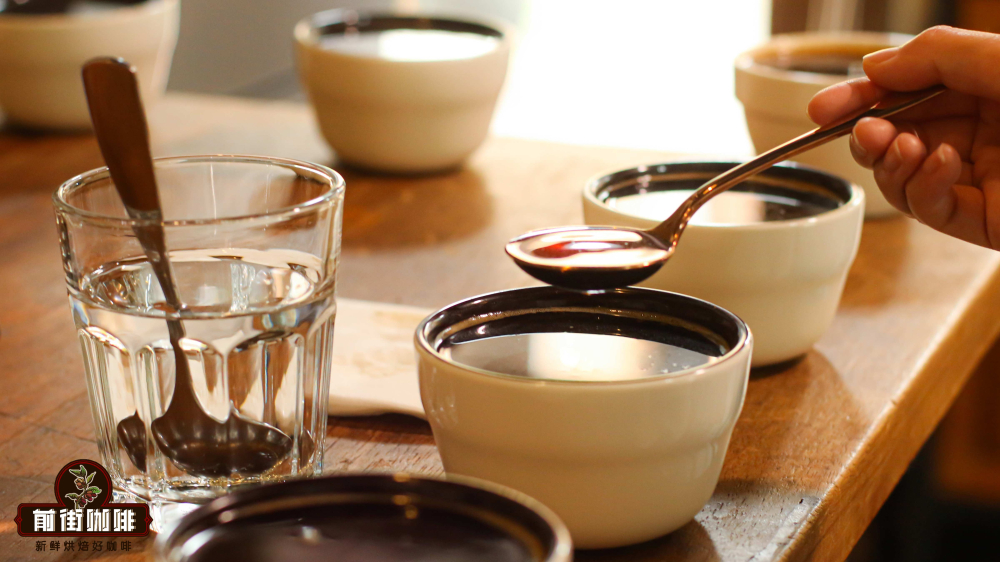
The birth of coffee bean grading standards is inseparable from the rapid growth of the specialty coffee industry. Coffee enthusiasts have long been unsatisfied with instant coffee and have turned to single-origin coffee. As is well known, single-origin coffee must be Arabica beans traceable to a single origin, with a cupping score of 80 or above. Take professional coffee shops as an example: all single-origin coffee beans on their shelves must meet the threshold of a cupping score of 80 or above, and those that fail to meet the standard will not be offered.
To reach this score, the coffee beans themselves must be of excellent quality. However, not every fruit on a coffee tree can be perfect, so each producing region began screening and grading coffee beans. This not only ensures flavor quality but also brings higher returns. Therefore, each country has established its own coffee bean grading standards based on its own circumstances.
Common Coffee Bean Grading Standards
According to Front Street Coffee, the grading of green coffee beans is usually based on several dimensions: defect rate, green bean size, hardness, growing altitude, and cupping grade. Next, Front Street Coffee will introduce the coffee bean grading standards of major well-known producing regions.
Ethiopia—Graded by Number of Defective Beans
Ethiopia is the birthplace of coffee, with an extremely rich variety of coffee plants—over 2,000 varieties have been recorded so far, and countless more remain unrecorded. Because of this, the size of Ethiopian coffee beans varies greatly and cannot be used as a grading basis, so the number of defective beans is used instead.
According to Front Street Coffee, before the establishment of the Ethiopian Commodity Exchange (ECX), the country's coffee export grades were set by the CLU (Cupping and Liquoring Unit) under the Ministry of Agriculture, mainly grading green beans by the number of defective beans in a 300-gram sample. The specific standards are shown in the table below.
Generally, washed beans are G1 to G2; due to the limitations of early sun-drying techniques, sun-dried green beans had more defects and mostly fell into G3 to G5. With improvements in sun-drying techniques, sun-dried beans can now also reach G1 to G2 grades.
Current Ethiopian ECX Grading System (applicable to the private processing plant system bidding for export through ECX or green beans exported through ECX)
According to Front Street Coffee, after the establishment of the ECX (Ethiopian Commodity Exchange) in 2008, the country's producing regions began grading by combining the physical attributes of green beans with cupping flavor characteristics.
The ECX divides coffee into two major categories by processing method—unwashed and washed—and defines the following three types:
a. Specialty Few defects, high cupping flavor quality b. Commercial Does not reach specialty grade but is superior to the Local/Domestic consumption grade c. Local/Domestic Many defects (unripe beans), off-season or improperly stored leading to poor flavor. (Consumed domestically in Ethiopia, does not enter the international market)
Among these, Specialty and Commercial are aimed at the international export market, and the grading standards differ slightly between the types. Below, Front Street Coffee will share the grading standards for Ethiopian coffee beans at the commercial and specialty levels.
Commercial Grade Grading Standards
Based on the total score of physical attributes and cupping flavor, the ECX divides green beans into nine grades, with physical characteristics accounting for 40% and cupping quality accounting for 60% (referencing SCAA cupping standards). See the table below for details.
Scores between 15 and 19 are classified as UG, meaning Ungraded.
Specialty Grade Grading Standards
This grade rating is further divided on the basis of the commercial grading. When the commercial grade reaches Grade 1 to 3, a specialized cupping evaluation is then conducted, with evaluation standards referencing SCA cupping basic requirements.
Kenya—Graded by Green Bean Size
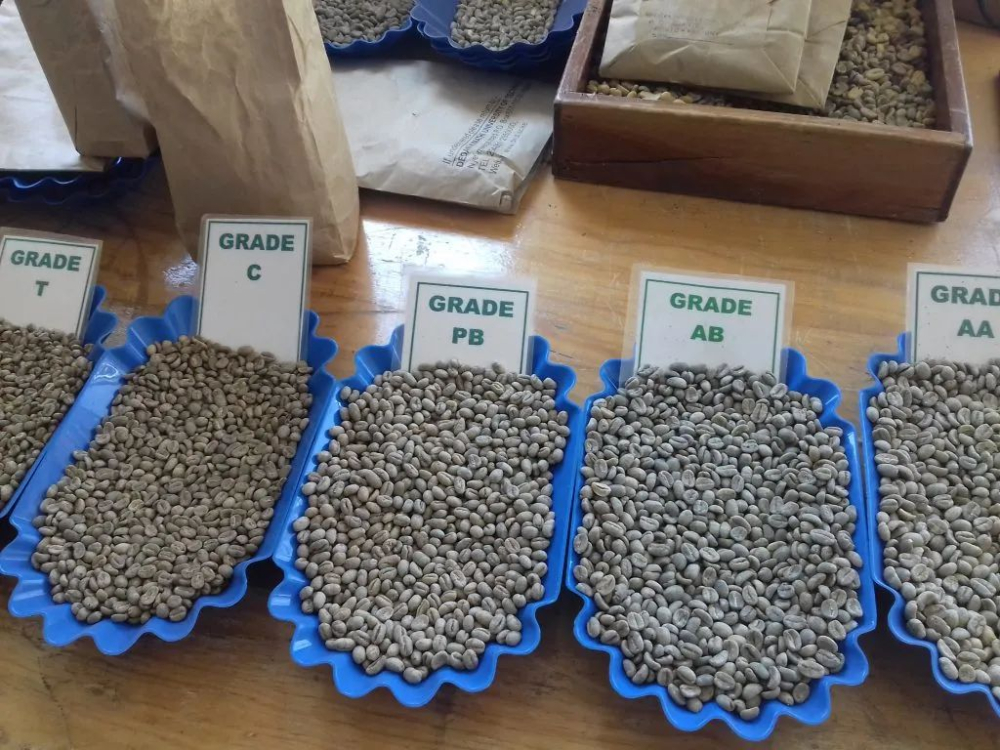
Kenya has implemented a strict grading system since the 1930s, mainly based on the size, shape, and hardness of coffee beans, divided from highest to lowest into AA or AA+, AB, PB, C, E, TT, and T. Selection is based on these grades, with flavor performance also taken into reference. Currently, the most common on the mass market are AA, AB, and PB.
E (Elephant Bean): The "E" here stands for "Elephant," but it is not the Elephant variety among coffee species. It is an abnormal development where two seeds become intertwined, forming a bean that "looks like one." It is a defect. Normally, a fruit contains two seeds pressed face to face, so one side is flat, called a flat bean, female bean, or double bean. E is when two seeds fuse and stick together during growth, becoming exceptionally large. E-grade beans are approximately 18 screen sizes (one screen is 1/64 inch) or above, and are rare in number.
AA: This grade is approximately 17 to 18 screen sizes (about 6.7 to 7.1 mm). It is the Kenyan coffee grade most people have heard of, often called AA TOP in specialty coffee, and is also the bean many coffee shop owners promote. But AA does not mean the best—it only reflects bean size and should not be confused with flavor.
AB: Most coffee beans belong to this grade. It is called AB because A's screen hole is 6.80 mm and B's is 6.20 mm, and beans of both sizes (A grade and B grade) are mixed and sold together, hence AB. The size is approximately 15 to 16 screen sizes (about 6.0 to 6.4 mm).
C: Beans are approximately 14 to 15 screen sizes (about 5.6 to 6.0 mm), smaller than B grade.
PB: In English it is called Peaberry, often called small round bean in Taiwan, also known as male bean or single bean. Compared to regular flat beans, it is relatively rare, accounting for about 10% of all coffee beans. Because only one seed develops fully within the fruit, the result is a small, round bean. Some people prefer the flavor of PB, so it is sorted out and sold separately.
TT: These beans are light beans screened out from AA and AB by an airflow separator. They are usually light in weight, fail to meet hardness standards, and have cracks and defects.
T: Lighter beans screened out from C-grade beans, mixed with broken beans and even fragments.
MH/ML: These beans are not for export. They are usually overripe coffee beans that have fallen to the ground, of poor quality, accounting for about 7% of total bean volume, and are only for Kenya's domestic market.
Kenyan Coffee Grading—Where Do AA TOP and AB TOP Come From?
According to Front Street Coffee, in addition to Kenya's official grading, exporters or traders have also created unofficial subdivisions for AA and AB, commonly including AA TOP, AA+, AA++, AB+, AB TOP, and AA FAQ.
FAQ is short for Fair Average Quality, meaning average fair quality, and is the basic version of the AA grade. Classifications such as AA TOP, AB TOP, and AA+ have no specific standards, and two "+" signs do not necessarily mean it tastes better or has a better flavor. Why?
The key is that this is not a unified standard. Every green bean trader or different person will arrive at different results. It is possible that one company's AA+ is comparable in flavor to another company's AA++. So ultimately, you still have to rely on cupping it yourself during roasting—that is the most practical approach!
Indonesia—Graded by Green Bean Screen Size and Defect Rate
According to Front Street Coffee, Indonesia's coffee bean grading standards are quite similar to Ethiopia's, also relying on defect rate for grading, but the final grade assessment method is different. Indonesian beans are mainly divided into 6 grades, namely G1 to G6.
Common abbreviations in Indonesian green coffee bean exports include:
Coffee category: R=Robusta, A=Arabica
Processing method: WP=Wet Processed, DP=Dry Processed/sun-dried, AP=After Polished (polishing to remove silver skin)
Hand-picked defective bean grade classification: D/P (Double Picked) T/P (Triple Pick)
Meaning and rules of Indonesian green coffee bean names: Indonesia W.I.B Indonesia G1
Country + Grade Name W.I.B is the most common and also the highest standard
Guatemala, Costa Rica, Panama—Graded by Green Bean Hardness
Next are the common Guatemala, Costa Rica, and Panama, all of which grade by green bean hardness. According to Front Street, the growing characteristics of coffee beans are: at the same latitude and in the same plot, the higher the altitude, the greater the day-night temperature difference, the longer the coffee growing period, the harder the beans, the more nutrients absorbed, and the more pronounced the flavor compounds. Therefore, many producing countries in Central and South America south of Mexico use this as a standard. When these producing countries export green beans, they only have the SHB grade. As shown in the figure below:
El Salvador, Honduras, Nicaragua—Graded by Growing Altitude
Brazil—Graded by Green Bean Size, Number of Defects, and Cupping Grade
Coffee enthusiasts all know that Brazil is the world's number one coffee producer and exporter. According to Front Street Coffee, Brazilian coffee naming follows the format: Country + Region (Port) + Grade Name + Cupping Quality.
For example: Brazil Santos NY.2 FC means Grade 2 from Brazil's Santos region, the best-cupping beans. Brazil considers that only beans with absolutely no defects can be called NY.1, and beans with absolutely no defects do not exist. Therefore, among Brazilian green beans, the best is NY.2.
The grading standards by cupping level are as follows:
Fine Cup (FC), Fine, Good Cup (GC), Fair Cup, Poor Cup, Bad Cup
Colombia—Graded by Green Bean Size
According to Front Street Coffee, Colombian coffee bean grade naming follows the format: Country + Region + Grade Name + Certification, for example: Colombia Huila Supremo SC17/18 FNC, meaning the highest-grade beans from Colombia's Huila region, FNC certified.
In addition, the Colombian Coffee Growers Federation is a joint organization that guides and helps coffee farmers sell and promote coffee. Therefore, all green beans produced in Colombia, whether in burlap sacks or cardboard boxes, will always show the letters FNC, whose full name is: Feeracion Nacinal De Cafeteos De Colombia.
Common Colombian coffee bean grade names and standards (as shown in the figure below):
Jamaica—Graded by Green Bean Size
According to Front Street Coffee, Blue Mountain No. 1, No. 2, No. 3, and Blue Mountain Peaberry are the only coffees in the world exported in wooden barrels, available in three specifications: 70 kg, 30 kg, and 15 kg. Other grades of Jamaican coffee are exported in 60 kg burlap sacks. The grading standards are shown in the figure below:
Hawaii Kona—Graded by Green Bean Screen Size and Number of Defects
According to Front Street Coffee, Hawaiian Kona coffee is mainly divided into Type 1 and Type 2, with several grades further subdivided under each. Type 1 refers to regular flat beans, while Type 2 refers to Peaberry.
Due to Kona coffee's excellent processing, all grades shown in the figure below can be considered specialty coffee.
The above is some information on coffee bean grading compiled by Front Street Coffee, hoping to help coffee enthusiasts who want to learn about related knowledge so they can select high-quality coffee beans that better suit their taste in the future.
For more specialty coffee beans, add our private WeChat Front Street Coffee, WeChat ID: kaixinguoguo0925
The above content is compiled by CoffeeHunters, a coffee news website.


