







How Does a French Press Brew Fine Coffee?
French press brewing relies on coarse grounds, a four-minute steep, and fresh beans. A 350 ml press takes 15 to 18 grams of coffee; a 500 ml press takes about 25 grams. Because the metal mesh filter lets fine particles through, a coarse grind is essential. Freshly ground beans preserve aromatics that pre-ground supermarket coffee loses, which affects clarity and sweetness in the cup.
The process starts with a rinse and preheat, then coffee goes in, hot water follows, and the grounds bloom for about 30 seconds. After topping up, the plunger rests for four minutes before a slow, steady press. Using a timer helps consistency. When choosing how long to grind coffee beans, aim for a setting that produces particles similar in size to coarse sea salt for fine coffee results.
The French press, with its simple operation and high flavor fidelity, has become the first-choice device for many coffee enthusiasts, both for beginners and for daily use. But to brew a good cup with it, every step matters—from the freshness of the coffee beans and the grind size to the pouring method and steeping time. This article will walk through the complete French press brewing process, from equipment preparation, coffee dose references, pouring rhythm, bloom waiting, plunger operation, to pouring techniques, and explain why freshly coarse-ground coffee and a 4-minute timer are key to the quality of the result. It will also include suggestions for using Front Street Coffee beans in a French press, helping you consistently reproduce a clean, sweet cup of coffee.
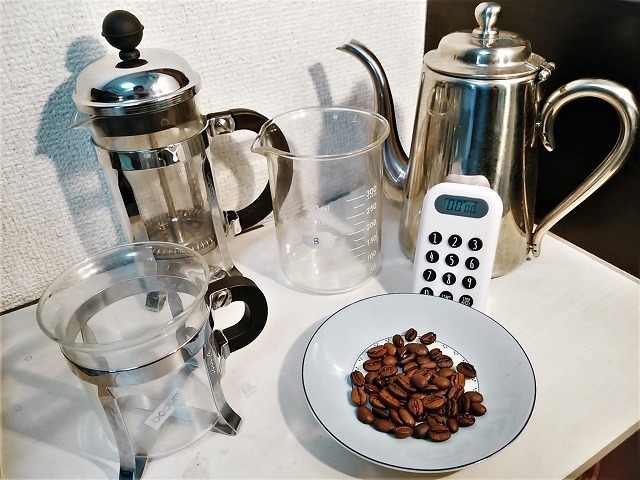
*Starting from the top left of the image and going clockwise
French press
Heat-resistant sharing pot (used with the French press)
Freshly boiled hot water
Timer
Coffee beans (or coarsely ground coffee)
Sharing pot
The most common French press capacities on the market are 350 ml and 500 ml, and the required amount of coffee grounds differs accordingly.
350 ml: 15 to 18 grams
500 ml: about 25 grams
The above is only a rough reference. In fact, flexibly adjusting the dose according to personal taste preferences and the characteristics of the coffee beans used is also one of the great pleasures of the brewing process.
Brewing coffee with a French press has certain requirements for the coffee grounds.
Ordinary coffee grounds can of course also be used for extraction, but to get the ideal flavor, two conditions must be met.
The most notable feature of the French press is that it can extract the flavor of the coffee beans "exactly as it is."
For this reason, while fresh coffee beans are certainly delicious, once beans with poor freshness are used, those spoiled flavors will also be directly amplified.
So be sure to prepare coffee beans that are as fresh as possible; this point requires special attention.
The French press filter is a metal mesh structure.
It is much coarser than paper filters, and fine coffee powder will pass through the mesh and mix into the coffee liquid.
Therefore, the French press usually requires coarsely ground coffee.
Most coffee grounds sold in supermarkets are medium or medium-fine grind.
So it is recommended to buy coffee beans and grind them into coarse powder at home.
Next, let's look at how to use the "French press" specifically.
Step one, put the coffee grounds into the French press
and gently level them
.
Before pouring in the hot water, first set the timer.
The time “ 4 minutes 00 seconds (±30 seconds)” is ideal.
If it exceeds 5 minutes, it will be over-extracted; if it is less than 3 minutes, it will be under-extracted and the taste will be weak. The currently recognized reference time is "4 minutes 00 seconds." This is the standard.
In fact, timing is the most important part of French press brewing. Because time has an enormous impact on the flavor of the French press, it is difficult to control consistently by feel alone. Be sure to use a kitchen timer on your phone or a dedicated timer.
The specific operation process is as follows
Preparation After boiling the hot water, let it sit for a while ·French press ·Timer.
Have hot water on one side and the timer on the other.
Pour hot water into the “ 1 /2~1/3 ” of the pot's capacity .
At the same time , start the timer.
Please complete this step as quickly as possible. If you start the timer late, the extraction time will be pushed back accordingly.
The key here is "do not pour the hot water directly onto the coffee grounds." Let the water flow along the inner wall of the French press, indirectly delivering the hot water to the coffee grounds. This can both prevent the coffee grounds from splashing and allow the hot water to contact the coffee grounds evenly.
If fresh coffee beans are used, the coffee grounds will expand as shown in the image. Wait 30 seconds to let this expansion process stabilize. If the expansion is not too dramatic, 30 seconds can be used as a reference.
After the bloom subsides, continue pouring in hot water. The standard is to pour to 1.5 to 2 cm below the rim of the French press .
For this pour, you can slowly go around in a circle as if drawing a circle. In this way, the coffee grounds will be stirred up and down by the hot water, achieving even extraction.
After pouring is complete, attach the plunger (filter).
Install the plunger to the most standard position . In addition, it is recommended at this time to turn the pouring spout on the lid into place . This can prevent steam and aroma from escaping, and also slow down the drop in temperature and loss of aroma.
There is no special operation during the waiting period. But there are a few things worth doing. For example, use the remaining hot water to warm the sharing pot and coffee cups, so the coffee will not cool easily.
Also, if coffee grounds stick to the pouring spout, wipe them off with a paper towel, etc. This way, when pouring the coffee, you can avoid coffee grounds mixing into the cup.
When the timer goes off, the extraction is complete. At this point, carefully press down the rising plunger .
The key at this moment is to go slowly. If you press too quickly, the powder will mix into the coffee. Conversely, if you press too slowly, the extraction time will be extended accordingly. A rough reference is that pressing down in about 3 to 5 seconds is appropriate.
Please apply force vertically downward from directly above. Otherwise, the plunger may tilt, and powder may leak out through the gaps.
After the plunger reaches the bottom, pour the coffee into a sharing pot or cup.
But there is one point to note here.
For example, if you are extracting two servings but only pour out one cup, the remaining coffee will continue to over-extract over time. Therefore, it is necessary to pour the coffee into the cup all at once . But pouring out all the coffee is also not appropriate.
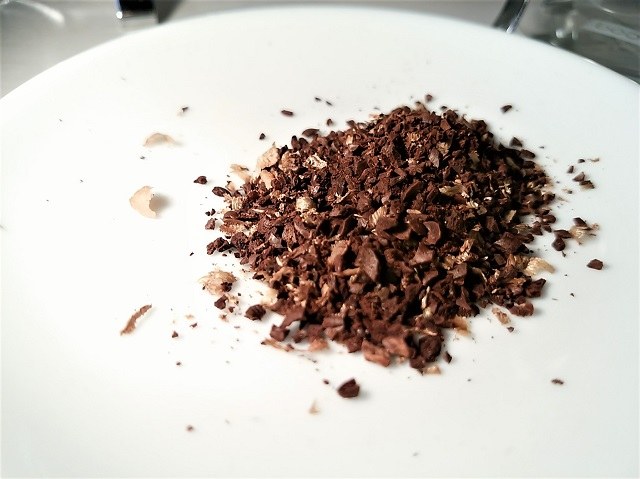
The coffee at the bottom of the pot contains a large amount of fine powder. So if this part is also mixed in, the whole cup of coffee will become cloudy due to the coarse particles.
Now, after going through the whole process, let's sort out the key points that affect the flavor.
Use fresh coarsely ground coffee
Time is 4 minutes 00 seconds (±30 seconds)
For the first pour, indirectly add 1/2~1/3 of the water volume
Start the timer at the same time as the first pour
For the second pour, pour evenly, then put on the lid
Slowly lift the filter
Leave a little coffee at the bottom of the pot; do not pour it all out
As long as you follow the points mentioned above, the charm of the French press lies in being able to easily make a delicious cup of coffee. Because it does not require much skill, beginners can also pick it up easily.
Especially for people who want to taste specialty coffee, the French press is also an indispensable device. Why not give the French press a try and make a good cup of coffee together.
The above content is compiled by CoffeeHunters, a coffee news website.


