







Which Coffee Extraction Methods Suit Espresso Grounds?
Espresso-ground coffee can be used for cold brew, but the fine particles extract fast, so the steep must be shortened and the coffee-to-water ratio widened to avoid over-extraction. Standard cold brew soaks coarse grounds in cold water for 8 to 12 hours; with espresso grounds, cut that time and taste early to check for bitterness.
Cold water pulls less bitterness and astringency while still releasing fruity acidity and sweetness, which is why cold brew tastes cleaner and rounder than hot-brewed coffee. Beans such as Huakui, Butterfly, Strawberry Candy Espresso, and Indonesian Lintong Mandheling work well. If the result turns out sour, a longer steep or a finer grind can help fix it.
Cold brew is widely recognized as the lowest-barrier way to make iced coffee—all it takes is soaking in cold water. But many coffee enthusiasts wonder: can ultra-fine espresso grounds also be used for cold brew? This article explores that question, first outlining cold brew's flavor characteristics and bean selection advice, then providing the standard cold brew water-to-coffee ratio, grind size, and step-by-step instructions, and finally addressing the particularities of espresso grounds—explaining how to avoid over-extraction by shortening the steeping time and widening the coffee-to-water ratio, with specific parameters and tasting suggestions included. The article recommends suitable beans such as Front Street Coffee's Huakui, Butterfly, Strawberry Candy Espresso, and Indonesian Lintong Mandheling, helping readers easily make clean, delicious cold brew at home.
For more specialty coffee knowledge, follow: Front Street Coffee (Frontsteet Coffee)
Among all coffee extraction methods, cold brew is probably the most effortless and least skill-dependent—even beginners just getting into coffee can use it to make a smooth cup of iced coffee. Front Street Coffee has already written quite a bit about various aspects of cold brew, and the relevant parameters have been repeatedly tested in controlled comparisons of different scales. However, a while back, a reader left a message asking Front Street Coffee a question: can espresso grounds be used to make cold brew?
What are the characteristics of cold brew coffee?
The reason cold brew is so appealing comes down to this: when steeping in low-temperature water, the compounds that tend to bring unpleasant sensations (like bitterness and astringency) are less likely to be extracted, while the pleasant ones (such as fruity acidity and sweetness) are released fairly fully. Because of this, compared to coffee brewed with hot water, cold brew has a cleaner taste, a rounder body, and a fuller flavor.
As for cold brew's shortcomings, Front Street Coffee sees two main ones. First, the wait time is fairly long—it usually needs 8 to 12 hours of refrigeration. But Front Street Coffee has always believed that good coffee is worth waiting for: soak the grounds and water before bed, strain it the next morning, and you get a cup of invigorating cold brew. The other is that if you don't pick the right beans, cold brew easily develops unpleasant flavors, tasting almost like a cup of Cantonese herbal tea. So besides controlling the parameters well, choosing beans that match your taste is equally key.
What coffee beans should be chosen for making cold brew?
Cold brew is itself a cold drink. If you use dark-roasted beans, the result will most likely be both icy and bitter; and without the support of high temperature, the bitterness lingers, making you not want to take a second sip after the first. That's why when making cold brew at home, Front Street Coffee usually prioritizes light-to-medium or medium-roast beans with prominent aromatics or clear sweet-and-sour balance. The resulting iced coffee has balanced acidity and sweetness with a refreshing juice-like quality—especially suitable for summer.
If you want a cold brew with light floral notes, full berry-like sweet acidity, a moderate fermented character, and a black-tea-like finish, you can choose Front Street Coffee's Huakui beans; if you prefer bright citrus acidity, fresh white floral notes, honey-like sweetness, and a green-tea-like aftertaste, Front Street Coffee's Butterfly beans would be the top choice.
If you plan to use espresso beans for cold brew, then you definitely shouldn't miss Front Street Coffee's Strawberry Candy Espresso. This bean pulls beautiful shots with grape and berry flavors; made into cold brew, it's refreshing as juice, with especially prominent blueberry and sweet orange aromas—very pleasant to drink in summer.
Cold brew's water-to-coffee ratio and step-by-step instructions
Cold brew's coffee-to-water ratio is generally kept between 1:10 and 1:12. For example, take 30 grams of coffee grounds, and Front Street Coffee typically adds 300 grams of cold water for steeping.
As for grind size, Front Street Coffee (FrontStreet Coffee) recommends using coffee grounds the texture of fine granulated sugar (based on China's No. 20 standard sieve, with a 75% pass-through rate). If you don't have a grinder at home, you can note when ordering that you need cold-brew grind. Front Street Coffee reminds you that once coffee is ground, the aroma dissipates noticeably faster—if conditions allow, it's still better to grind fresh and brew right away.
To make it, find a clean, sealable container, pour in the coffee grounds and the appropriate amount of water, stir briefly so the grounds and water make full contact, then seal it and refrigerate for 8 to 12 hours.
Once the steeping time is about up, take it out, strain the coffee liquid with a filtering tool, pour it into a clean sealed container, and put it back in the fridge to store. After filtering out the grounds, cold brew generally keeps for about 5 days—try to drink it as early as possible within that time.
Can espresso grounds be used to make cold brew?
Back to that reader's question. The reason this question arises is that the grind size of the coffee grounds doesn't meet the requirements for cold-steep extraction. As we know, espresso grind is usually as fine as flour. If you add water at the previous ratio and steep for a long time, it releases soluble compounds more readily than a standard grind (fine granulated sugar level), resulting in coffee that's both strong and bitter, even astringent. So to avoid over-extraction, we need to adjust two details: the steeping ratio and the time.
Here Front Street Coffee used Front Street Coffee's Indonesian Lintong Mandheling for demonstration. This bean is medium-dark roasted; as pour-over it shows caramel, roasted nut, dark chocolate, herbal, and caramel aromas. It works for various brewing methods, and its taste is closer to the espresso grounds commonly found on the market; pulled as espresso, it also has a rich crema.
To be close to what everyone actually encounters, Front Street Coffee used the Galileo Q18 espresso grinder from its shop, setting it to 2.5 notches—suitable for pulling espresso—to grind, yielding particles as fine and uniform as powdered sugar.
Since the grind size is fixed, to lower the extraction rate we first need to shorten the contact time between water and grounds, and second, widen the coffee-to-water ratio—that is, change the coffee's concentration to make the flavor lighter. The specific parameters are as follows:
Coffee grounds: 50g
Coffee-to-water ratio: 1:14
Cold water: 700g
Steeping time: 3 hours
After filtering: refrigerate for another 2 hours
Because the grounds are on the fine side, the water flow meets more resistance during filtering, making it take longer. In the freshly filtered coffee liquid, flavor compounds are still suspended in the water, so it often tastes a bit powdery. You can seal it and refrigerate it briefly to let the suspended particles settle a little, and the coffee's mouthfeel will become cleaner.
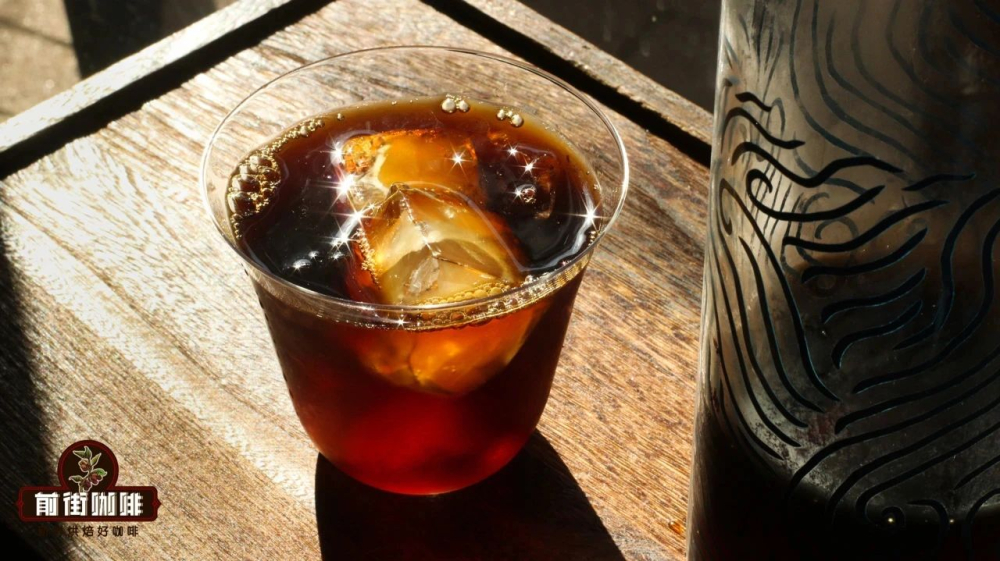
Also, considering that espresso grounds are on the darker-roast side, with flavors dominated by caramelized aromas, a full body, and slightly heavy bitterness, Front Street Coffee suggests adding some ice before drinking after filtering.
Take today's cup of Front Street Coffee Indonesian Mandheling cold brew—with the help of ice, it drinks with prominent spice notes, dominated by dark chocolate and caramel flavors, with a pu-erh-tea-like finish. The mouthfeel is icy and refreshing, quite invigorating.
The above content is compiled by CoffeeHunters, a coffee news website.


