







When brewing pour-over coffee, the coffee-to-water ratio and extraction time often determine the completeness of the final flavor. This article uses Huakui coffee beans as an example, systematically reviewing Front Street Coffee's recommended three-stage pouring scheme, from origin background and naming rules to specific brewing parameters. The article not only provides key data such as water temperature, coffee dose, and grind size, but also explains the relationship between the 18%–22% extraction yield and 1.15%–1.35% concentration in the Golden Cup extraction standard, clarifying why a 1:15 coffee-to-water ratio more easily falls into the ideal range. It also reminds readers not to remove the dripper early out of fear of over-extraction, otherwise the actual ratio will deviate from the set value and instead lead to incomplete flavor.
In the culinary world, masters often speak of "a moderate amount," but when asked exactly how much that is, they often struggle to give a clear answer. The coffee world is entirely different: almost every step here relies on quantifiable data, and "a moderate amount" appears very rarely. For example, when brewing a cup of coffee, how much ground coffee to weigh and how much hot water to pour—what is commonly called the coffee-to-water ratio—is backed by a series of data. Below, Front Street uses Huakui coffee beans as an example to discuss several points worth noting in the pour-over brewing process.
Huakui coffee beans have recently been much discussed, triggered by an internet celebrity's review of Luckin, which suddenly brought Huakui coffee into the public eye and added a lot of heat to the specialty coffee circle. This bean comes from Ethiopia, widely recognized as the birthplace of coffee, specifically the Hambela sub-region under the Sidamo producing area.
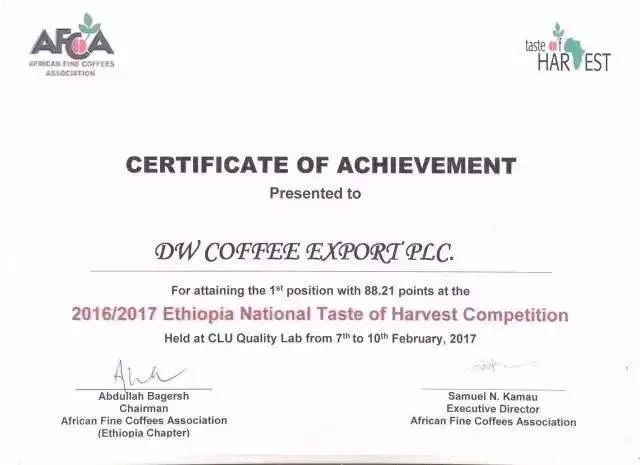
In 2017, the Ethiopian green bean company DW sent a natural-process coffee bean from its Buku Abel processing station to that year's TOH competition. With its intense strawberry-cream profile, this bean won over the judges and took first place in the natural group of the TOH Ethiopia region.
In the same year, a Beijing green bean merchant introduced the same winning lot into China. Because its strawberry-cream flavor was especially prominent, the bean hunter had great expectations for this bean, believing that if the processing method were further optimized, it had every potential to become as sought-after a star as Geisha, and so named it "Huakui," meaning "chief of a hundred flowers."
In that year's World Brewers Cup China region, the field was almost entirely Geisha, yet contestant Li Jianfei competed with a bean worth far less than Panama Geisha and ultimately took second place. Upon asking, it turned out he was using Huakui coffee beans from Ethiopia.
Coffee is an agricultural crop, and its quality fluctuates with that year's climate, environment, and other factors—meaning the Huakui of one year and the Huakui of the next will differ slightly in flavor. Huakui coffee beans therefore adopt the naming method "Huakui X.0," increasing with the year to distinguish them from the previous year. For example, Huakui coffee beans from the 2020 season are called Huakui 4.0, while those from the 2021 season are called Huakui 5.0.
Front Street once found similar small-particle beans in the 2018 and 2019 batches of Huakui coffee beans. After many cupping comparisons, Front Street found that the aroma of Huakui coffee mainly comes from these small-particle Huakui beans. In 2020, the processing station processed the small-particle Huakui separately, and thus small-particle Huakui coffee beans were born.
After the 2022 season arrived, Huakui 6.0 was shipped to Guangzhou in April, and FrontStreet Coffee also reserved a batch at the first opportunity. Front Street will not let everyone down, and I believe that before long, everyone will be able to see Huakui Coffee 6.0 at FrontStreet Coffee stores.
At present, everyone can still taste Huakui 5.0 and small-particle Huakui. Front Street once conducted a cupping comparison of these two Huakui coffee beans, and the result was that the small-particle Huakui coffee beans have a more intense strawberry aroma and berry sweetness, while the Huakui 5.0 coffee beans have a livelier berry acidity and brighter fruit acidity.
On FrontStreet Coffee's bean list, coffee beans from the Ethiopian producing area usually use a medium-light roast. When Front Street brews medium-light roasted coffee beans, it uses the following parameters:
Dripper: Hario V60
Water temperature: 91°C
Coffee dose: 15 grams
Coffee-to-water ratio 1:15
Grind size: 80% passing rate on China standard No. 20 sieve
In order to present a richer layering in the coffee while also keeping the technique simple and efficient, Front Street usually uses three-stage pouring to brew. First pour 30 grams of hot water for a 30-second bloom, then from the center point pour in a thin stream slowly in circles to 125 grams to complete the first stage; when the water level in the dripper drops to just about to expose the coffee bed, continue pouring in circles to 225 grams, with a total extraction time of about 2 minutes.
It should be understood that the extraction process of pour-over coffee is: grinding a certain amount of coffee beans into powder, putting it into the dripper, and then extracting it with a certain amount of hot water. During brewing, when the grind size, water temperature, and coffee-to-water ratio change, the expression of acidity, sweetness, and bitterness will also change accordingly.
From the moment coffee grounds contact hot water, the three flavor factors in the grounds—acidity, sweetness, and bitterness—are released over time in three stages.
Many friends know that Front Street recommends a brewing time of about 2 minutes, but after 2 minutes there is still quite a bit of water in the dripper that has not finished dripping. Worried that prolonging the time will bring out bitterness, they remove the dripper. Front Street does not encourage this practice. If the dripper is removed before the water has finished dripping, the final coffee-to-water ratio is no longer the set 1:15, and the coffee flavor is very likely to be incomplete.
As Front Street mentioned earlier, the determination of the coffee-to-water ratio has scientific data as its basis, namely what baristas often call the "Golden Cup extraction standard." Concentration refers to the proportion of extracted coffee substances in a cup of coffee relative to the total coffee liquid; extraction yield refers to the proportion of extracted coffee substances relative to the total weight of the coffee beans.
An extraction yield below 18% means under-extraction; above 22% is over-extraction.
Through many brewing tests, Front Street has obtained data: when the coffee-to-water ratio is between 1:14.5 and 1:15.5, it most easily falls into the golden range of the Golden Cup extraction standard: 18%–22% extraction yield and 1.15%–1.35% concentration. This is also why FrontStreet Coffee has always recommended a 1:15 coffee-to-water ratio.
Of course, whether coffee tastes good also depends on the freshness of the beans. The coffee beans shipped by Front Street are all freshly roasted within 5 days, and by the time they arrive they have passed a 4-to-7-day resting period,正好处于风味最佳阶段。Even so, Front Street still recommends blooming before brewing to help the carbon dioxide inside the coffee particles escape and create more stable conditions for the later stages of extraction.
Front Street also provides grinding service for friends who do not have grinding equipment at home. However, after coffee beans are ground into powder, the contact area between the particles and air increases, degassing intensifies, and flavor substances are lost along with it. Therefore, Front Street recommends buying whole beans and grinding fresh before brewing, so you can taste a better flavor.
For more coffee bean information, please follow Coffee Workshop (WeChat public account cafe_style)
For professional coffee knowledge exchange, please add WeChat ID kaixinguoguo0925
The above content is compiled by CoffeeHunters, a coffee news website.


