







Coffee extraction methods for French press beans and grind size
A French press works with almost any bean, but medium to dark roasts with sweetness and body hold up best, since the metal mesh lets oils through. Grind coarse, roughly like sea salt, because fine particles slip past the filter and turn the cup muddy or bitter. Steep for about four minutes, then press slowly and pour right away.
The press pot dates to around the 1850s, when a piston-filter device was patented; a Milan company registered an improved version in the late 1920s, and early models were often used for tea rather than coffee. Among coffee extraction methods it is the simplest for fine coffee at home: use a ratio near 1:15, water around 92 to 96C, and a coarse grind to avoid astringency.
Want to enjoy a cup of fine coffee but feel overwhelmed by complicated equipment? A French press may be the easiest answer. This article starts with the origin and structure of the French press, answers what kind of coffee beans it suits, and uses Huakui coffee beans as an example to present Front Street Coffee's complete brewing parameters and steps. The article also compares the grind size differences between pour-over and French press, explaining why the French press needs coarser particles, and how water temperature, coffee-to-water ratio, and steeping time work together to help you avoid the pitfalls of bitterness and astringency, so you can consistently recreate a full and mellow flavor at home.
If today's coffee enthusiasts want to make a standard pour-over at home, the equipment list is often quite long: gooseneck kettle, server, dripper, filter paper, thermometer... Not to mention the setup taking over the counter, storage also takes up space. Does that mean without a full set of pour-over gear, you can't enjoy fine coffee? If you posed this question to a barista at Front Street Coffee, they would probably turn around and dig out that dust-covered French press.
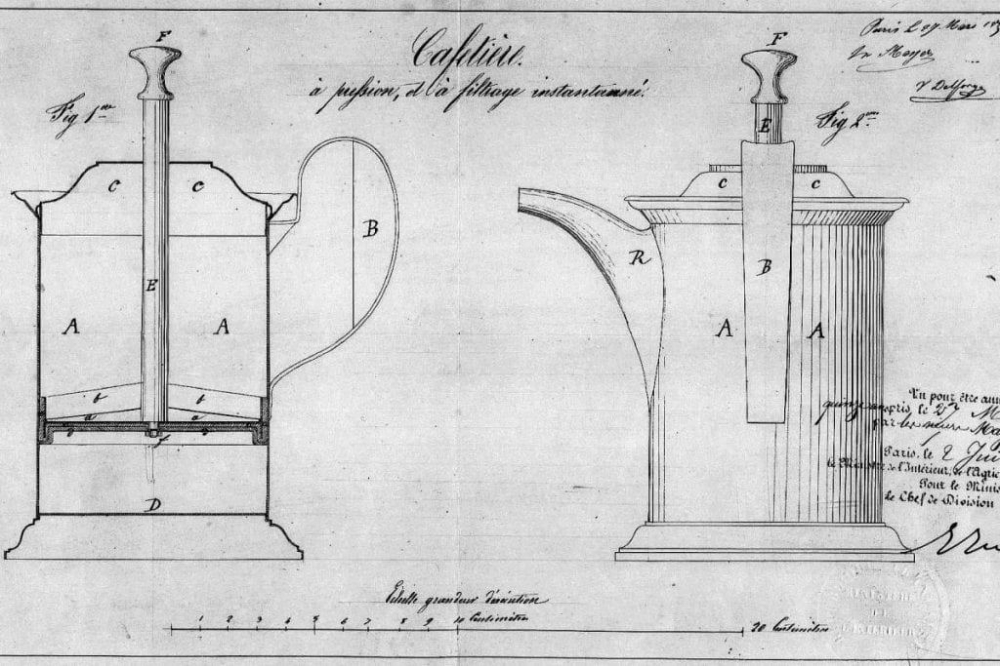
The French press, also called the French press pot, in English French Press, can be considered one of the most effortless and convenient coffee extraction methods. Its history is not short. Around the 1850s, a craftsman and a merchant jointly obtained a patent for a "piston-filter coffee device": a metal canister connected to a movable rod, with holes at the bottom of the rod, and a layer of flannel clamped above and below. Pressing the rod down manually to the bottom traps the coffee grounds at the bottom of the pot, and the coffee in the cup is relatively clean.
After that, technology continued to improve. By the late 1920s, a Milan company registered a patent for an improved version of the French press. The form of the French press familiar to the public today was basically finalized and gradually became known to more people.
However, in the early years, the French press was mainly used not for brewing coffee, but for brewing tea. Usually, the mesh for brewing tea is coarser, while the mesh for brewing coffee is finer. If you love drinking coffee but have no time, or don't have an expensive coffee machine at home, the French press is a good alternative.
Coffee made with a French press has a heavier mouthfeel and a fuller flavor. Front Street uses Huakui coffee beans as an example to explain how to brew a delicious cup of coffee with a French press. As usual, first let's introduce the background of this bean.
Huakui coffee beans come from the Buku Abel processing plant in the Hambela sub-region of the Guji region in Ethiopia, and are processed using the natural method. In 2017, the Ethiopian DW company sent the natural beans from the Buku Abel processing plant to participate in that year's TOH competition, and won the championship in the natural group of the TOH Ethiopia division with a rich strawberry cream flavor. A Beijing green bean merchant introduced the same batch of championship beans into China. Because that strawberry cream flavor was so outstanding, they believed that as long as post-harvest processing of the green beans continued to improve, there was a chance it would become the next explosively popular bean. So they placed high hopes on it and named it "Huakui," meaning "chief of a hundred flowers."
In the same year, on the stage of the World Coffee Brewing Championship China division, almost the entire field was using Geisha varieties. But contestant Li Jianfei took second place with the same batch of Huakui coffee beans. When asked, everyone realized it was actually Huakui coffee beans from Ethiopia, and Huakui's fame took off from there.
Huakui coffee beans are named in the style of "Huakui X.0," with the year increasing and the number increasing along with it: 2018 Huakui 2.0, 2019 Huakui 3.0, 2020 Huakui 4.0, 2021 Huakui 5.0. The arrival of 2022 means Huakui 6.0 is also about to appear. Front Street Coffee has already pre-booked the batch, and it is believed that before long, friends will be able to see Huakui Coffee 6.0 on Front Street Coffee's bean list.
Currently, on Front Street Coffee's bean list of nearly fifty coffee beans, there are Huakui 5.0 and small-particle Huakui coffee beans. Front Street once discovered small-particle Huakui among the Huakui coffee beans of 2018 and 2019. After comparison, it was found that these small particles are precisely the main source of Huakui coffee's aroma. In 2020, the DW company processed the small-particle Huakui separately, and thus the brand Small-Particle Huakui came into being.
Front Street conducted a cupping comparison between Huakui 5.0 coffee beans and small-particle Huakui coffee beans: the flavor of small-particle Huakui is closer to the strawberry cream of the 2017 natural championship batch; Huakui 5.0 leans more toward the citrus and berry notes and tea-like mouthfeel of the Guji region.
After all, your own hands are not the hands of a barista. Even if the Huakui you drink in a cafe is delicious, you often can't brew that flavor at home. Compared with complicated pouring and brewing, friends then turned their eyes to the simplest brewing method—brewing Huakui coffee beans with a French press.
But problems followed: how should you brew to avoid Huakui coffee being bitter and astringent, and how can you get a delicious cup of Huakui?
Front Street Coffee French Press Brewing Tutorial
Brewing equipment: French press
Water temperature: 90 degrees Celsius
Coffee dose: 15 grams
Coffee-to-water ratio: 1:15
Grind size: 70% passing rate on China standard No. 20 sieve
First, pour an appropriate amount of hot water into the French press to fully preheat it, then pour the hot water out.
Pour 15 grams of coffee grounds into the French press, and pour in 225 grams of 90 degrees Celsius hot water.
Pull the plunger to the highest position and cover with the lid, then steep for 4 minutes.
After 4 minutes, gently and slowly press the plunger down to one quarter of the French press, pour out the coffee liquid, and it is ready to enjoy.
The Huakui coffee brewed by Front Street according to the above parameters and steps gives off a mixed berry aroma as soon as it enters the mouth, with an obvious compound berry juice sensation and a creamy mouthfeel, full and mellow overall.
Huakui coffee beans are medium-light roasted. The flavor substances in the coffee are released relatively slowly after contact with hot water, so Front Street recommends using a higher water temperature to accelerate the release of flavor substances.
When producing coffee, Front Street generally uses a dripper with a three-pour brewing extraction. Because the poured hot water contacts the coffee grounds in a relatively short time and finally drips into the server, Front Street usually uses a grind size of 80% passing rate on China standard No. 20 sieve when brewing Huakui coffee, which is somewhat finer than what is used for the French press.
But French press brewing is ultimately a method of obtaining coffee by steeping for a long time in relatively high-temperature water. To avoid excessive extraction bringing bitterness and astringency, Front Street recommends using a coarser grind size, 70% passing rate on China standard No. 20 sieve. Coarser grinding means the coffee particles are larger in size, and the total surface area contacting the hot water decreases accordingly. Too fine a grind easily leads to over-extraction; too coarse a grind easily leads to under-extraction, resulting in a watery taste and obvious acidity.
For more coffee bean information, please follow Coffee Workshop (WeChat public account cafe_style) For professional coffee knowledge exchange, please add WeChat ID kaixinguoguo0925
The above content is compiled by CoffeeHunters, a coffee news website.


