








How did Catimor become Yunnan's main arabica variety?
Catimor is the variety behind most Yunnan coffee today. A French missionary brought the first trees to Zhukula Village in Binchuan County in 1904. Large-scale planting began in 1952 at Lujiangba in Baoshan, and in 1988 the Dehong Tropical Agriculture Research Institute introduced Catimor from Portugal's Leaf Rust Research Center, with trial planting in Pu'er in 1990.
Catimor spread because it resists leaf rust and yields well, though it has flavor shortcomings that careful washing, altitude, and roasting can offset. Main areas include Baoshan, Pu'er, and Dehong, with harvest running roughly from November to March. Washed processing and a V60 three-pour recipe at about 90C bring out sweetness. For contrast, where are robusta coffee beans grown is a separate question, as Robusta favors lower elevations.
Yunnan coffee has gradually entered the public eye in recent years, and the main variety supporting Yunnan's coffee production is Catimor. This article starts with the history of its introduction, sorts out the varietal origins and botanical characteristics of Catimor, explains why it could be widely promoted in Yunnan, and objectively analyzes its inherent shortcomings in flavor. The article further focuses on the altitude, climate, and harvest rhythm of major producing areas such as Baoshan, introduces the washed processing flow, and, combining Front Street's bean selection and roasting approach, provides V60 three-pour hand-brewing parameters and flavor descriptions to help coffee lovers fully understand the true character of Yunnan small-bean Catimor.
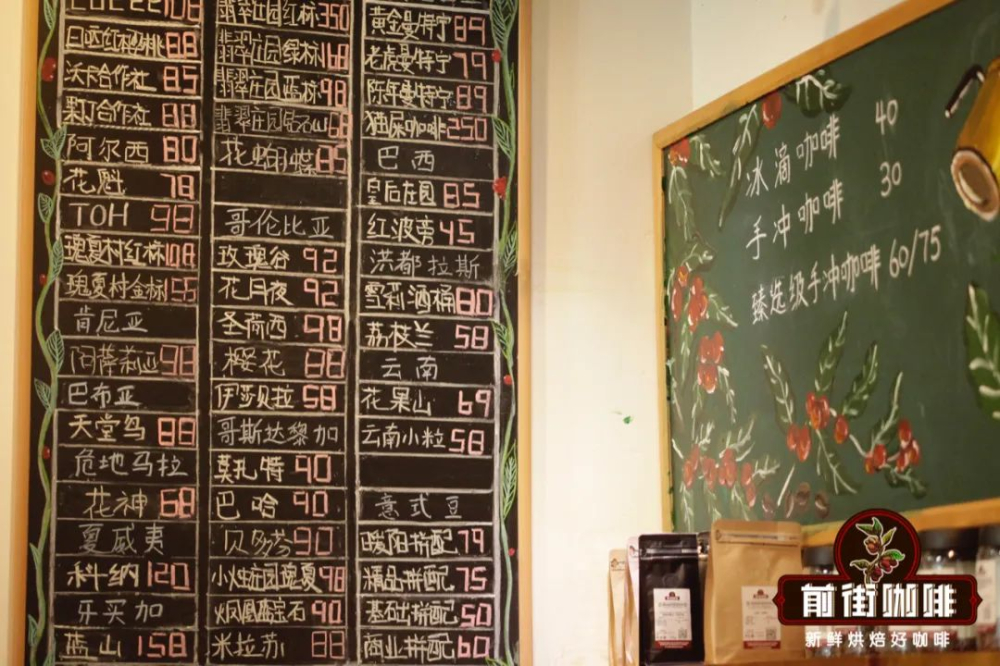
The circle of domestic coffee lovers continues to grow, and coffee beans produced in Yunnan have accordingly gained more attention. Many guests who walk into Front Street stores will actively order a cup of Yunnan beans from the bean list to try. Today, let's systematically talk about the representative variety of Yunnan small-bean coffee—Catimor.
How did Yunnan small-bean Catimor come to be?
In 1904, a French missionary brought China's earliest batch of coffee trees to Zhukula Village, Binchuan County, Yunnan, for planting, thus opening the first page of China's coffee cultivation history. After the founding of New China, in 1952, researchers from the Yunnan Academy of Agricultural Sciences planted a batch of coffee seedlings in areas such as Lujiangba in Baoshan, marking the official start of large-scale cultivation. Counting it up, China has been cultivating coffee on a large scale for more than sixty years.
In order to select varieties more suitable for Yunnan's terroir that are both high-yielding and disease-resistant, the Dehong Tropical Agriculture Research Institute of Yunnan began coffee introduction in 1986. In 1988, Nestlé established a joint venture in Yunnan, and the coffee planting area continued to expand. In the same year, the research institution introduced the new variety Catimor from the Portuguese Leaf Rust Research Center and began raising seedlings, with trial planting in Pu'er, Yunnan, in 1990. With advantages such as strong disease resistance and considerable yield, Catimor was gradually promoted, and today the vast majority of coffee planted in Yunnan is this variety.
Varietal characteristics of Catimor
Coffee around the world can generally be divided into two major categories: Arabica and Robusta. Arabica's beans, leaves, and overall appearance are all smaller than Robusta's, so Arabica is also called small-bean coffee. In the early stage of Yunnan coffee, Typica and Bourbon, two ancient and pure Arabica varieties, were planted. Later, in order to increase yield, Yunnan switched large areas to Catimor, with other varieties remaining only in a very small proportion. Therefore, what is called Yunnan small-bean today basically refers to Catimor.
Catimor is a hybrid of Timor (belonging to Robusta) and Caturra (a Bourbon variety), and is the offspring of a natural cross between Arabica and Robusta. In other words, Catimor carries about 25% Robusta blood.
The Catimor tree is relatively short, small in size, and densely branched, suitable for compact cultivation, and can grow vigorously even without shade. It not only has extremely strong resistance to leaf rust, but also has a certain tolerance to common diseases such as coffee berry disease, so its fruit-bearing rate is higher, and the fruit matures faster than other varieties, naturally increasing yield. For coffee farmers, a Catimor with a good harvest is clearly more attractive.
However, some of the Robusta genes carried by Catimor also make its flavor inherit certain defects of Robusta. When planted at low altitudes, Catimor tends to be bitter, and when improperly processed, it can also develop irritating astringency and musty flavors. Even when planted at relatively high altitudes above 1,200 meters, its aroma richness is limited, and in various competitions it often cannot compare with pure Arabica varieties such as Caturra and Catuai. Therefore, from cultivation to final output, Yunnan Catimor must rely on more professional management and more complete green bean processing technology to keep quality stable.
Cultivation of Yunnan Catimor
Yunnan Catimor is mainly planted in the west and south, covering Pu'er, Baoshan, Dehong, Lincang, and other places, among which Baoshan small-bean coffee became famous earliest.
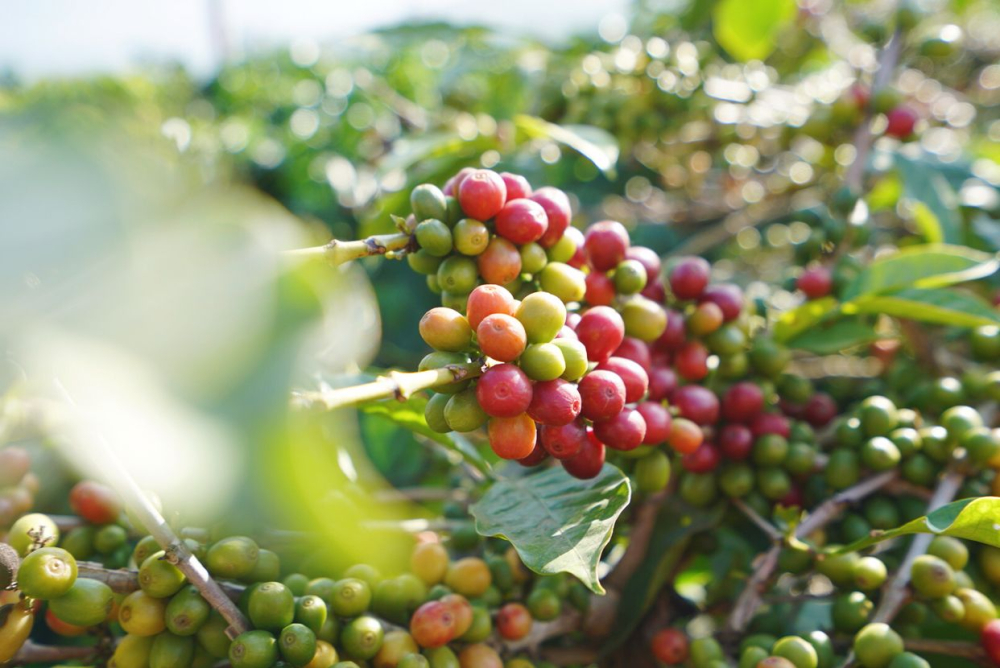
Baoshan is the earliest region in China to cultivate coffee on a large scale, with contiguous planting beginning in the mid-1950s. Coffee trees are mainly concentrated in the Nujiang River valley around Lujiangba, where the terrain is mostly noticeably undulating sloping land, and the planting altitude is usually between 800 and 1,800 meters. The local area has abundant sunshine and rainfall, and the high altitude brings a large temperature difference between day and night. Coffee fully absorbs sunlight during the day and slowly accumulates nutrients at night.
Baoshan's average annual temperature is about 21.5°C, with basically no frost period, and it is regarded by many coffee farmers as an ideal producing area for small-bean coffee. Yunnan's subtropical monsoon climate has distinct dry and wet seasons, with plenty of rain in summer, so coffee trees do not lack water; after the flowering period in the first half of the year ends, the coffee cherry harvest period begins successively in the second half. The higher the altitude, the later the ripening. For example, the Baoshan Catimor that Front Street obtains is grown at an altitude of 1,200 meters, and harvesting is generally concentrated from October to November each year.
Flavor characteristics of Yunnan Catimor
Yunnan's rainy season is relatively long and sunlight is not very stable, so most local coffee beans follow the traditional washed route. Coffee farmers first remove the skin from the harvested coffee cherries, then place them in clean water tanks to ferment, using the acidic substances produced by fermentation to break down the pectin on the outer layer of the green beans. After that, it can be easily removed by manual scrubbing, and finally the wet parchment beans are spread out on the ground to dry. Once the moisture content reaches the standard, they can be bagged and stored.
Front Street has always believed that coffee flavor is not only affected by variety and terroir; the green bean processing method also largely determines the direction of the flavor. Usually, when approaching a coffee, Front Street starts with the washed version, because washing can better show the bean's own flavor, while natural processing adds a fruity fermented taste on top of the washed base. For this reason, Front Street chose Baoshan washed Catimor as the representative daily-drinking bean of the Yunnan producing area, hoping everyone can taste the characteristics of Yunnan small-bean at the lowest price, and the 100g small package also saves worry about waste if it cannot all be finished.
Front Street believes that Yunnan coffee is not the type known for acidity, but rather has a more balanced mouthfeel, so when making Yunnan daily-drinking beans, the roaster uses a medium roast, which preserves some soft acidity while highlighting a nutty sweetness.
Brewing suggestions
As mentioned earlier, Catimor's layering is not particularly rich, and Front Street recommends drinking it as hot black coffee (after cooling, negative flavors such as earthy fishiness tend to emerge). Before brewing, it is best to choose freshly roasted coffee beans. Beans enter their best tasting period 4 to 7 days after roasting, after which the aroma will continuously dissipate over time, so they should be finished as soon as possible. Front Street insists on shipping only beans freshly roasted within 5 days, so everyone can drink them at their most aromatic state.
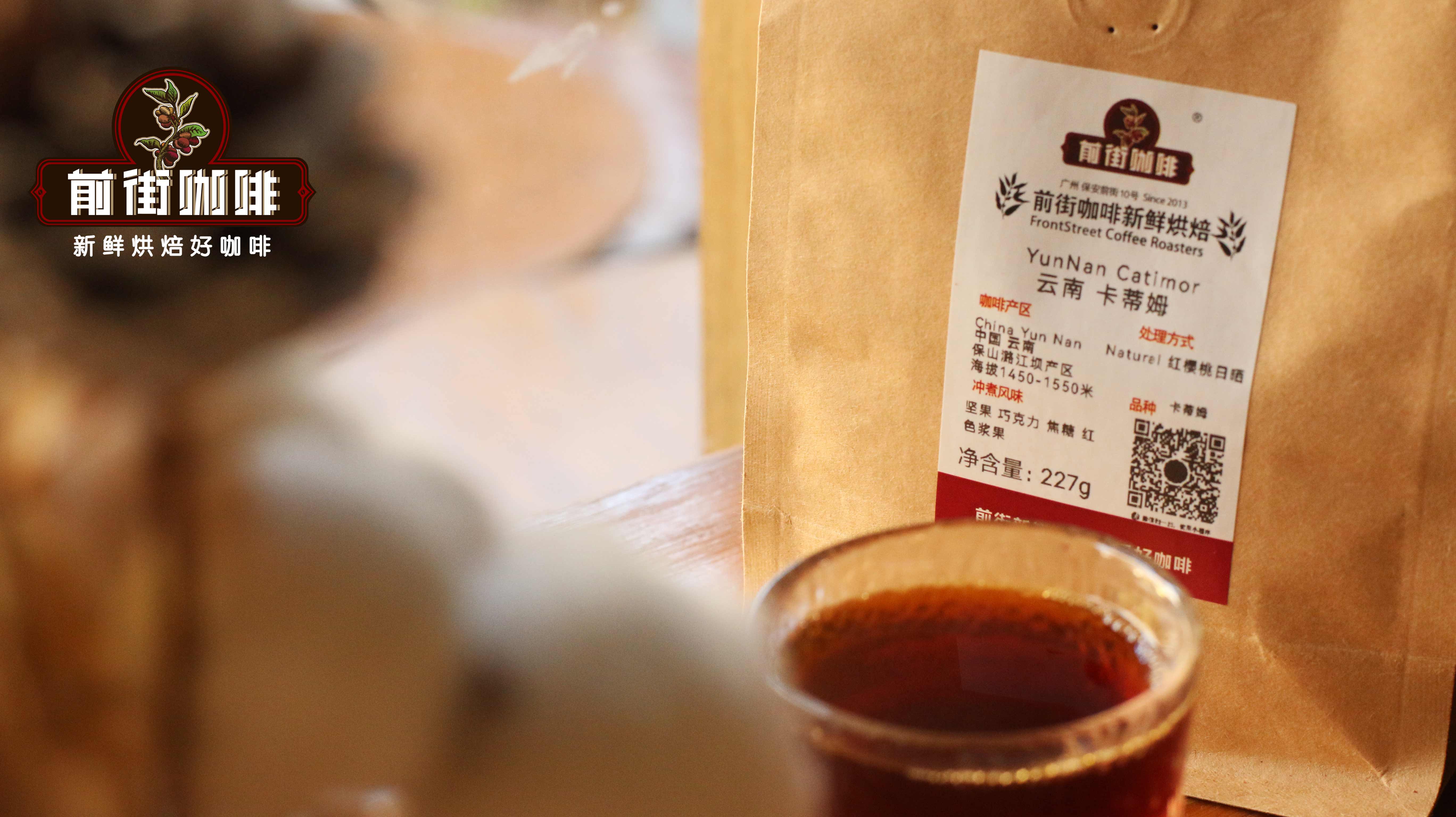
Since Yunnan Catimor presents a balanced profile of acidity, sweetness, and bitterness, the baristas at FrontStreet Coffee will choose a dripper with a relatively fast flow rate, such as the V60. The V60's spiral ridges not only extend the contact time between coffee grounds and water, but also, as the water level drops, cause the water flow to gather along the spiral ridges toward the center of the dripper, using the gravity of the falling water to press the coffee grounds and form a richer sense of layering. Grind size and water temperature should both be kept in the medium range as much as possible to avoid an overly intense mouthfeel during extraction.
Hand-brewing parameters: 15g coffee grounds, 1:15 coffee-to-water ratio, 90°C water temperature, medium-fine grind (80% passing rate on China standard sieve No. 20), V60 dripper, three-pour extraction
Three-pour extraction operation: First use 30g of water to bloom for 30 seconds, then pour in a small stream in circles until 125g, then stop; when the water level drops to almost exposing the coffee bed, continue pouring to 225g and stop; when the water level drops again to the point of almost exposing the coffee bed, remove the dripper (timing starts from the beginning of blooming). Total extraction time is about 2 minutes.
Flavor description: Yunnan Catimor offers the aroma of roasted nuts, accompanied by herbal and chocolate notes; after the temperature drops slightly, plum-like acidity can be tasted, along with a caramel-like sweet aftertaste, and the overall mouthfeel is quite balanced.
For professional coffee knowledge exchange and more coffee bean information, please follow Coffee Workshop (WeChat public account cafe_style)
For more specialty coffee beans, please add the private WeChat FrontStreet Coffee, WeChat ID: qjcoffeex
The above content is compiled by CoffeeHunters, a coffee news website.


