







How Does Arabica Coffee Behave in Espresso and Cold Brew
Arabica coffee bean is the small-bean species with 44 chromosomes, twice the count of Robusta, and that doubling supports its layered sweet-and-sour flavor and pronounced aroma. It suits espresso, Americano, latte, and cold brew, but results depend on roast level and how the bean is handled. High-grown Arabica needs 800 to 2,200 meters of altitude without frost.
Coffee shops generally choose Arabica coffee because its aromatic expression and layered acidity stand out compared with Robusta, though its low-altitude yields and slower ripening push costs higher. For a rich-style espresso, an espresso blend is more advisable than a single lightly roasted Arabica, since pressurized extraction at 9 bars amplifies the bean's own character, including harsh acidity or burnt bitterness.
Arabica is the most mainstream variety in today's specialty coffee market, but is it suitable for making espresso, Americano, latte, or cold brew? From Front Street's perspective, this article systematically sorts out the fundamental differences between Arabica and Robusta, explains why coffee shops generally choose Arabica, and clarifies Arabica's flavor characteristics and growing conditions. We'll also discuss: if you want to use Arabica to make a rich-style espresso, why it's more advisable to choose an espresso blend, as well as the specific applicable scenarios of Front Street's everyday drinking bean series and classic blend, to help you find the brewing solution that suits you best.
For more specialty coffee knowledge, please follow our WeChat official account: Front Street Coffee (FrontStreet Coffee)
For many coffee lovers, coffee has become deeply embedded in daily life, an indispensable part of it, and having a cup every day is nothing out of the ordinary. However, how much do you know about coffee itself? In this article, Front Street will talk about the Arabica coffee that everyone encounters most often.
Why do coffee shops all use Arabica coffee?
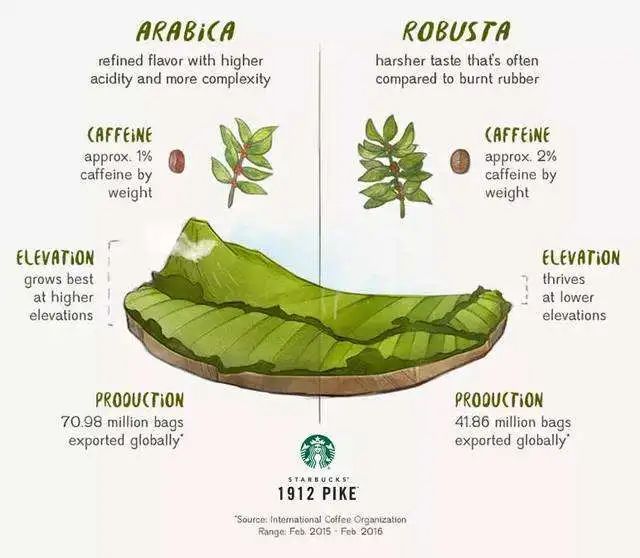
The two most common varieties on the market are Arabica and Robusta, the former being a small-bean species and the latter a medium-bean species. Robusta has 22 chromosomes, while Arabica has 44, that is, 22 pairs. The doubling of chromosome count not only gives Arabica a more outstanding aromatic expression, but also endows it with a layered, uniquely distinctive sweet-and-sour flavor. Therefore, Arabica's taste is overall superior to Robusta's.
To display diverse flavors, Arabica needs to be grown in highlands at 800–2200 meters above sea level where frost does not occur. The higher the altitude, the more pronounced the temperature difference between day and night, and the slower the coffee fruit matures, which favors the accumulation of flavor compounds and fuller aroma development. The microclimates of various coffee-producing regions also provide Arabica with diverse growing conditions, creating unique flavors and mouthfeels. At the same time, the higher the altitude, the more susceptible coffee is to pests and climate effects, usually bearing fewer fruits and maturing more slowly. High-quality Arabica requires more manual management and picking, so production costs are naturally higher.
The bitterness we feel when drinking coffee mainly comes from chlorogenic acid in coffee. Robusta has relatively high contents of caffeine, amino acids, and chlorogenic acid, so it inherently lacks the ethereal aroma unique to Arabica, replaced instead by a fuller, deeper bitterness. Arabica has a lower caffeine content, about 0.9% to 1.2%, and 60% more fat than Robusta. Compared with the strongly flavored Robusta, Arabica is low in caffeine but has twice the sugar of Robusta, so it tastes soft and sweet, with layered acidity and aroma, naturally becoming everyone's first choice for coffee.
As specialty coffee culture continues to spread, people have higher demands for coffee's taste, mouthfeel, and quality, and only high-quality Arabica beans better meet the needs of the current specialty coffee market. Many pour-over single-origin coffees on Front Street's bean list are Arabica varieties, showing that compared with Robusta, people prefer Arabica with its pure flavor.
What are the characteristics of the Arabica variety?
Arabica coffee originated from the Ethiopian Highlands in Ethiopia, Africa. It was initially mainly consumed as medicine, and later people gradually developed the habit of drinking it after roasting. In the sixteenth century, Arabs spread it around the world through trade, and only then did it gradually develop into today's popular beverage. Many specialty coffee beans we know well are Arabica varieties, such as Front Street Jamaica Blue Mountain Coffee, Front Street Panama Geisha Coffee, Front Street Ethiopia Yirgacheffe Coffee, and so on.
Friends who often drink coffee should know that coffee is a tropical plant and needs to be grown in warm places. The main coffee-growing areas are distributed between 25° south latitude and 25° north latitude centered on the equator, an area known as the "Coffee Belt." For example, Brazil and Colombia in Central and South America, Ethiopia and Kenya in Africa, Sumatra in Indonesia and Yunnan in China in Asia... all are high-quality coffee-producing regions located in the Coffee Belt.
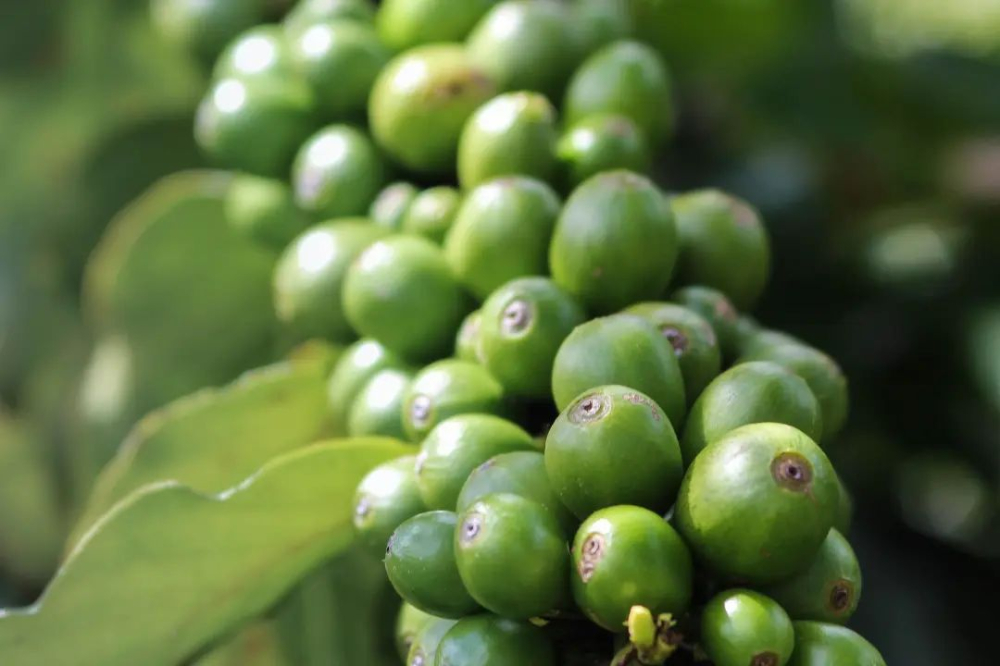
The Arabica species is a relatively large shrub, with oval, dark green leaves and oval fruits, generally containing two slightly flat beans. The beans are round and full, elongated-oval when viewed from the front, with a narrow, curved S-shaped crack in the middle, and the arc on the back of the bean is relatively flat. Next to Front Street's Dongshankou store, two Arabica coffee trees are planted, so when you drink coffee, you might want to take a look.
Arabica coffee bean recommendations
On Front Street's bean shelf there is a cost-effective everyday drinking bean series, carefully selecting 6 excellent classic coffee-producing regions and covering multiple highly representative regions, varieties, and natural processing methods. So-called everyday drinking beans, as the name suggests, are varieties that are burden-free to drink daily, with both price and flavor very accessible. Front Street has selected multiple "representative faces" so that everyone can recognize the basic flavors of major producing regions. These include Ethiopia's Front Street washed Yirgacheffe, Colombia's Front Street Huila, Brazil's Front Street semi-washed Cerrado, Costa Rica's Front Street Tarrazu, Indonesia's Front Street wet-hulled Mandheling, and our China's Front Street Yunnan small bean.
Each everyday drinking bean is suitable for extraction by pour-over, cold brew, French press, and other methods. If you want to taste coffee's most original aroma, Front Street suggests black coffee is best. No matter which extraction method is used, Front Street believes that the freshness of coffee beans is very important. If more than two months have passed since the roast date, the coffee's aroma has very likely already been lost, and even an excellent extraction technique will find it hard to restore the aroma in the cup. To let everyone experience coffee at its best tasting stage, Front Street only ships beans freshly roasted within 5 days, so when you receive them, they are just about ready for you to start brewing.
If you want to use Arabica coffee to make rich, aromatic espresso, Front Street suggests choosing coffee beans blended specifically for espresso. Because espresso is extracted under fine grinding, high water temperature, and high pressure, the concentrated coffee gathers multiple tastes, and various flavor compounds strike our tongue exponentially. If we use light-roasted single-origin coffee beans for extraction, the taste may be too intense and mask the coffee's aroma. As an agricultural product, coffee changes with climate, soil, and so on; even from the same place, each batch of coffee beans will have a somewhat different flavor, while blended coffee beans use the method of making up for each other's shortcomings, ensuring that every time the coffee beans can express a balanced and stable aroma and mouthfeel.
Front Street has a total of 5 espresso blend coffee beans in different styles. To let everyone drink the most complete coffee flavor, all coffee beans sold by Front Street are shipped within 5 days after roasting is completed.
One of the best-selling espresso coffee beans is Front Street Classic Blend Coffee Beans, suitable for beginners, for learning latte art, and for specialty coffee shops pursuing a high-end positioning. Friends who want to learn latte art at home should buy Front Street Classic Blend. This is a medium-dark roast espresso recipe composed of three producing regions. Its design inspiration comes from the "Mamba" popular in ancient times, namely Mandheling and Brazil. To add aroma and crema, Front Street Classic Blend also contains a small amount of Robusta, thereby enhancing flavor intensity, so that beginners can easily make espresso with golden crema at home.
The above content is compiled by CoffeeHunters, a coffee news website.


