








Why Does a Coffee Heart Drift Away From the Center?
Three causes push a latte art pattern off-center: milk foam that is too thin and therefore too fluid, pouring the cup back too quickly so the impact force increases, and choosing an improper landing point for the pour. Centered composition is the usual goal because most patterns are symmetrical and centered placement reinforces that balance.
Correcting the drift starts with texture and timing. Build milk foam that holds its shape, slow the pour as the cup fills, and set the drop point so the pattern opens in the middle rather than near the rim. The base espresso also matters, since fine, smooth crema helps the pattern sit where it is placed.
In coffee latte art, whether the pattern looks beautiful depends not only on the shape outlined by the milk foam, but composition also plays a key role. Centered composition has become the most commonly used method because it highlights the stability and balance of symmetrical patterns. However, Front Street Coffee has found that many beginners often encounter the problem of the pattern deviating from the center of the cup when doing latte art. There are three main reasons for this phenomenon: milk foam that is too thin leads to excessively high fluidity, pouring back the cup too quickly increases the impact force, and choosing an improper landing point. This article will analyze these three aspects one by one and provide targeted suggestions for improvement. It will also mention that to make beautiful latte art, choosing the right coffee beans and obtaining an espresso with fine, smooth, and rich crema is an important prerequisite. Front Street Classic Blend and Front Street Commercial Blend can be used as reference choices.
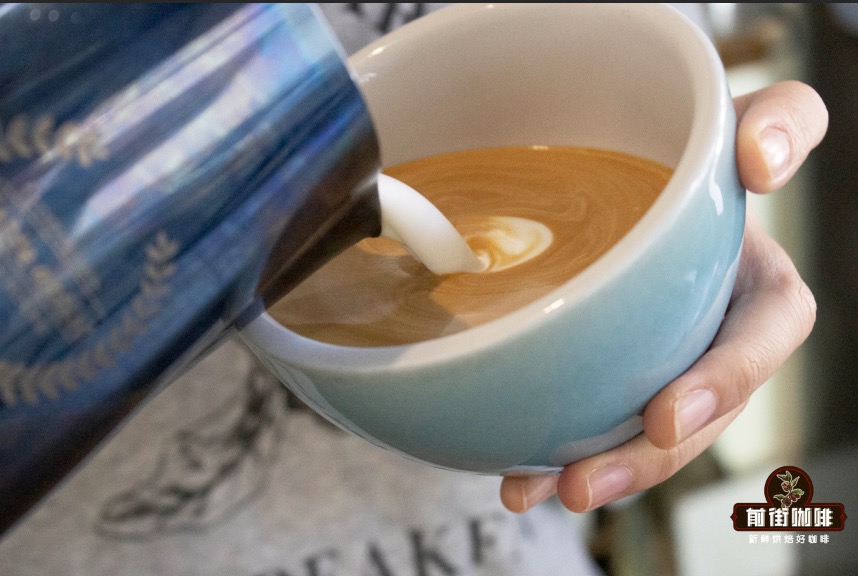
In the art of coffee latte art, whether a pattern is pleasing to the eye depends not only on whether the "form" depicted with milk foam is in place, but composition is also very important. Reasonable composition can guide the line of sight to focus on the pattern itself, thereby better showcasing the beauty of the pattern. Therefore, in actual practice, we not only need to complete the outlining of the pattern, but also "place" it in an appropriate position.
Among the many latte art compositions, centered composition is the most common, which means placing the pattern in the very center of the cup. Most patterns themselves are symmetrical, and placing them in the center can strengthen this symmetrical effect and bring a stable, balanced visual experience. Therefore, when facing simple and symmetrical figures, we usually arrange them in the exact center of the cup.
But Front Street Coffee has noticed that many beginners often encounter a problem during latte art: the final pattern position always deviates from the center. What exactly causes this? There are mainly the following three situations.
It must be admitted that to make beautiful latte art, the prerequisite is to have an ideal espresso, so the choice of coffee beans is crucial. Front Street Coffee believes that an espresso with fine, smooth, and rich crema is the best standard. Two popular products, Front Street Classic Blend and Front Street Commercial Blend, can be chosen. The former combines the wild character of Brazil and Mandheling, while the latter is rich in various nutty aromas, and both include a small amount of Robusta to enhance the richness of the crema and its golden color.

1. Milk foam is too thin
Before learning latte art, everyone must first master the skill of steaming milk foam, because for latte art, the quality and thickness of the milk foam directly affect the difficulty of creating the design. This is something Front Street Coffee often emphasizes.
There is no need to say much about quality; the key lies in the thickness of the milk foam. It determines the fluidity of the milk foam during latte art: the thicker the milk foam, the lower the fluidity; the thinner the milk foam, the higher the fluidity.
When the milk foam is too thin, its higher fluidity makes the pattern more likely to deviate from the target position during the design process. Because the fluidity is too strong, if the flow is slightly larger, the pattern is easily pushed outside the target area. This also explains why many cafés do not make latte art for flat whites - the milk foam in a flat white is too thin, and if latte art is attempted, it is a huge test of the barista's design skills.
This situation is also relatively easy to judge: if during latte art you see the pattern being washed out, or "sawtooth lines" appear, then it is most likely caused by milk foam that is too thin. The solution is simple: next time you steam milk foam, appropriately extend the steaming time.

2. Returning the cup too quickly
If asked which step is the most difficult for beginners during latte art, Front Street Coffee believes it is none other than the cup-returning motion. The so-called cup-returning means continuously adjusting the angle of the cup during latte art according to the design stages, with the cup body gradually changing from tilted to upright, hence it is called "returning the cup."
Its difficulty lies in the fact that it must be done simultaneously with latte art, and it is hard for people to "do two things at once," so repeated practice is needed to form muscle memory. Many friends, in the beginner stage, because they are not yet used to it, will return the cup too quickly.
Returning the cup too quickly increases the impact force when the milk foam is poured, and the pattern that has already formed will be directly pushed out of the target position by this force. If you find that the pattern keeps deviating from the center as the cup is returned, Front Street Coffee suggests strengthening practice of the cup-returning motion.
3. The landing point is incorrect
The last reason causing the pattern not to be centered is that the landing point is incorrect. Different patterns have different landing points, because the design steps differ, so the landing point positions naturally also differ. For example, the landing point for a heart-shaped latte art is slightly above the center of the cup, while the landing point for a leaf is below the center of the cup.

If the landing point is mistaken during latte art, the final pattern will deviate from the center and appear below or above the center, thereby affecting its beauty. Therefore, the landing point position in latte art is also an aspect that needs special attention.
The above content is compiled by CoffeeHunters, a coffee news website.


