







How Do Kochere and Other Ethiopian Arabica Regions Differ?
Kochere is a sub-region of Yirgacheffe in Ethiopia's Gedeo zone, alongside Wenago and Gelena Abaya. In November 2009 Ethiopia revised its trading and grading system and added these three areas to the Yirgacheffe classification, because their cup profiles sit very close to Yirgacheffe itself. Washed Kochere lots typically show honey and citrus notes with a black tea finish.
Ethiopia is the birthplace of Coffea arabica, and its southern regions — Yirgacheffe, Sidama, Guji and Anasora — each carry distinct character. Kochere beans come from smallholders farming roughly one hectare each at about 1,800 to 2,000 meters. Medium-light roasting is often used to keep the bright acidity and tea-like finish intact.
Ethiopia, as the birthplace of Arabica coffee, has nurtured many well-known coffee-producing regions. Regions such as Yirgacheffe, Sidama, Guji, and Anasora each have their own characteristics, among which Yirgacheffe occupies an important position in the specialty coffee market with its unique flavor. Kochere, as a sub-region of Yirgacheffe, is also famous for its washed processing, showing complex notes of honey and citrus. Front Street Coffee selects Kochere washed beans and presents their bright acidity and black tea finish through a medium-light roast. This article will deeply analyze the regional divisions of Ethiopian coffee, focus on the relationship between Kochere and Yirgacheffe, and share the roasting and brewing details of Front Street Kochere coffee beans, providing a professional reference for coffee lovers.
The birthplace of Arabica coffee is Ethiopia, and this land has created a remarkable coffee legend. Walking into a Front Street store and browsing the coffee beans on the menu, you will find a dazzling array of beans from major well-known Ethiopian regions—Yirgacheffe, Sidama, Guji, Anasora, and many more. So some customers wonder: among the many regions in Ethiopia, which one best represents the country's coffee flavor?
Front Street's answer is: Yirgacheffe is fully deserving of this. Yirgacheffe is located in the Gedeo region of southern Ethiopia. Because its coffee has a unique flavor, a distinctive style, and is widely favored, it stands out in product classification and has always held a place in the global specialty coffee field. Yirgacheffe itself is a small town in Sidama Province, and around it there are also three small regions: Wenago, Kochere, and Gelena Abaya. Because the coffee produced in these areas is almost on par with Yirgacheffe in flavor, Kochere is also included in the Yirgacheffe regional classification. In November 2009, Ethiopia implemented a new trading and grading system. In addition to Yirgacheffe, three sub-regions—Wenago, Kochere, and Genlena Abaya—were added, showing that the flavors of these regions are extremely delicate and worthy of further subdivision.
The coffee beans from the Kochere region come from many local smallholder farmers and are gathered from multiple harvest lots. These smallholders cultivate an average area of about 1 hectare (15 mu), at an altitude of about 1,800 to 2,000 meters. This region has relatively advanced washed processing equipment, so it has always performed excellently in the washed field. The coffee beans show complex notes interwoven with honey and citrus, clean and sweet, and are highly praised. The main local production model is: smallholder farmers send the red cherries from each harvest directly to the nearby cooperative's washed processing station for unified processing.
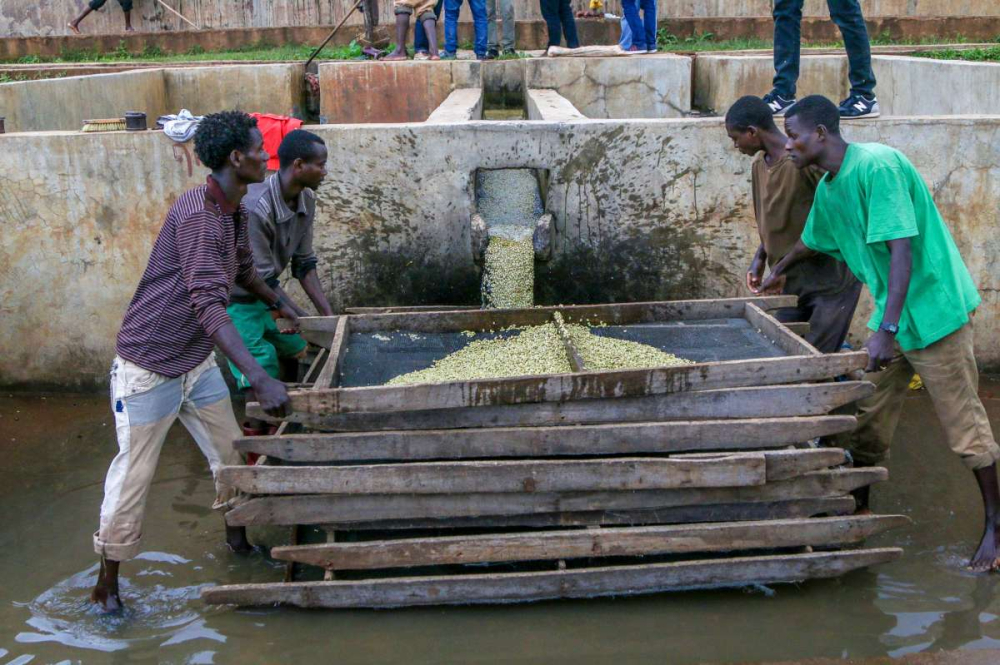
The Kochere coffee beans selected by Front Street also use washed processing. The washed method removes the skin, pulp, and mucilage through washing and soaking (fermentation). Farms using this method must build washing channels and be able to continuously introduce fresh water.
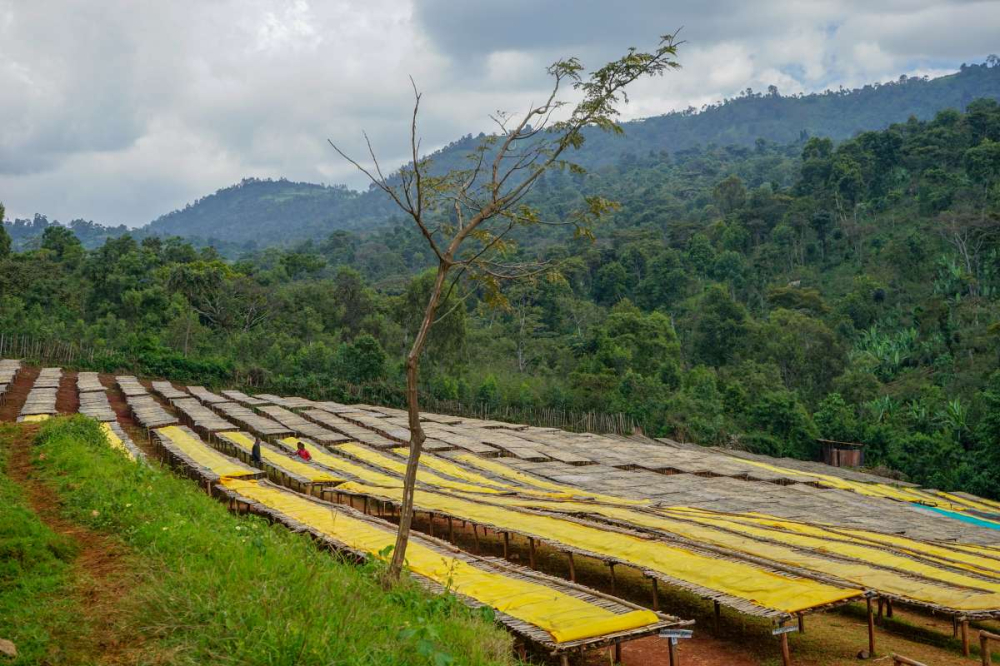
During processing, the fermented beans are placed in the channel and pushed back and forth. With the friction between the beans and the force of the water flow, the coffee beans are washed until smooth and clean. After washing, the coffee beans are still wrapped in the parchment layer, with a moisture content of about 50%, and must be dried to reduce the moisture content to 12%; otherwise, fermentation will continue, leading to mildew and spoilage. The ideal drying method is sun drying. Although it takes 1 to 3 weeks, the flavor is outstanding and it is very popular.
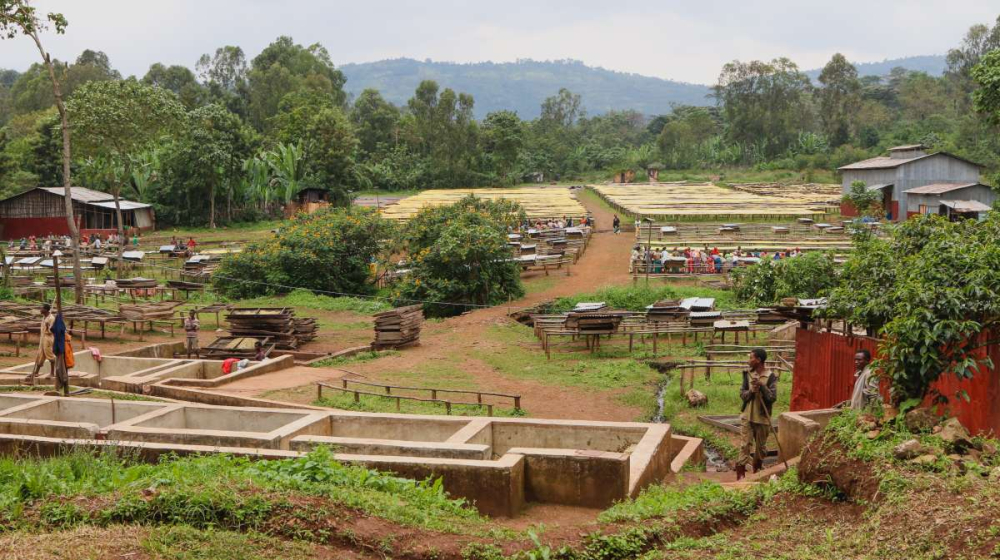
After the washed processing station screens out the red cherry-colored coffee fruits, they are directly depulped and washed and fermented. After washing, the parchment green beans are placed on raised beds to dry naturally in the sun. When the humidity drops below 12%, they are sent directly to the Ethiopian Commodity Exchange (ECX) warehouse in Awassa. Cup grading and quantity statistics are carried out here. Usually, washed beans are stored in parchment form until hulling is carried out before export.
In the early years, traditionally sun-dried coffee beans had a relatively high defect rate, but after the introduction of washed technology, the defect rate of coffee beans decreased and quality improved. The new washed processing adopted in the Kochere region has significantly improved the quality of coffee beans in the area and has also attracted many coffee hunters to come and purchase.
FrontStreet Coffee Ethiopia Kochere Coffee Beans
Region: Yirgacheffe Kochere Region
Altitude: 1,650 meters to 1,800 meters
Processing Method: Washed Processing
Grade: G1
Variety: Local Heirloom
Roast Level: Medium-Light Roast
FrontStreet Coffee Roast Analysis Roaster: Yangjia 600g, semi-direct fire
The light roast makes the fruity aroma of Yirgacheffe, which grows in the tropics, more prominent and richer. On the palate, there is a slight acidity, like the tart aroma of apples. This acidity instead brings out the coffee's body, and the bitterness also becomes full of aroma, leaving a lingering aftertaste. Coffee is originally a fruit, and after high-temperature roasting it can still retain the sweet and sour fruitiness. This is precisely the characteristic of Yirgacheffe. Using a fast-roast profile, charge when the drum temperature rises to 200°C, set the airflow to 3, and after 1 minute adjust the heat to 160 degrees with the airflow unchanged. Roast until 4 minutes 50 seconds, at 150 degrees, when the bean surface turns yellow, the grassy smell disappears, and dehydration is complete. Adjust the heat to 130 degrees and open the airflow to 4;
At the 8th minute, wrinkles and dark patches appear on the bean surface, and the toast aroma clearly turns into coffee aroma, which can be regarded as the prelude to first crack. At this time, listen clearly for the sound of first crack. At 8 minutes 20 seconds, first crack begins. Reduce the heat to 70 degrees and fully open the airflow (adjusting the heat requires great care, and it must not be so low that there is no cracking sound). Drop at 192 degrees.
FrontStreet Coffee Cupping Record
Front Street conducts cupping 8-12 hours after the coffee beans are roasted. The flavor performance of Kochere coffee beans is orange blossom, lemon, black tea, and fruity sweet acidity.
FrontStreet Coffee Brewing Suggestions
Front Street believes that the freshness of coffee beans has a major impact on flavor performance. Generally, the best tasting period for coffee is from the 4th day to the 40th day after roasting. If you want to taste more flavors, Front Street recommends buying freshly roasted coffee beans and grinding and brewing them fresh. Front Street's coffee beans are all roasted and shipped fresh. In the case of express delivery, Front Street will send beans roasted within 5 days, so that when they arrive in the customer's hands, the resting period has just passed and they can be drunk immediately.
Kochere Coffee Bean Brewing Parameters
Dripper: V60 dripper
Dose: 15 grams of coffee
Water temperature: 91 degrees
Grind size: medium-fine grind for pour-over (80% passing through a No. 20 sieve) Water-to-coffee ratio close to 1:15
Pouring scheme: three-stage
First stage: 30 ml of water for a 30-second bloom;
Second stage: pour with a small stream in a central circular motion to 125 ml;
Third stage: after the water level drops to half, pour to 225 ml;
Total time is 2 minutes.
Pour-over flavor description: the acidity of washed processing is brighter, like citric acid, the mouthfeel is more fragrant and clear, the citrus aroma is more obvious, and the finish has a black tea tea-like sensation.
The above content is compiled by CoffeeHunters, a coffee news website.


