







Is Catimor really an arabica variety?
Yes, Catimor is an arabica variety, but it carries roughly 25 percent Robusta lineage, which shapes what ends up in the cup. Yunnan coffee has grown quickly in the specialty market, with Luckin, Manner, Blue Bottle, and Seesaw all releasing single-origin products, yet the region still lacks a clearly defined flavor profile the way Yirgacheffe has one.
The reason often cited is Catimor itself, which shows a less clean flavor and weaker layering, with modest aroma, heavier bitterness, and a tendency toward astringency. Its yield far exceeds Typica, but quality stays limited. Since 2013, growers in Lincang have planted Typica and some Bourbon, testing whether variety choice at the source can lift Yunnan specialty coffee.
Yunnan coffee has risen rapidly in the domestic specialty coffee market in recent years, with brands such as Luckin, Manner, Blue Bottle, and Seesaw launching Yunnan single-origin products, sparking widespread attention. However, the flavor of the Yunnan growing region has never been clearly defined like Yirgacheffe. Front Street Coffee believes this is closely related to the fact that the Catimor variety widely planted in Yunnan inherently lacks a clean flavor and clear layering. Catimor carries 25% Robusta lineage, with insufficiently rich aroma, a heavier bitterness, and a tendency toward astringency. Although its yield far exceeds Typica, its quality is limited. Since 2013, Front Street Coffee has been growing Typica and a small amount of Bourbon in Lincang, Yunnan, attempting to explore more possibilities for Yunnan specialty coffee from the source of the variety. This article will clarify the relationship between Catimor and Arabica, and introduce the flavor performance and brewing suggestions of Front Street Yunnan Typica and Catimor everyday beans.
For more specialty coffee knowledge, please follow the WeChat official account: Front Street Coffee (FrontStreet Coffee)
In recent years, Yunnan coffee's visibility in the specialty coffee field has climbed rapidly, leaping from past obscurity to becoming an industry focus. Well-known brands such as Luckin, Manner, Blue Bottle, and Seesaw have successively added Yunnan beans to their product lines. Each time related products are launched, they stir up discussion and purchasing enthusiasm among coffee lovers, and the price of Yunnan coffee beans has risen accordingly.
The reason Yunnan coffee has gained collective attention in recent years is partly due to consumers' support for domestic products under the guochao trend, and partly because coffee companies have increased investment in the Yunnan growing region, enabling local coffee farmers to obtain more scientific cultivation techniques, with both yield and quality improving simultaneously. At the same time, advances in processing methods have also given Yunnan beans more distinctive flavor expressions, thereby attracting the attention of the younger generation of consumers.
Although Yunnan coffee is receiving increasing attention, its regional flavor has never been clearly defined. When the concept of specialty coffee was first proposed, it referred to coffee beans that can demonstrate a unique regional flavor under specific climatic and geographical conditions. The so-called regional flavor refers to the signature taste produced by a coffee variety under a specific environment that is enough to let people identify its place of origin. For example, when drinking coffee with bright acidity, people naturally think of Yirgacheffe. However, Yunnan's regional flavor has still not been clearly established.
Front Street Coffee (FrontStreet Coffee) believes that an important reason for this situation is that the Catimor variety mainly grown in Yunnan inherently lacks a clean flavor and clear layering. In addition, the large number of Yunnan beans on the market using special processing methods leaves consumers' impression of Yunnan coffee mostly停留在 those colorful and unique flavors, while their memory of the variety's own flavor is not deep. If consumers are to form a long-term understanding of Yunnan coffee, variety selection is particularly crucial.
For this reason, Front Street Coffee (FrontStreet Coffee) began in 2013 to mainly grow Typica coffee and a small amount of Bourbon in Lincang, Yunnan. There are two reasons for choosing Typica: first, it is one of the oldest coffee varieties, with pure Arabica genetics, and is recognized as a specialty coffee variety for its elegant, clean flavor; second, the earliest coffee trees planted in Yunnan were precisely Typica, introduced by French missionaries.
Yunnan once planted Typica coffee trees on a large scale to repay debts to the Soviet Union, but after the debt repayment ended, domestic coffee consumption demand was extremely low, and many farmers cut down coffee trees and switched to other cash crops. It was not until the 1990s, when Nestlé took a fancy to Yunnan's natural conditions and distributed the Catimor variety with stronger resistance to leaf rust, that people began planting coffee again and supplied raw materials to Nestlé for a long time. However, Catimor contains Robusta genes, and its flavor performance is unsatisfactory. It does not taste good when drunk directly, so the public's impression of Yunnan coffee remained at the level of instant coffee for a long time.
Catimor is not of pure Arabica lineage. It is a hybrid of the Timor variety (which belongs to Robusta) and Caturra (a variant of Bourbon), and therefore carries about 25% Robusta genes. This lineage determines its flavor defects: the aroma is not rich enough, the overall bitterness is relatively heavy, and it is prone to astringency and a rather pungent musty taste. But Catimor's yield is several times that of Typica, so Yunnan has planted this variety in large quantities for many years without paying much attention to quality, mainly supplying Nestlé with raw materials.
Therefore, when Yunnan coffee using conventional processing methods is tasted directly, both the flavor and mouthfeel are difficult to satisfy, and Yunnan coffee thus did not receive attention for a long time. It was not until recent years, as special processing techniques gradually matured, that people began applying them to Yunnan Catimor coffee beans. By masking undesirable flavors through external intervention, consumers slowly came to accept Yunnan coffee.
Then why not simply switch to growing Typica? Because a coffee tree needs at least 4 years from planting to having commercial value, and the time and labor costs invested during this period are extremely high, so processing methods can only be used to improve the flavor. But this approach may be a guide that leads further and further astray.
Catimor and Typica are not originally contradictory: one is a raw material, the other is specialty coffee. The meaning of specialty coffee lies in improving quality, while the meaning of raw materials lies in increasing yield. It is inevitable that Yunnan is mainly based on Catimor. But conflating the two seems on the surface to solve the problem of Yunnan coffee's way out; in reality, the coffee is still the same coffee, the variety and altitude have not changed, and merely emphasizing post-processing methods to claim that quality is improving is somewhat far-fetched.
Using the excuse of solving the way out for the current two million mu of coffee planting area, guiding people to emphasize processing methods after coffee cherries are picked and then labeling it as good coffee is too simplistic and rough. Those who elevate this evaluation may not truly understand Yunnan coffee. From the perspective of growers, encouraging and supporting adherence to the basic rules of specialty coffee starting from variety and altitude may be another attempt at the healthy and sustainable development of the Yunnan growing region. It is difficult for an entire growing region to become specialty coffee, but it must exist. When the washed method tastes good and can present the main flavor every year, that is the true beginning of Yunnan specialty coffee.
So Front Street Coffee (FrontStreet Coffee) chose from the very beginning to build its own estate and grow the Typica coffee variety. Although until 2022, the output of Front Street Yunnan Typica coffee beans was not large, only more than 600 kilograms, available for sale in the Front Street Coffee (FrontStreet Coffee) Taobao store and for production at Front Street Coffee (FrontStreet Coffee) physical stores, only by personally experiencing the entire process can one know where the shortcomings are and continuously improve and upgrade. Also precisely because a change was made in the variety, although "Front Street 2013 Yunnan Typica Coffee Beans" uses traditional sun-drying processing, its flavor performance is very full and enticing, with notes of plum, berries, brown sugar, black tea, and nuts.
In addition to Front Street Yunnan sun-dried Typica, Front Street Coffee (FrontStreet Coffee) also has a Catimor coffee bean from the Baoshan growing region in Yunnan. As a member of Front Street Coffee's (FrontStreet Coffee) signature everyday bean series, this Yunnan small-bean coffee allows everyone to taste the flavor of the Yunnan growing region at the highest cost-performance ratio. This series also covers representative coffee beans from six major coffee growing regions: Ethiopia, Colombia, Costa Rica, Guatemala, Brazil, and Indonesia. If coffee novices or beginners do not know what coffee beans to buy, they can first try Front Street Coffee (FrontStreet Coffee) everyday beans to clarify their preferences for coffee taste.
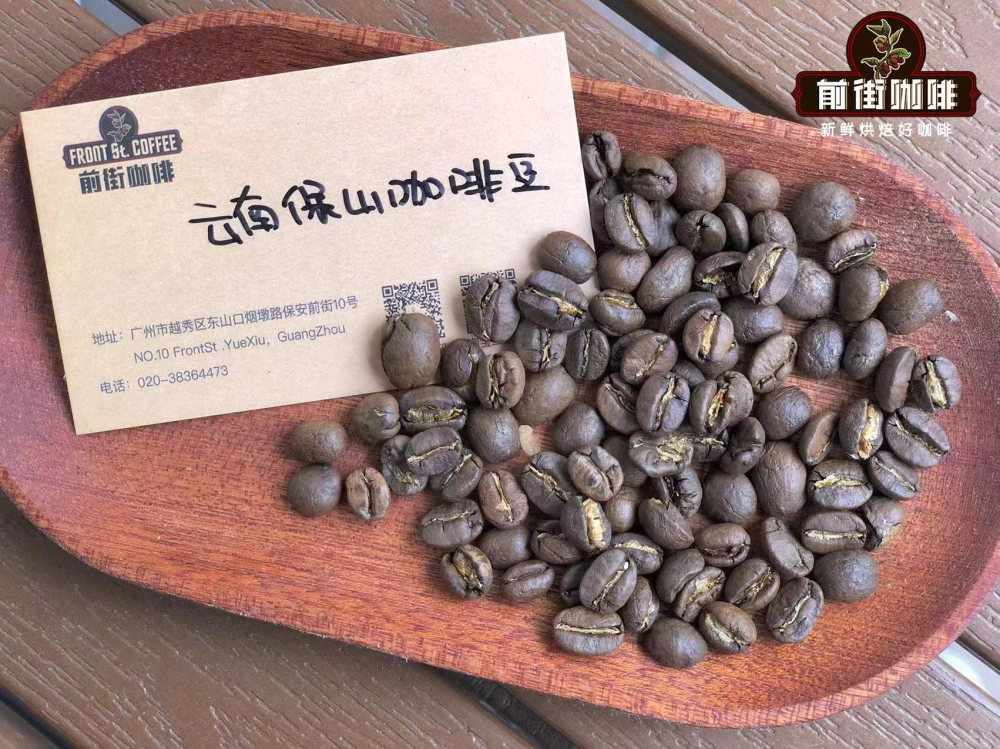
All coffee beans sold by Front Street Coffee (FrontStreet Coffee) are shipped within five days after the roast date. Only freshly roasted coffee beans can show their most beautiful flavor. In order to preserve the sweet-and-sour sensation and tea-like quality of Yunnan coffee, Front Street Coffee (FrontStreet Coffee) uses a medium roast. For brewing, it is recommended to use a V60 dripper, with a coffee-to-water ratio of 1:15, medium grinding (about the size of coarse granulated sugar, 75% passing through a Chinese No. 20 standard sieve), and a water temperature of 88-89 degrees.
Specific brewing method: first pour 30g of water and bloom for 30 seconds; in the second stage, pour in a circular motion with a small stream of water up to 125g, and after the water level in the coffee bed drops by half, pour again, continuing to pour in a circular motion with a small stream of water up to 225g. After all dripping is complete, the total extraction time is about 2 minutes and 10 seconds.
The above content is compiled by CoffeeHunters, a coffee news website.


