







How does Rainforest Alliance certified coffee relate to Blue Mountain?
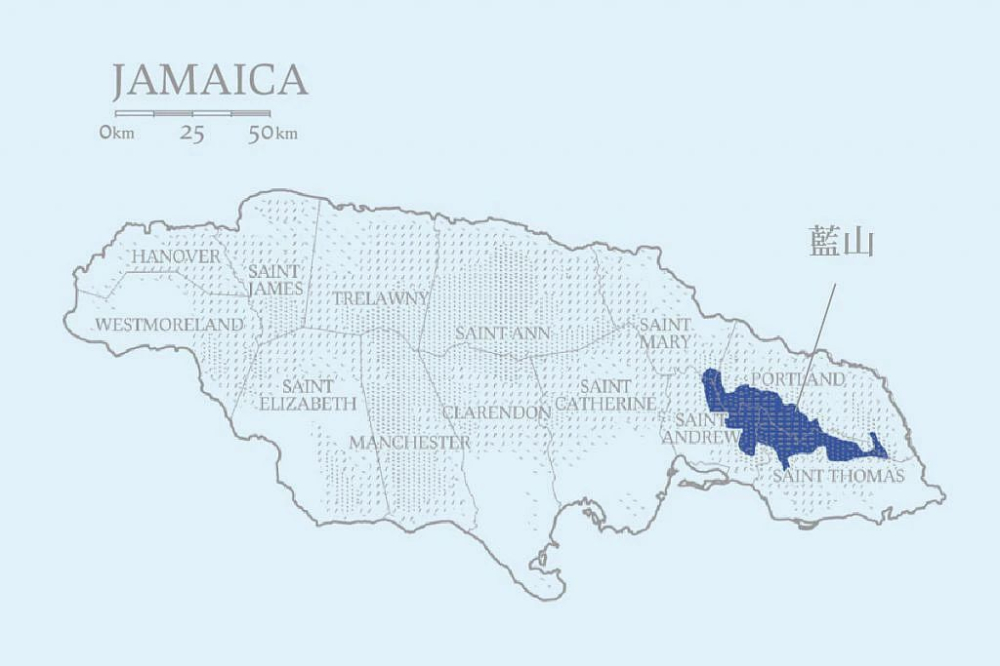
Jamaican Blue Mountain coffee is graded by the Jamaica Coffee Industry Board, which allows only Arabica grown between 910 and 1,700 meters to carry the Blue Mountain name. Lower elevations fall under Jamaica High Mountain or Jamaica Prime. The four producing regions are St. Mary, St. Thomas, St. Andrew, and Portland, where volcanic ash soils and misty high altitudes support the balanced, gentle cup.
Rainforest Alliance certified coffee and Rainforest Alliance coffee beans reflect farm-level environmental and social standards; Blue Mountain's Clifton Estate-style environmental philosophy follows a similar idea, and Jamaica was an early adopter of the taste-of-place concept. With Caribbean rainfall, good drainage, and banana intercropping, trees need little irrigation or fertilizer, and Blue Mountain No. 1 pour-over parameters bring out its intertwined acidity, sweetness, and bitterness.
Jamaican Blue Mountain coffee is renowned worldwide for its balanced and elegant flavor, but Blue Mountain coffee beans that truly meet CIB standards are scarce in production and strictly graded. This article will guide you through the four major Blue Mountain producing regions, the green bean grading standards, Clifton Estate's environmental philosophy, and the Blue Mountain No. 1 pour-over parameters and flavor profile recommended by Front Street Coffee. From bean selection to brewing details, this will help you fully master the tasting points of this legendary coffee and experience the classic Blue Mountain charm where acidity, sweetness, bitterness, and sweetness intertwine.
Jamaican Blue Mountain No. 1 coffee beans are truly the nation's treasure, and it is this very bean that has made Blue Mountain flavor famous worldwide. This bean has a full and rich aroma, with acidity, sweetness, bitterness, and sweetness interwoven just right, smooth and gentle on the palate with a full-bodied richness.
As the name suggests, Blue Mountain coffee is produced in Jamaica's Blue Mountain range. However, not all coffee trees in the Blue Mountain region produce beans that meet the standards of premium Blue Mountain coffee. The Jamaica Coffee Industry Board (CIB) has established strict production regulations: only Arabica coffee grown at altitudes between 910 and 1,700 meters qualifies to be called "Jamaican Blue Mountain Coffee"; coffee produced at lower altitudes is classified as Jamaica High Mountain Coffee and Jamaica Prime Coffee. Blue Mountain coffee has four major producing regions: St. Mary, St. Thomas, St. Andrew, and Portland.
The Blue Mountains are surrounded by the Caribbean Sea, exhibiting characteristics of an island tropical rainforest climate. Rainfall is concentrated in the rainy season, but drainage conditions are excellent; volcanic ash left by active volcanoes enriches the soil with nutrients, so coffee trees need almost no additional irrigation or fertilization. The high-altitude growing areas are shrouded in mist year-round and are cool and pleasant, very suitable for various crops. Local farmers often plant coffee trees alongside banana trees on the slopes of the Blue Mountains.
Compared with other coffee-producing regions, Jamaica was the first country to pay attention to coffee's "taste of place." When evaluating the quality of Blue Mountain green beans, quite diverse dimensions are considered: bean size, defect ratio, color, uniformity, and post-roast cupping performance—covering dry aroma, wet aroma, acidity, flavor, body, cleanliness, and more.
Based on the above standards, Blue Mountain coffee is divided into four grades, from highest to lowest: Blue Mountain No. 1, Blue Mountain No. 2, Blue Mountain No. 3, and Blue Mountain Peaberry. Top-grade Blue Mountain No. 1 green beans must reach a screen size of 17 or above, with a defect rate controlled below 3%, a moisture content of about 13%, and in cupping they must display rich aroma, a smooth and balanced mouthfeel, low acidity, and a lasting sweet aftertaste.
In the 1950s, the Jamaican government officially approved the establishment of the CIB and established detailed coffee export grading rules, with strict requirements for the size, color, defects, and taste of exported green beans. Among them, Jamaican Blue Mountain coffee beans must meet a screen size of 17 or above, with defective beans not exceeding 2%, moisture content of about 10% to 12.5%, and possess just the right acidity, sweetness, bitterness, body, and aroma. It is not hard to imagine that such exquisitely flavored premium coffee beans are extremely limited in quantity. Front Street Coffee's daily bean list has long kept this Blue Mountain No. 1 coffee bean for customers who love the classic Blue Mountain flavor. Front Street's Blue Mountain No. 1 comes from Jamaica's historic Clifton Estate.
Clifton Estate is one of the estates certified by the Rainforest Alliance. Its entire coffee production process upholds the environmental philosophy of sustainable development, minimizing all kinds of pollution, and the processing plant's water is also recycled. When Front Street Coffee receives Blue Mountain green beans, the green Rainforest Water Frog logo is printed on the outside of the wooden barrel. When you visit Front Street's store for coffee, you can spot this unique Blue Mountain wooden barrel with a little attention.
We have already mentioned how precious Blue Mountain No. 1 coffee beans are, so the brewing process naturally cannot be careless. First, the coffee beans used for brewing should preferably be freshly roasted. Front Street Coffee has always believed that the freshness of coffee beans has an extremely critical impact on aroma and flavor. A bag of coffee enters its optimal tasting period on days 4 to 7 after roasting. Once the tasting period passes its peak, aromatic compounds will accelerate their loss over time. Therefore, even if coffee beans past their tasting period are precious, they may no longer possess a full and delicate flavor. Front Street Coffee hopes every customer can drink coffee with aroma at its best, so all shipped beans are freshly roasted within 5 days, and when you receive them, they are just right for brewing.
If you are tasting Blue Mountain No. 1 coffee for the first time, Front Street Coffee recommends starting with a hot pour-over, which allows you to taste the classic Blue Mountain flavor and experience the layers the coffee reveals as the temperature changes. The key to pour-over lies in controlling all the parameters; a little carelessness can easily result in brewing Blue Mountain coffee with only bitterness. Below, Front Street Coffee will discuss the brewing approach.
Blue Mountain coffee is roasted to a medium-dark level, so the beans are relatively loose in texture and absorb water more readily, which is why a coarser grind is chosen here. Likewise, to avoid excessive bitterness from too-high water temperature causing over-extraction, it is best to brew with a slightly lower water temperature.
In addition, the body of Blue Mountain coffee is also quite important. The baristas at Front Street Coffee (FrontStreet Coffee) are accustomed to using the KONO dripper to extract coffee with high body. KONO's dripper design features a smooth curved upper section paired with regular guiding ribs in the lower section. The filter paper fits tightly so that steam cannot "travel upward" and can only flow out through the large holes, thereby extending the soaking time between coffee grounds and hot water, creating an effect similar to bloom extraction and making the coffee richer. Besides Blue Mountain, Brazil Queen Estate coffee and Indonesian Golden Mandheling coffee are also suitable.
Blue Mountain No. 1 coffee brewing parameters:
Grind: medium-coarse grind with 75% passing through a No. 20 standard sieve
Water temperature: 87–88°C
Coffee grounds: 15 grams for 1–2 servings
Coffee-to-water ratio 1:15
Three-stage extraction.
Front Street Coffee first wets the KONO dripper with a small amount of hot water, aligns and places the filter paper, then fully wets the filter paper so it adheres better to the dripper. After pouring out the water in the sharing pot, add 15g of coffee grounds, bloom with 30g of water for 30 seconds, then pour in a small stream in circles from the center, starting分段 at 125g; when the coffee bed drops to the halfway point of the dripper, pour the second stage in the same manner until 225g, and once all dripping is complete, remove the dripper.
The aroma of Blue Mountain No. 1 coffee can already be smelled from the grinding stage as a very full chocolate biscuit note. On the palate, there is the sweetness of roasted nuts, chocolate, and caramel, with soft and delicate acidity, all flavors balanced together, smooth and rich in mouthfeel, presenting a very typical Blue Mountain flavor.
For professional coffee knowledge exchange and more coffee bean information, please follow Coffee Workshop (WeChat public account: cafe_style)
For more specialty coffee beans, please add the private WeChat of Front Street Coffee (FrontStreet Coffee), WeChat ID: qjcoffeex
The above content is compiled by CoffeeHunters, a coffee news website.


