







How Should You Roast and Brew Yirgacheffe Gedeb Gotiti?
Yirgacheffe Gedeb Gotiti comes from the Gedeb district in southern Ethiopia, where smallholders deliver cherries to the Gotiti cooperative. The washed process used for most lots removes fruit quickly, which keeps the cup clean and tea-like. Learning how to process coffee beans this way helps explain the bright jasmine, bergamot, and stone fruit notes that show up in the final roast.
For roasting, aim for a light to medium profile. First crack usually arrives around nine to ten minutes, and dropping shortly after preserves florals while adding body. Over-roasting flattens the aroma. For pour-over, use a medium-fine grind, water at 92 to 93 degrees Celsius, and a 1:16 ratio. Bloom for forty seconds, then pour in three stages. The result is a delicate, aromatic cup.
Yirgacheffe is known for its citrus, lemon, and berry-like sweet-tart acidity and rich floral aroma, and it is often given a medium-light roast and brewed as pour-over. This article focuses on Front Street Coffee's Yirgacheffe Gedeb Gotiti Cooperative coffee beans, outlining the producing region background, washed processing flow, and green bean information, and providing complete pour-over parameters and a three-pour pouring procedure to help coffee lovers understand how variables such as grind size, water temperature, and coffee-to-water ratio affect flavor, and to build a reusable brewing framework.
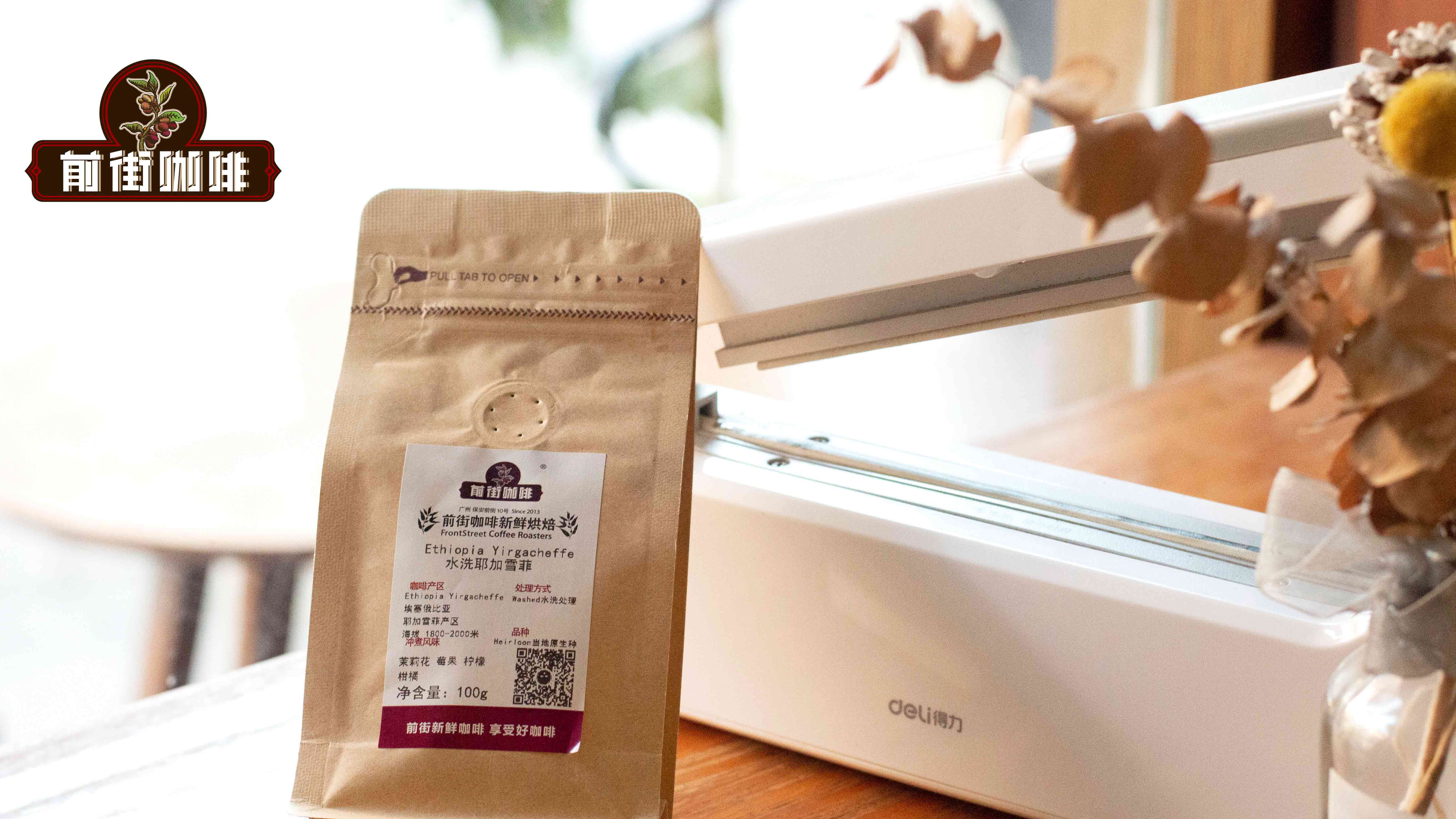
The key reason Yirgacheffe is often processed as a medium-light roast and served as a pour-over single origin is that it has a sweet-tart profile woven from citrus, lemon, and berries, with a rich floral aroma and a pleasant tea-like quality. Anyone who has tasted Front Street Coffee's Yirgacheffe knows that this bean's flavor is clear and bright, clean on the palate, with the crisp lemon-citrus note and a faint floral aroma spreading across the taste buds, and all of this is inseparable from its processing method.
Within the Yirgacheffe producing area there are more than forty cooperatives, and coffee cultivation is mostly family-run. This producing area is further divided into many well-known micro-regions, such as Kochere, Misty Valley, and Gedeb, each with outstanding cooperatives whose Front Street Coffee Yirgacheffe coffee beans have their own detailed character. Among them, Front Street Coffee's Gotiti Cooperative is especially favored by coffee lovers who prefer floral and fruity notes.
Gotiti Cooperative Banko Gotiti
The Gotiti Cooperative is located in the Worka producing area at the southeastern end of Yirgacheffe, and was originally only part of the Worka Cooperative under the Yirgacheffe Coffee Farmers Cooperative Union (YCFCU). As the coffee industry placed increasing importance on green bean traceability, the concept of single producing areas was gradually uncovered by coffee hunters around the world.
In 2012, Gotiti, with about 300 farmer members, formally separated from the original organization and became an independent Gotiti Cooperative. Gotiti Village is one of the earliest village areas to be independently established, and many smallholder farmers were originally members of the Worka Cooperative, so their coffee cultivation techniques are naturally very solid. The Gotiti Cooperative has long been known as the last pure land of Yirgacheffe, and its green bean processing methods are quite traditional, mainly washed and natural.
Yirgacheffe Processing Methods
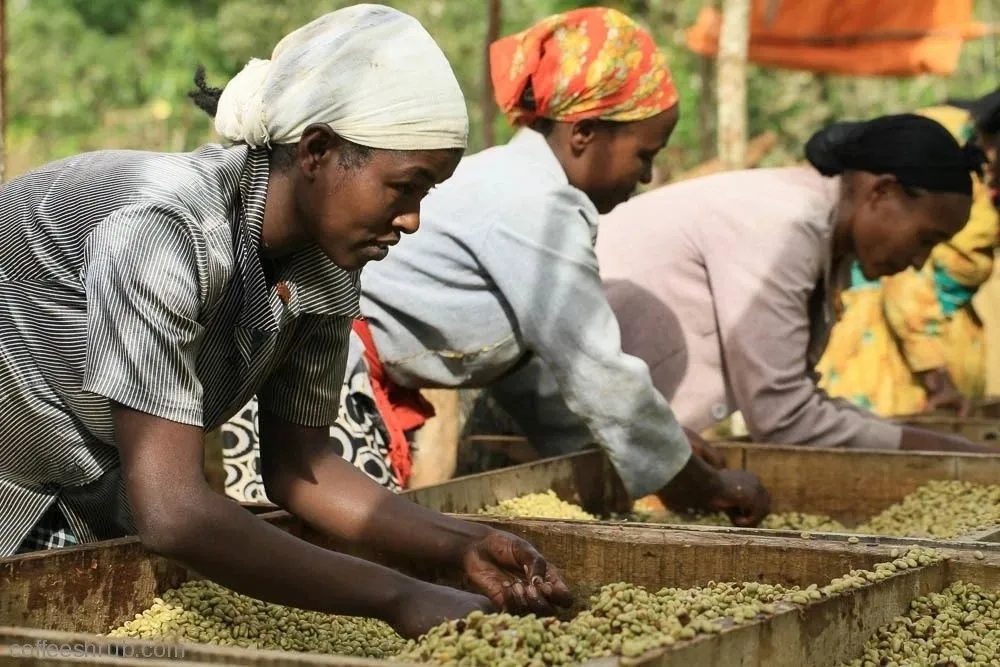
Front Street Coffee's Yirgacheffe Gotiti Cooperative coffee beans use the washed processing method. Specifically, the skin and pulp of the cherries are first removed with a depulper, and then the beans are left to rest in fermentation tanks for 18 to 36 hours so that the mucilage layer naturally breaks down, with the duration adjusted flexibly according to local temperature and humidity. After that, the parchment beans are scrubbed through washing channels for 30 to 60 minutes.

Through the channel design and the scouring action of the water flow, lower-density and poorer-quality beans are removed, while the remaining high-quality parchment beans are spread on African raised beds to dry for about 14 days. After drying is complete, the beans are first stored in the processing plant warehouse, and before export they are sent to a Dry Mill for hulling and go through a series of complicated steps such as foreign matter removal, silver skin polishing, gravity sorting, and color sorting, before finally being bagged for export.
Front Street Coffee Washed Gotiti Coffee Beans
Country: Ethiopia
Region: Yirgacheffe Gedeo Zone producing area
Altitude: 1900-2300m
Variety: Heirloom
Processing Method: Washed Grade: G1 Flavor: Berry, cream, honey, citrus, juicy
Before starting to brew, you need to prepare the following equipment: a pour-over kettle, a dripper, a server, a grinder, filter paper, a digital scale, a thermometer, and a bag of Front Street Coffee's Gotiti Yirgacheffe coffee beans at their peak flavor. Coffee is all about freshness. All coffee beans sent by Front Street Coffee are roasted within 5 days and support shipping within 24 hours, so that when you receive the beans they are exactly in their best tasting period.
Front Street Coffee Yirgacheffe Gotiti Cooperative Pour-Over Parameters
Dripper: Hario V60
Water temperature: 92℃
Dose: 15 grams
Coffee-to-water ratio: 1:15
Grind size: medium-fine grind (80% passing through a Chinese standard No. 20 sieve)
The grinder plays a decisive role in pour-over brewing, as the coarseness and uniformity of the coffee grounds directly affect the taste of a cup. If the grind is too coarse, it is easy to underextract and taste thin; if the grind is too fine, it is easy to overextract and taste bitter.
When adjusting grind size, Front Street Coffee uses a tool — the Chinese No. 20 0.85mm standard sieve. For medium-light roasted coffee beans, Front Street Coffee usually uses a 75% to 80% passing rate, corresponding to a texture like fine granulated sugar; for medium-dark roasted coffee beans, it uses 70% to 75%, corresponding to coarse granulated sugar particles. Yirgacheffe is a high-altitude bean with a medium-light roast, and Front Street Coffee wants to extract richer aromatic substances, so it chooses a coarseness with an 80% passing rate on the No. 20 standard sieve; in stores, the setting is 10 when using an EK43s grinder.
Based on past brewing experience, Front Street Coffee recommends that beginners use a three-pour method. Three-pour extraction helps dissolve flavor substances more fully during brewing, improves the layering of the mouthfeel, and at the same time avoids overextraction caused by too long a steeping time. If using 15 grams of coffee grounds, a 1:15 coffee-to-water ratio, and a total water amount of 225ml, the three pours can be allocated as: 30ml, 95ml, and 100ml, corresponding to readings on the digital scale of: 30g, 125g, and 225g.
First, place the folded filter paper into the dripper and fit it snugly, then wet it with water so it adheres better to the dripper. Prepare hot water and a thermometer, and at the same time pour 15 grams of ground coffee into the dripper and tare the digital scale.
For the first pour, add 30g of water for blooming, lasting 30 seconds, and start timing as you pour. Keep a small stream throughout, pouring from the center point and circling outward, making sure to wet the entire coffee bed.
After 30 seconds, use a slightly larger steady stream to pour the second stage of 95g of water, with the purpose of lifting the entire coffee bed, and the stream should be poured vertically and evenly. At this point the timing scale shows 125g, and the pour is finished at about 55 seconds.
When the liquid level drops to the halfway point, begin pouring the third stage of 100 grams in a fine stream in small circles, trying to control the stream so the circles are not too large, otherwise it is easy to disturb the coffee bed and cause underextraction. The final total pouring amount is 225 grams, and the drip finish time is about 2 minutes. After removing the dripper, swirl the coffee liquid in the server to even it out, and it is ready to taste.
The amount of water for each pour is not fixed and can be adjusted flexibly according to your accumulated pour-over experience and understanding of the coffee beans. Front Street Coffee understands coffee brewing as an experiment grounded in science. To learn pour-over well, you need to deeply understand the true meaning behind each brewing parameter. Only then can you more easily find experimental methods and gradually build a brewing framework that suits you.
The above content is compiled by CoffeeHunters, a coffee news website.


