








How do you brew drip bag coffee so it tastes close to pour-over?
Drip bag coffee is a filtered coffee product patented in Japan: coffee grounds are sealed inside a filter bag with cardboard hangers on both sides that hook onto the cup rim, and the bag is thrown away after brewing. The grounds are real coffee, not instant coffee, so they leave sediment and do not fully dissolve in water.
Tear open the top along the Open line, spread the hanger cards apart and hook them on the cup rim. Then pour in stages, keeping water temperature and volume in check, to get a clean, smooth black coffee at the office or while traveling. Because drip bags contain brewed coffee rather than instant granules, health questions about instant coffee such as carcinogen concerns do not apply in the same way, and brands like Nescafé make a different type of product.
Pour-over drip bags have become increasingly popular in recent years. They are essentially a filtered coffee patent invented by the Japanese, sealing coffee grounds inside a filter bag with cardboard hangers on both sides that rest on the rim of a cup. Once brewed, you simply toss it away, giving you a drip coffee experience close to hand-brewed anywhere, anytime. Though the design is minimalist, Front Street believes there are still some small tips worth noting if you want to brew a good-tasting cup. This article starts with the structure of the drip bag, explains how it differs from instant coffee, and then demonstrates a minimalist brewing method covering water temperature, water volume, and staged pouring, helping you consistently brew a clean, smooth cup of black coffee at the office or on the go.

The filter drip bag coffee that has won over more and more people in recent years was originally a patented invention by the Japanese. The method is to seal coffee grounds inside a filter bag, with cardboard hangers on both sides that rest on the rim of the cup. Once brewed, you simply toss it away, letting you enjoy drip coffee close to hand-brewed anywhere, anytime. The structure of drip bag coffee looks simple, but Front Street believes that to brew a tasty cup, you still need to master a few small tips.
Recently a friend asked me how exactly to brew drip bag coffee and whether there are any finer points. You've come to the right person. As someone who once brewed drip bags as if they were instant coffee, today I'll talk about the ultimate secret of brewing drip bags!
First, let's talk about what drip bag coffee is.
Drip bag coffee is simply a filter bag with ear-like cardboard hangers containing coffee grounds. These grounds are ground from coffee beans, not instant coffee. They leave coffee sediment and won't fully dissolve in water. So tearing open the drip bag and dumping it directly into hot water is a very unwise move—it wastes the drip bag's design and leaves you with a mouthful of coffee grounds.
The correct way is: tear open the top along the Open line, then spread the small hanger cards apart and hook them onto the rim of the cup.
The secret of brewing drip bags—keep everything simple
First of all, people who choose drip bag coffee usually aren't too interested in the taste of instant coffee. Both focus on convenience, but the flavor difference is obvious. Drip bags are more like a simplified version of hand-brewing. The brewing method is basically the same, and the flavor from the same beans is largely similar.
So when brewing a drip bag, you can of course replicate the full ceremonial hand-brew routine: a slender gooseneck pour-over kettle, a scale precise to 0.01g, an elegant glass carafe. Tear open the drip bag, gracefully hang it on the glass carafe, then use a practiced circular pouring motion to bloom and pour.
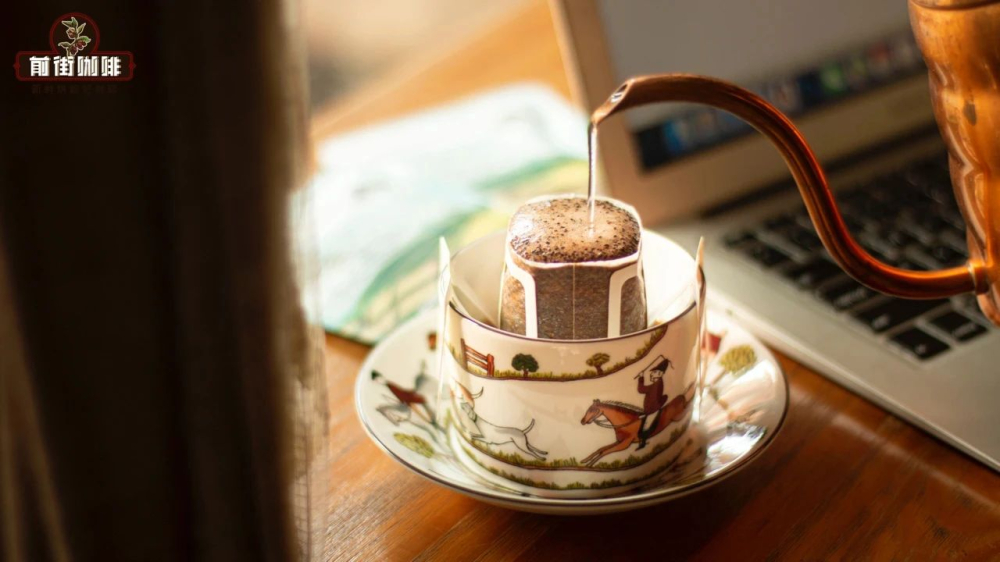
But if you just want to simply enjoy a good cup of drip coffee, the drip bag can easily help you achieve that—especially suited for those on the go who pursue minimalism.
The most important thing about drip bag coffee is convenience. The filter bag with "ears" replaces the dripper and filter paper, and pre-ground coffee saves you the trouble of a grinder. All you need to do is pour water into the filter bag and wait for it to drip out clean, transparent black coffee.
Some may ask again: should I pour in circles? Should I pause? Should I bloom? For pouring, drip bags aren't as strict as hand-brewing. There are two main reasons: first, a hand-brew dripper is cone-shaped, wide at the top and narrow at the bottom, so circular pouring is meant to ensure even extraction; whereas a drip bag is roughly the same width top and bottom, with a relatively small opening, so circular pouring doesn't mean much.
Moreover, the pouring equipment for drip bags isn't limited to a slender gooseneck kettle. To put it another way, as long as it can pour water, it works—an ordinary hot water kettle or an ordinary thermos will do.
Why do I say technique and skill don't mean much for drip bags? Because drip bags sacrifice coffee freshness and the operability of brewing techniques for convenience. So for the same beans, the flavor of a drip bag won't exceed that of hand-brewing. All we need to do is use the simplest method to extract the coffee's flavor—no need to compare with hand-brewing.
The only things to pay attention to when brewing drip bag coffee are water temperature and water volume. Water temperature is a factor to watch when brewing any coffee. Many office workers are used to brewing drip bags with water heated by a water dispenser, but most water dispensers don't heat above 75°C. Brewing directly with such hot water makes the taste thin and bland. Front Street recommends keeping the brewing temperature for drip bags within 88-91°C.
How much water should be poured? A standard drip bag coffee pack is 10g, and we only need to pour 120ml-150ml of water. Of course, if you're after a simple brewing method, you can skip the scale too. Drip bag coffee is usually brewed directly hanging on your own mug for personal consumption, so you can memorize the water line at 150ml on your mug, and when the coffee drips to around 150ml, lift out the drip bag.
There's another method. Below is a demonstration for your reference:
The equipment used is also very simple: just one drip bag coffee pack, one tall cup, and one thermos filled with hot water boiled in the morning. Using a tall cup is also to avoid the coffee grounds being continuously soaked in water, which would produce a bitter taste.
① First, tear open the drip bag coffee pack and hang it over the cup.
② Open the thermos and pour the first stage of hot water into the center of the drip bag filter, pouring until the filter bag is 1/2 full, then wait 15 seconds.
③ For the second stage, continue pouring hot water until the filter bag is 9/10 full—roughly stopping at the point where the small cardboard strip is attached at the very top of the filter bag.
④ After all the coffee liquid has dripped into the cup, continue pouring hot water for the third stage until the filter bag is 9/10 full, then stop.
⑤ After all the coffee liquid has dripped into the cup, continue pouring hot water for the fourth stage until the filter bag is 9/10 full. Once the coffee liquid has dripped into the cup, you can remove the drip bag filter.
⑥ Pour in a total of 4 stages. The first stage is poured to 1/2 full, and the remaining three stages are each poured to 9/10 full after all the coffee liquid has finished dripping. After several tests, Front Street found that pouring this way results in a total water volume of around 150ml.
Actually, brewing a cup of drip bag coffee really doesn't require complicated operations or equipment. Just like this—simply and ordinarily—you can get a delicious cup of drip bag coffee.
The above content is compiled by CoffeeHunters, a coffee news website.


