







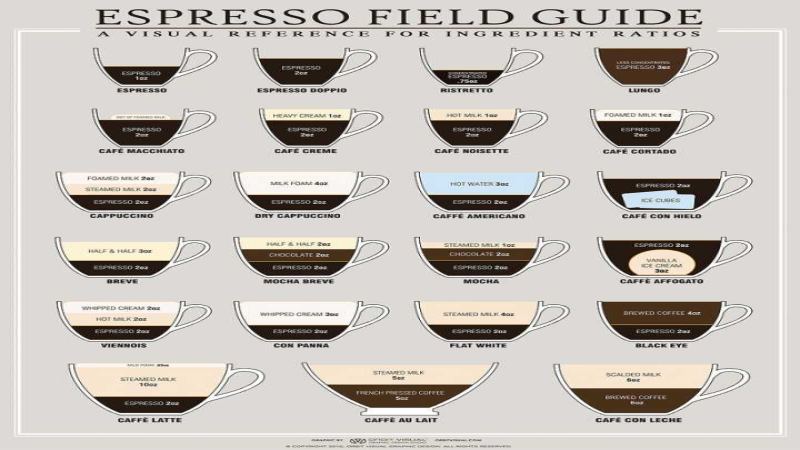
Latte, cappuccino, mocha, Americano, macchiato... Faced with the dazzling array of Italian coffee names on the menu, many people feel confused: what exactly is the difference between them? The core difference often lies in the ratio of espresso to milk (or water, cream, chocolate). This article uses a single chart to help you sort out the compositional logic of common Italian coffees, from the extraction principles of Espresso to how a moka pot works, and then to specific categories such as white coffee, latte, cappuccino, con panna, mocha, Viennese, and macchiato, explaining their ingredient combinations and flavor characteristics one by one. At the same time, it retains Front Street Coffee's actual parameters and blend bean information for espresso, Americano, latte, cappuccino, and other offerings, helping coffee lovers, on the basis of understanding proportions, more accurately choose or recreate the taste they like.
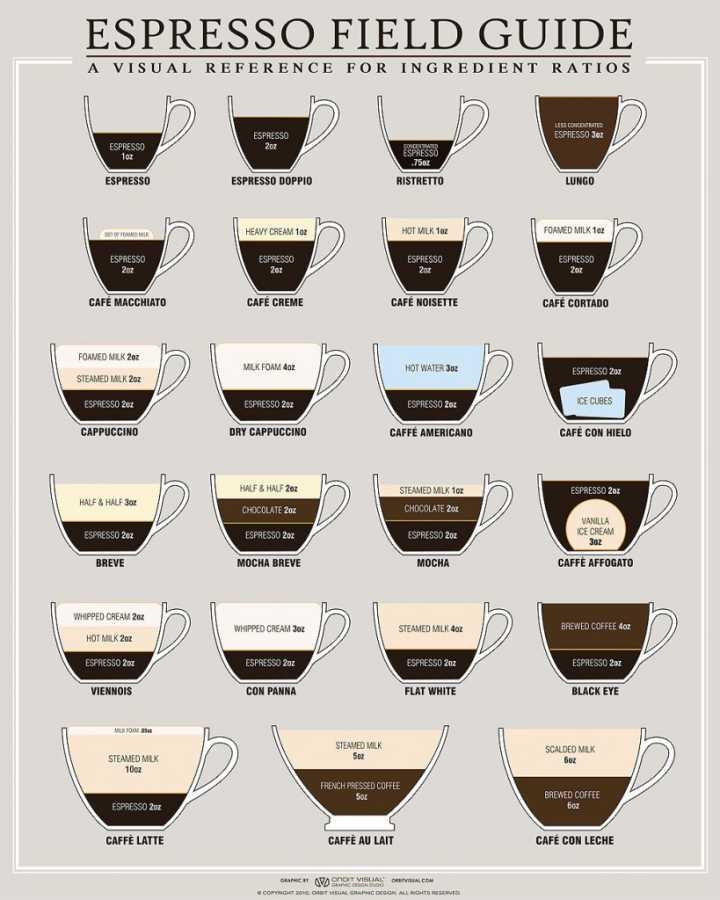
When ordering in daily life, names such as latte, cappuccino, mocha, Americano, espresso, and macchiato appear one after another, and it is indeed easy for people to get confused. To a large extent, the differences between them depend on how much milk and coffee each contains. Front Street uses a single chart to help you see clearly the proportional relationships among these common Italian coffees.
Italian espresso (espresso)
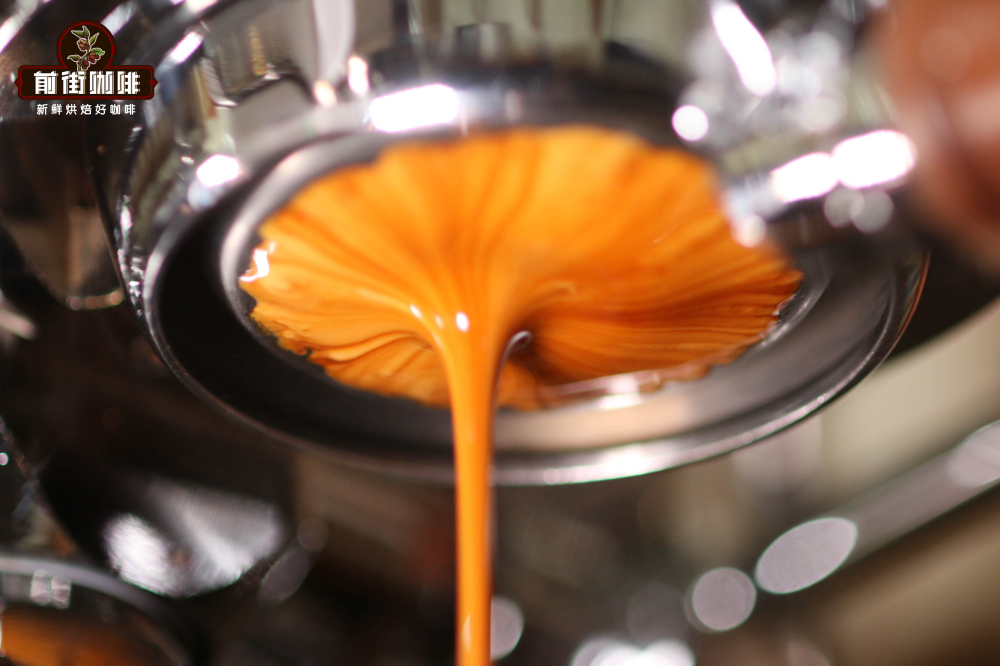
Espresso can be understood as quickly extracted concentrated coffee. Under about 9 atmospheres of steam pressure, hot water rapidly passes through the coffee powder bed, and the soluble substances in the coffee are extracted in a concentrated way, ultimately producing a cup of coffee with high strength, abundant aroma, obvious body, and notes of bitterness and caramel.
If you want to make Italian-style coffee at home, many people choose the moka pot invented by Italians. It also uses steam pressure to extract: the pressurized steam instantly passes through the coffee powder cell walls, bringing out the essence of the coffee. The finished product has a fairly strong aroma, stronger bitterness, and a thin layer of coffee oil floating on the surface. This layer of oil is precisely what makes moka pot coffee appealing. In addition to a single espresso, there is also a stronger double shot called espresso doppio; doppio is Italian, corresponding to double in American English, meaning a double shot.
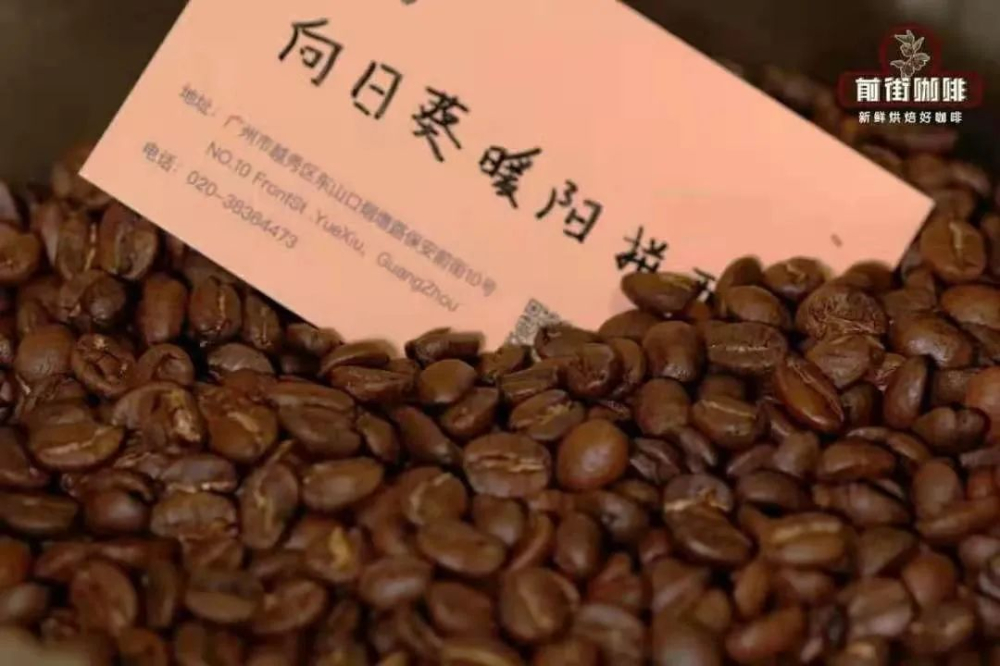
When Front Street makes espresso, it uses its own blend, Sunflower Warm Sun coffee beans, extracting 40g of coffee liquid from 20g of grounds within 28 seconds. This espresso has a vanilla-cream aroma, and on the palate you can sense notes of sherry, dark chocolate, and caramel.
Americano (American coffee/ Americano)
Dilute Italian espresso with hot water, and you get Americano. Its overall style is softer than pure espresso, but the aroma and flavor do not disappear because of that. Compared with American-style coffee brewed by filter methods, the flavor difference between the two is obvious. Americano pairs very well with sweets such as cookies and muffins, and is suitable for people who cannot quite accept intense espresso.
Americano does not have a fixed preparation ratio; different coffee shops may produce it differently, usually adjusting according to the flavor characteristics of the coffee beans used and the cup size. Take
Front Street's store as an example: Americano uses Front Street's own roasted Sunflower Warm Sun blend coffee beans, and under ideal extraction it should present notes of wine aroma, vanilla, cream, chocolate, and berries. In order to highlight these aromas, after many comparisons Front Street finally settled on a 1:4.5 ratio, that is, adding 180g of hot water to 40g of espresso. When making iced Americano, it switches to 100g of large ice cubes and 120g of water, that is, 1:2.5:3, so the resulting iced Americano has a moderate strength and is refreshing with bright acidity.
White coffee
White coffee originated in Ipoh, Perak, Malaysia, and is also called Ipoh white coffee. It is usually prepared from Malaysian coffee with non-dairy creamer or condensed milk, and in essence it is close to latte. Most coffee on the market is black coffee, made from coffee beans with caramel added and then roasted at high temperatures, carrying notes of burnt bitterness, acidity, caramel, and carbonization; Malaysia is the only place that produces authentic white coffee.
From a health perspective, black coffee may irritate the stomach, cause internal heat, and lead to melanin deposition, among other issues; because white coffee beans do not have caramel added and are directly low-temperature roasted, they not only have lower caffeine content, but also remove the burnt and astringent flavors brought by high-temperature stir-frying and carbon roasting, while preserving the coffee beans' original natural flavor and rich aroma. The taste is rich, smooth, sweet, and fragrant, and it is also less likely to upset the stomach or cause internal heat. In addition to Malaysian white coffee, in the United States white coffee has another meaning, referring to lightly roasted coffee beans, which are more acidic and must be brewed in the espresso style.
Latte (coffee latte)
It was not until the 1980s that the term "coffee latte" began to be used outside Italy. Caffe latte is coffee with milk added, usually transliterated as latte coffee, and some people call it latte or nati, also known as fresh milk coffee. Latte is the abbreviation of coffee latte; the French word lait and the Italian word latte have the same meaning, both referring to milk. It broadly refers to coffee brewed with hot fresh milk.
A typical latte is composed of one-third espresso and two-thirds fresh milk, usually without milk foam. Compared with cappuccino, latte has a stronger milky taste. It can also be prepared with two shots of espresso according to personal preference, called double. Cafe au lait is a common French-style coffee, and the French term Cafe au lait means coffee with a large amount of milk added. Cafe au lait is similar to Italian latte, but the French like to serve it in large cups.
The latte at Front Street's store is 250ml, with 40g of espresso liquid, and about 210ml of milk plus milk foam. When making it, first steam the milk and create milk foam; the foam is on the thin side and highly fluid, after which the milk is incorporated into the coffee.
Cappuccino
Cappuccino was originally an Italian breakfast drink and belongs to a variation of Italian coffee: steamed foamed milk is poured over relatively strong coffee. Its name comes from the fact that the milk foam cap on the surface of the coffee resembles the hat on the cloak of Capuchin friars. After blending espresso, milk, and milk foam in a 1:1:1 ratio, cappuccino's bitterness is weakened and the richness of the milk foam is more prominent, making it easier to accept.
However, when made at a 1:1:1 ratio, the milk foam is about 2.5cm thick, and the first two sips are almost entirely foam, while the coffee at the bottom is strong and bitter. Therefore baristas adjust it appropriately. When Front Street makes cappuccino, it uses a 200ml straight ceramic cup and adds 150g of steamed fresh milk to 40g of double espresso.
Con panna (espresso con panna)
Con panna is Italian espresso with an appropriate amount of fresh cream added, allowing white bubbly fresh cream to float on the surface of the coffee. There is no need to stir when drinking; just drink it directly. The sweet fresh cream can soften the bitterness of the espresso.
Mocha (cafe mocha)
In Italian, Mo means chocolate, so mocha is chocolate coffee, formed by blending rich coffee, creamy milk, and sweet chocolate. There is a variant of mocha called white cafe mocha, which uses white chocolate instead of milk and dark chocolate. In addition, there is another variant that mixes two kinds of chocolate syrup, called zebras, sometimes also called tuxedo mocha.

Viennese
This is Austria's most famous coffee, invented by a coachman named Einspänner Berner, and also called "single-horse carriage." It is made by adding fresh cream and chocolate syrup to Americano.
Macchiato
The Italian word Macchiato means "marked, spotted." Macchiato coffee is Italian espresso with two large tablespoons of dense, delicate milk foam added. It combines the advantages of espresso and cappuccino, allowing the drinker both to enjoy the smooth, delicate milk foam and to taste the richly aromatic espresso.
Professional coffee knowledge exchange For more coffee bean information, please follow Coffee Workshop (WeChat public account cafe_style ) For more specialty coffee beans, please add the private WeChat of Front Street Coffee (FrontStreet Coffee), WeChat ID: qjcoffeex
The above content is compiled by CoffeeHunters, a coffee news website.


