







Is Golden Mandheling a distinct arabica variety?
Golden Mandheling is not a separate arabica variety. The name points to Sumatra Mandheling lots that meet PWN's strict screening standards, covering defect counts, bean size and cup quality. Regular Mandheling shares the same origin and wet-hulling process, so the difference lies in grading and selection rather than in the plant itself.
Mandheling is prized for a heavy, solid mouthfeel, with notes of cedar, licorice and dark chocolate under a mellow smoky base. Sumatra's wet-hulling method and the region's climate shape that profile. Roasters extend the time between the yellowing point and first crack, dropping the beans close to, but not into, second crack.
Mandheling coffee stands out in the coffee world with its heavy, solid mouthfeel, and Golden Mandheling is among the most sought-after of them all. But beans marketed under the name "Golden Mandheling" keep popping up on the market—what kind of Mandheling truly deserves this title? Is the difference between it and regular Mandheling just the name? This article, from the perspective of Front Street Coffee, sorts through the variety origins of Mandheling, the characteristics of the Sumatra producing region, the wet-hulling process, and PWN's strict screening standards for Golden Mandheling, helping coffee lovers build a clear framework for identification. It also includes Front Street's recommended brewing parameters and techniques, so that when you get a good bag of beans, you can brew a cup of Mandheling that is rich, clean, and layered.
"If I had to pick one coffee to drink every day, Mandheling would always be at the top." A while ago, a customer remarked this while chatting with a barista at Front Street Coffee. The name Mandheling carries an old-school air in many people's impressions, yet its steady, substantial, intense flavor expressiveness has been cherished by generation after generation of coffee lovers since the day it became popular.
Mandheling's taste indeed runs counter to the coffee style many young people prefer today, but it is precisely this steadiness that makes it unforgettable after just one sip. The bright, sweet-tart quality of light-roasted coffee is certainly appealing, but its mouthfeel is too light, making it hard to identify the beans' origin characteristics. Dark-roasted Mandheling coffee beans, by contrast, though their flavor layers are not especially distinct, manage to leave every taster with a clear memory.
Of course, Mandheling that has been properly roasted and extracted is by no means limited to bitterness alone. Mandheling coffee of solid quality presents rich notes of cedar, licorice, and dark chocolate, with a faint hint of floral and fruity aroma emerging from beneath a mellow, smoky base. To fully unleash the charm of Mandheling coffee beans, Front Street Coffee, in its roasting strategy, moderately extends the time between the yellowing point and first crack to help the beans accumulate more sweetness, and drops them at the point close to, but not yet entering, second crack—allowing caramelization to proceed fully while preserving a slight acidity for Mandheling, making the cup's layers more three-dimensional.
What gives Mandheling its mellow depth is, of course, not the roaster alone. The genetic makeup of the Mandheling coffee variety, its growing environment, and Indonesia's uniquely local processing methods together lay a solid foundation for this substantial flavor.
Mandheling is not the name of a coffee variety; it specifically refers to Arabica variety coffee beans grown on the Indonesian island of Sumatra. As for the origin of the name "Mandheling," it is because when Japan introduced these beans, to make them easier for consumers to remember, it borrowed the transliteration of the island's indigenous ethnic group—the Mandheling people—to name the coffee beans.
Sumatra is located in western Indonesia, and its overall elevation is not particularly high; Arabica coffee is usually planted in mountainous areas at elevations of 600 to 1,200 meters. According to historical records, Mandheling coffee plantations can be traced back to the forced cultivation system implemented by the Dutch East Indies government. In 1835, the Dutch brought coffee seeds from Java to Sumatra, attempting to cultivate them on this land. Under the promotion of the Dutch East Indies government, coffee then gradually spread to multiple areas of North Sumatra.
The Arabica varieties planted on the island are mainly TimTim and Ateng, which are local-language names for the varieties. In fact, TimTim is Timor, an Arabica variety with Robusta lineage; and Ateng refers to Catimor, a cross between Caturra and Catimor. Because these varieties all carry Robusta coffee bean genes, and combined with the low planting elevation, it is difficult to create drastic day-night temperature differences to push the coffee beans to develop finer flavors. Therefore, whether TimTim or Ateng, they naturally carry unique notes of herbs, forest agarwood, and spices.
In addition to the influence of climate, elevation, and variety, the way locals separate coffee beans from the fruit further reinforces the mellow flavor direction. The local weather is mostly rainy, with frequent typhoons, making it difficult to meet the good weather conditions required for the natural process; at the same time, the local economic level is limited, so it cannot afford the higher-cost washed process. Against this backdrop, the highly regionally distinctive wet-hulled process came into being.
The key steps of this processing method are: after the coffee fruit is picked, first use a wooden pulper to remove the skin and pulp, ferment for 3 hours, then dry it in the sun until the moisture content drops to 30% to 50%, half-dry and half-wet. Immediately afterward, remove the mucilage and parchment layer, and continue with the later stage of drying. The entire drying process takes 2 to 4 days, with the final moisture content dropping to 12% to 13%.
Front Street Coffee believes that Mandheling and the wet-hulled process are deeply bound together, but today's coffee market is long past being satisfied with the status quo. Even though wet-hulling is Mandheling's signature process, there is no lack of exploration with other processing methods. Front Street Coffee has even put a naturally processed Mandheling coffee bean on its shelves; its flavor direction is quite different from the Mandheling we are familiar with, leaning more toward fruit notes, with a sweeter mouthfeel and soft fruit acidity.
Beyond the processing method, the overall quality of the coffee beans also brings a completely different flavor experience. The Golden Mandheling coffee beans produced by the well-known Indonesian green bean company PWN undergo three rounds of manual hand-sorting to ensure the beans reach a screen size of 18 or above. With fewer than 3 defective beans (based on a 300g green bean sample), they belong to the highest grade, G1. PWN's Golden Mandheling is darker green in color, with a neat, flat bean shape.
After strict screening, each bean of Front Street's PWN Golden Mandheling coffee beans can be heated more evenly when roasted at the same temperature. Front Street Coffee has found that Golden Mandheling not only removes the earthy, miscellaneous flavors common in regular Mandheling, but also drinks with varied layers overall—mellow yet clean. Rich nut and caramel aromas interweave with chocolate notes, with a lasting finish and excellent balance.
As Golden Mandheling's fame grows, many beans bearing the Golden Mandheling label—though not produced by PWN—have appeared on the market; these can actually only be classified as specialty Mandheling. The Front Street PWN Golden Mandheling sold by Front Street Coffee, however, is Golden Mandheling coffee beans certified with a certificate issued by PWN. Both the certification certificate issued by PWN and the gunny sacks of Golden Mandheling green coffee beans printed with the PWN logo can be seen with your own eyes at Front Street Coffee's store.
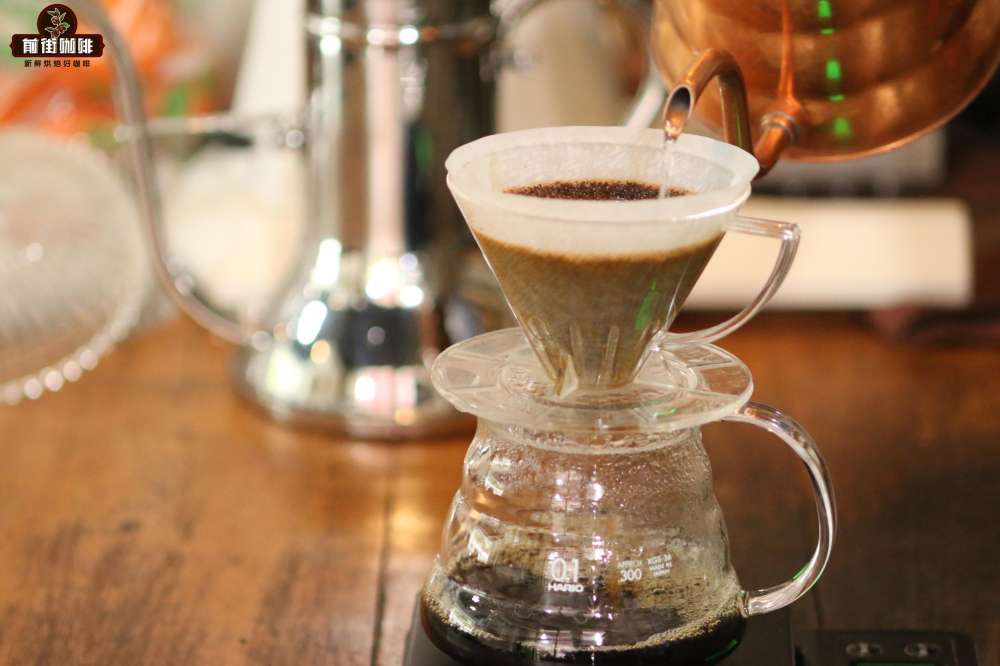
As long as Mandheling coffee beans receive a reasonable roast that lets them show their charm, the brewing stage requires only conventional techniques and suitable extraction parameters to produce a cup of mellow, rounded coffee. Front Street Coffee recommends using a KONO dripper, with brewing parameters as follows: water temperature 88°C, coffee-to-water ratio 1:15, take 15g of coffee powder ground to the size of coarse granulated sugar (70% passing rate on the Chinese No. 20 standard sieve).
The specific brewing technique is as follows: first pour 30g of water, bloom for 30 seconds; for the second stage, pour in a circular motion with a small stream of water up to 125g, and when the water level in the coffee bed drops to half, pour again, continuing to pour in a circular motion with a small stream of water up to 225g. Wait for all dripping to complete; the total extraction time is about 2 minutes 10 seconds.
Professional coffee knowledge exchange. For more coffee bean information, please follow Coffee Workshop (WeChat public account: cafe_style)
For more specialty coffee beans, please add the private WeChat of Front Street Coffee, WeChat ID: qjcoffeex
The above content is compiled by CoffeeHunters, a coffee news website.


