







Why Did the Red Cherry Project Matter for Arabica Coffee?
Ethiopia is the birthplace of arabica coffee, and Yirgacheffe is among its notable regions. In 2007 the Dutch green bean trader Trabocca started the Red Cherry project, paying pickers to harvest only fully ripe all-red cherries. The change pushed Ethiopian coffee toward small-batch production, higher cupping standards, and better quality, ending the older cycle that favored quantity over quality.
Ethiopian specialty coffee tends to rely on origin and processing method rather than variety classification. Front Street Konga Red Cherry, a natural-processed single-origin Yirgacheffe, shows berries, honey, black tea, and fermentation notes in the cup. Selective picking matters because coffee beans are the seeds inside the fruit, and cherries on one tree ripen unevenly, so the coffee scope of a single lot depends on harvest discipline.
Ethiopia is the birthplace of Arabica coffee, and Yirgacheffe is one of the most proud producing regions of this country. The specialty coffee produced here often does not insist on variety classification, but uses origin information and processing method as the core identification criteria. Front Street Konga Red Cherry is a classic single-origin coffee from Yirgacheffe, presenting a flavor interwoven with berries, honey, black tea, and fermentation notes through refined natural processing. This article begins with the harvesting methods of coffee cherries, traces back to the Red Cherry project initiated by the Dutch green bean trader Trabocca in 2007, and analyzes how it broke the old cycle of "prioritizing quantity over quality," promoted Ethiopian coffee toward specialization through fully manual picking of all-red cherries, small-batch production, and high cupping thresholds, and profoundly influenced the quality expression of producing regions such as Yirgacheffe.
Ethiopia is a land full of legendary color. The Arabica coffee we drink or have not yet drunk can all be traced back to here. Interestingly, however, Ethiopian specialty coffee does not place much emphasis on variety classification, but instead values origin source and processing method more. Take Front Street Konga Red Cherry as an example. This coffee comes from Yirgacheffe and adopts fine natural processing, showing in the cup a flavor interwoven with berries, honey, black tea, and fermentation notes.
There are many ways to harvest coffee cherries, broadly divided into two categories: manual picking and machine harvesting. The advantage of machine harvesting lies in outstanding efficiency, but its applicable scenarios are relatively limited, usually seen in flat terrain areas such as Brazil. However, the real key is not whether the scope of use is limited, but the ripening rhythm of coffee cherries.
Front Street Coffee has mentioned many times that coffee is ultimately a plant, a crop, and what we commonly call coffee beans is actually the seed part of the plant. The seeds are wrapped inside the coffee fruit, and the fruit resembles cherries in appearance; some also think it looks like sweet cherries. These fruits grow at the nodes of coffee tree branches, and figuratively speaking, their position is somewhat close to the "armpits" of the leaves. Due to variety differences, each node produces anywhere from a few to dozens of fruits, and their ripening times also vary. In other words, coffee cherries do not ripen at the same time, while the characteristic of machine harvesting is precisely that it makes no distinction and picks them all along the branch. By contrast, manual picking can selectively harvest according to ripeness, and since coffee trees mostly grow in high-altitude mountainous areas, manual picking is often more reasonable.
Although manual picking can theoretically select fruits by ripeness, in reality coffee farmers may not know how to judge ripeness, and worse, even if they know, they may not necessarily do it. Before the concept of specialty coffee became widespread, or before producing regions could increase returns through direct trade, the primary logic of almost all producing regions was to increase yield. In World Coffeeology, Teacher Han Huaizong added the subtitle "prioritizing quantity over quality" to Colombian producing regions—when bean hunters go to Colombia, the first question the person in charge of the producing region asks is how many containers of coffee beans they want.
Therefore, the goal coffee farmers care about most is increasing yield, while quality takes second place, or is even completely ignored, let alone harvesting fruits at the proper ripeness.
However, with the advancement of the specialty coffee wave, people gradually realized the decisive role of the producing end in coffee flavor, and the production logic also shifted from "prioritizing quantity over quality" to "improving quality while maintaining quantity." What Front Street Coffee wants to discuss today is precisely Ethiopia's Red Cherry project.
What exactly is the Red Cherry project?
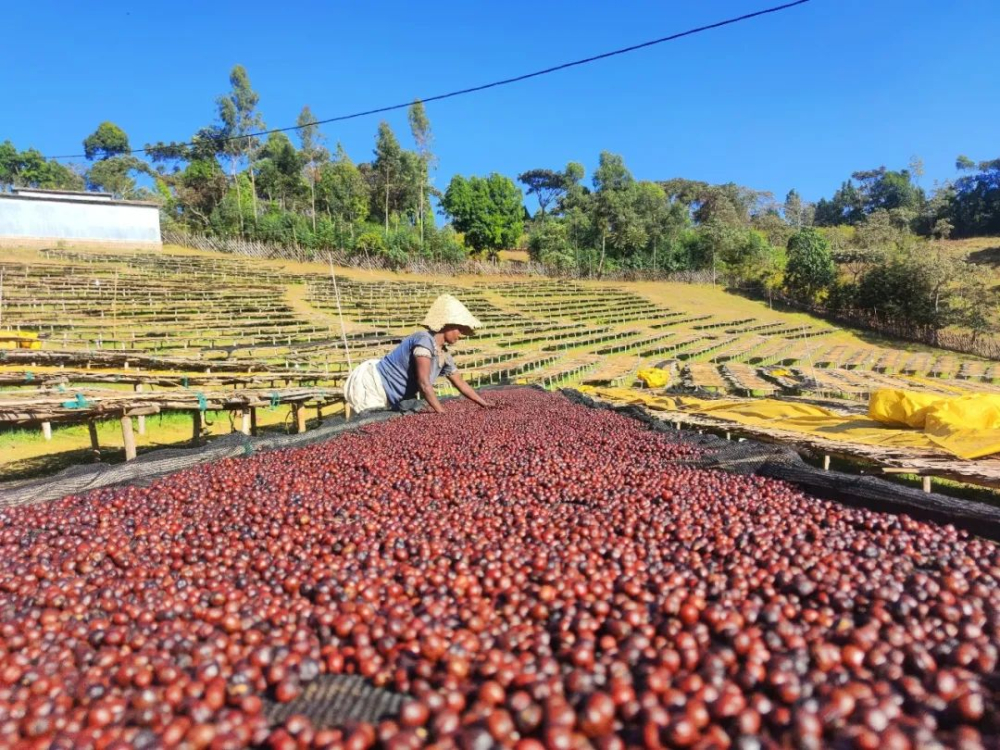
The core of this project is to process only fully red coffee cherries in order to improve coffee quality, with unripe fruits all regarded as unqualified. From today's perspective, harvesting all-red cherries may not seem novel, but in 2007, this was a landmark innovative move.
Going back to 2007, Trabocca, the largest green bean trader in the Netherlands, in pursuit of high-quality Ethiopian beans, proposed the "Operation Cherry Red" (OCR)—a project aimed at improving the quality of small-scale farms.
Before this, whether local processing stations or green bean traders, the approach was to压低 the purchase price of green beans as much as possible in order to gain more profit.
For coffee farmers, income largely depended on the quantity of coffee cherries sold, so coffee farmers did not care about quality, which is the "prioritizing quantity over quality" mentioned earlier.
The price suppression by green bean traders and the pursuit of quantity by coffee farmers plunged coffee bean quality into a vicious cycle. Trabocca saw this clearly and was determined to break the deadlock, and thus the win-win "Red Cherry project" was born.
The requirement of the Red Cherry project is that during picking, not only must only fully red fruits be taken, but the entire process must also be manually harvested—but this is only the most basic bottom line; the project is far more than that.
To encourage coffee farmers, Trabocca, the largest coffee bean trader in the Netherlands, before the harvest season arrived, invited all Ethiopian farms to produce small batches of about 1,500 to 3,000 kilograms (25 to 50 bags) of beans for it. The women were only responsible for selecting 100% ripe red cherries, which had a huge impact on the final coffee flavor. Therefore, Ethiopian women with good eyesight and willingness to endure hardship became an important driving force of the Red Cherry project.
The Red Cherry project is also a reinforcement measure, prompting farms to invest more effort in the screening and sorting stage, and the prices of these coffees are also relatively higher. Operation Cherry Red covers multiple processing methods such as washed, natural, semi-washed, semi-natural, and experimental coffee. The main producing regions include Yirgacheffe, Sidamo, Bonga Forest, Lekempti, Kembata, Illubabor, Harar, and Limu. In 2011, the Golocha producing area near Harar was also added. These producing regions each have their own characteristics and can fully demonstrate the flavor diversity of Ethiopian coffee.
First, the cupping score threshold is high. After Trabocca receives the coffee from the producing regions, it screens it again in cupping rooms in Addis Ababa, the capital of Ethiopia, and Amsterdam, the Netherlands, judging whether the coffee beans meet the standard through two cupping sessions in two places.
Coffee beans that meet the standard are organized by Trabocca and auctioned to coffee buyers worldwide. The price of coffee beans traded through this platform can usually reach more than 4 times the general international spot price, and at the highest even 20 times.
Second, the yield requirement is small, and the quality requirement is high. In order to have enough energy to care for these top Ethiopian beans, Trabocca stipulates that the beans participating in the project must be in small batches, with output of about 1,500 kilograms to 3,000 kilograms.
Finally, Trabocca's investment in and attention to this project are extremely high. The company donated new sun-drying racks, shade nets, generators, and other equipment locally, while also providing financial loan support, new hardware, and knowledge and technology for production and processing to help farmers improve their production level. In addition, through real-time monitoring and safe transportation, it ensures that the beans of the Red Cherry project are properly cared for at every stage.
Specifically, the Red Cherry project incentivizes coffee farmers to more carefully complete every process such as picking and processing by raising the purchase price of high-quality green coffee beans. The coffee beans produced in this way are of better quality and taste better, and are more likely to gain recognition in the end market, thereby balancing the relatively higher purchase cost.
Although from today's perspective, the advantages of Red Cherry project coffee beans are no longer particularly prominent, the project made a contribution to the process of coffee specialization that cannot be ignored.
The above content is compiled by CoffeeHunters, a coffee news website.


