







Colombian coffee is one of the few specialty coffees that can be marketed globally under its country name, with a balanced harmony of acidity, bitterness, and sweetness, and a rich, full-bodied aroma that makes it highly favored by coffee lovers. This article will systematically review the cultivation history of Colombian coffee, the flavor characteristics of major specialty regions (Huila, Cauca, Santander, Antioquia, Tolima, Narino), and include information on several Colombian beans recommended by Front Street Coffee along with V60 three-stage brewing parameters. Whether you are a beginner just getting into pour-over or a veteran looking for everyday beans, you will find practical references here.
For more specialty coffee knowledge, please follow the WeChat public account: FrontStreet Coffee
When people mention Latin America, they always think of its passionate and vibrant local culture, and the coffee born from this land also exudes an irresistible charm. Brazilian coffee is known for being smooth and easy-drinking, like a gentle greeting. In contrast, Colombian coffee displays a rich, full-bodied aroma, bright fruity acidity, and excellent balance, sometimes with a nutty finish that is unforgettable. From appearance to quality, Colombian Supremo beans perform excellently, like a restrained elegance that is charming in just the right way.
History of Colombian Coffee
While reviewing historical materials on coffee beans, Front Street noted that in the early 18th century, as Spanish colonists entered Colombia, coffee was also brought into this "New World" by Spanish missionaries. The earliest record of coffee harvest in Colombia appeared in the northeastern region, and afterward coffee rapidly spread across the country as a cash crop for small family farms.
However, local farmers were initially unwilling to grow coffee because they worried about facing economic hardship in the first five years. Later, a priest named Francisco Romero firmly believed that coffee was Colombia's future and vigorously promoted its cultivation, and only then did coffee gradually develop into one of Colombia's main export crops. It was not until 1835 that Colombian coffee beans first achieved commercial production, with a total export volume of 25.6 million bags that year.
In 1927, the National Federation of Coffee Growers of Colombia (FNC) was established, and the number of coffee growers subsequently increased substantially. In 1938, the Colombian authorities also established Cenicafé, with the aim of helping growers improve coffee quality and yield through advanced agricultural techniques. Today, Colombia's coffee production has steadily ranked third in the world.
Colombian Coffee Regions
Colombian coffee is one of the few coffees in the world that can be sold directly under its country name.
Taste Characteristics of Colombian Coffee Beans
It has sweetness within its acidity, mild bitterness, and moderate strength, and is often used as an important component of premium coffee blends. Colombian Supremo coffee has a perfectly balanced combination of acidity, bitterness, and sweetness, with a unique aroma filling the mouth and a very full-bodied scent.
Colombia has a mild climate and humid air, and its diverse climatic conditions allow coffee to be harvested throughout the year, with different varieties ripening successively at different times. The local crop is high-quality Arabica coffee beans, and the coffee ground and brewed from them is rich in flavor with a long finish, truly deserving to be called specialty. Today, many people regard "Colombian coffee" as synonymous with "high quality" and "great taste."
The outstanding flavor of Colombian coffee is inseparable from the superior local growing environment. While reading Han Huaizong's book "Specialty Coffee Studies," Front Street came across this description: if Brazilian coffee is a "phoenix man" who relies on high technology to overcome soil and water conditions, then Colombia is a "rich second generation" blessed with good mountains, good water, and beautiful scenery. Brazil plants coffee on hilly red soil in a relatively extensive way; Colombia cultivates intensively on mountainous black soil.
Colombia's coffee-producing regions are mainly distributed in the northwest, among which the most famous is "MAM," namely Medellin, Armenia, and Manizales. The specialty coffee bean regions are mainly in the south, with cultivation elevations above 1,500 meters, including Huila, Cauca, Santander, Antioquia, Tolima, and Narino.
[Huila]
The Huila region is renowned worldwide for its coffee quality and is also Colombia's largest and most representative coffee-producing region. The terrain in this region is mainly hilly, with coffee plants grown at elevations above 1,500 meters. Colombia's most important rivers converge here, bringing abundant moisture and water resources to the region.
Thanks to these superior conditions, the coffee produced in Huila is quite outstanding. Front Street Coffee classifies Huila as a representative option in its everyday beans series and uses washed-process beans to present Colombia's basic flavor, because washed processing best preserves an original, clean, and bright taste, thereby showcasing the characteristics of Colombian Huila coffee to the greatest extent.
Front Street Colombian Huila Coffee Beans
Region: Huila, Colombia
Altitude: 1500m—1800m
Variety: Caturra
Processing Method: Washed
In addition, Front Street Coffee also has another bean on its list from Huila as well, using anaerobic natural processing, with a more intense fruity aroma in flavor.
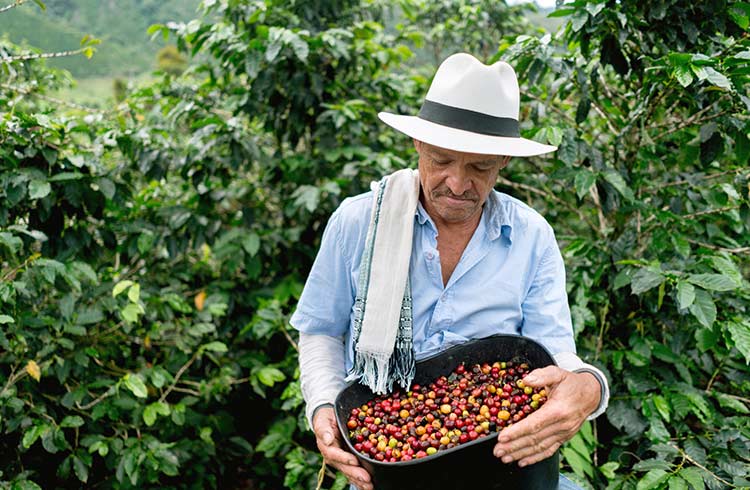
Front Street Colombian Flower Moon Night Coffee Beans
Region: Huila, Colombia
Altitude: 1800m
Variety: Caturra
Processing Method: Anaerobic Natural
[Cauca]
The Cauca region is a certified Colombian coffee region of origin, with an average altitude of 1,758 meters and a maximum of 2,100 meters. Excellent conditions such as volcanic soil, complex mountainous terrain, high altitude, significant temperature differences between day and night, and microclimates make coffee beans from Cauca sweet and tart.
[Santander]
Santander is also a famous region in Colombia, with cultivation elevations between 1,400 and 1,600 meters. Coffee beans from this region are known for their strong taste, long finish, and unique fresh herbal flavor.
Front Street Colombian Rose Valley Coffee Beans
Region: Santander, Colombia
Estate: Big Tree Estate
Altitude: 1700m
Variety: Caturra
Processing Method: Anaerobic Enzyme Washed
[Antioquia]
The Antioquia region is located in central-northern Colombia, with a coffee planting area of about 126,000 hectares, yet its output is second only to Huila, accounting for 18% of Colombia's total coffee production. Most of the region is mountainous terrain and is also brushed by warm sea breezes from the Caribbean.
[Tolima]
The name Tolima comes from the Pijao people who first lived here. In their language, "tolima" means "snowed," that is, "covered with snow."
[Narino]
The coffee-growing area of the Narino region is located in the cloud belt at elevations between 1,600 and 2,300 meters, with fertile volcanic soil. The coffee beans produced are small in shape but plump, with an emerald green color. Because the cultivation elevation can reach 2,000 meters, combined with fertile soil and a special microclimate, the Narino region is able to produce high-quality coffee beans with a unique flavor.
Brewing Suggestions
Colombian coffee has a prominent aroma, so Front Street Coffee's baristas use the Hario V60 dripper when brewing Colombian coffee beans. The V60 dripper's long spiral ribs and large-hole design can better highlight the coffee's aroma, extract more high-quality acidic substances, and at the same time produce a cleaner and brighter coffee liquid. Front Street uses a three-stage pouring method during brewing to give the final cup more layers.
Dripper: Hario V60
Water Temperature: 90°C
Dose: 15 grams
Coffee-to-Water Ratio: 1:15
Grind Size: EK43s#10 (80% passing rate on China standard No. 20 sieve)
Front Street uses three-stage pouring when brewing Colombian coffee beans:
First pour 30 grams of water and bloom for 30 seconds, then pour the second stage up to 125 grams for segmentation. When the water level in the dripper drops to the point where the coffee bed is about to be exposed, immediately pour the third stage up to 225 grams. After all the water in the dripper has flowed into the server, remove the dripper. Total extraction time: 2'00".
[Colombian Huila] Notes of dark chocolate and nuts are obvious on the palate, with caramel sweetness and soft fruity acidity.
[Colombian Flower Moon Night] Intense strawberry jam flavor, strong fermented aroma, and a sweet chocolate mouthfeel.
[Colombian Rose Valley] Obvious peach characteristics, accompanied by aromas of rose and liqueur chocolate, a grape juice sensation, and a silky mouthfeel like cream toffee.
For more coffee bean information, please follow Coffee Workshop (WeChat public account: cafe_style)
For professional coffee knowledge exchange, please add WeChat ID: kaixinguoguo0925
The above content is compiled by CoffeeHunters, a coffee news website.


