







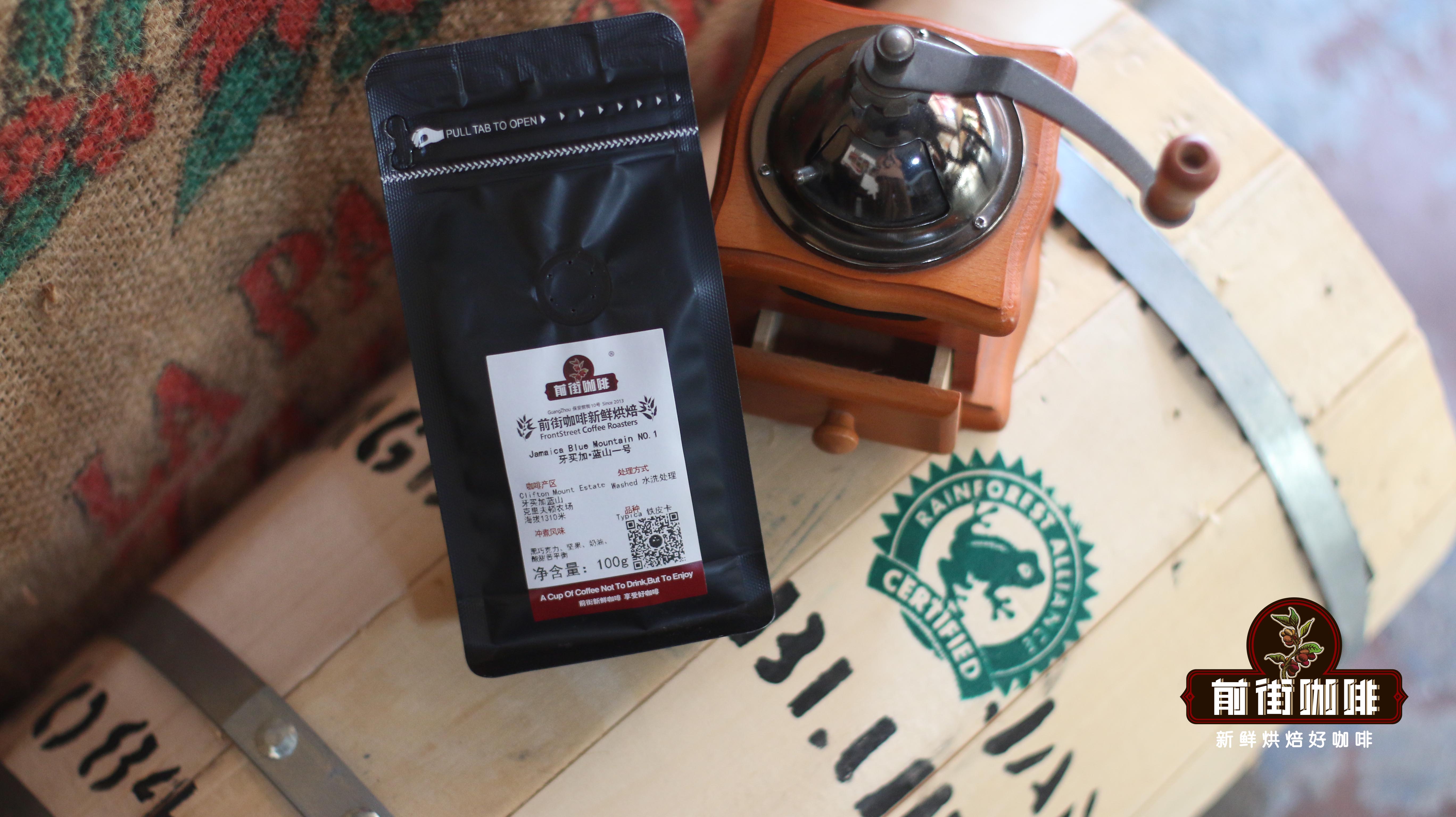
Blue Mountain coffee is hailed as the Hermès of the coffee world, but when it comes to its price and authenticity, plenty of outdated and even incorrect information circulates. Some say Japan has monopolized Blue Mountain and that No. 1 beans are impossible to find domestically; others believe authentic Blue Mountain costs no less than 300 yuan per cup. What is the truth? This article will start with Blue Mountain coffee's origin definition, grading system, and import history, combine Front Street Coffee's actual purchasing experience, do the math on Blue Mountain coffee bean prices for you, and share methods for identifying real versus fake Blue Mountain. If you also love Blue Mountain's balanced, mellow flavor, it is worth a read.
Front Street recently noticed a few customers discussing the topic of Blue Mountain coffee beans. Some seasoned coffee enthusiasts were sharing with beginners their experience in distinguishing authentic Blue Mountain coffee beans and how to judge whether the price of Blue Mountain coffee is reasonable.
However, from their conversation, Front Street felt that some people's understanding might still be stuck twenty years in the past. For example, someone said, "Japan has monopolized Blue Mountain coffee, and China cannot buy real Blue Mountain," backing it up with data: Jamaica exported 688 tons of Blue Mountain coffee to Japan, 75 tons to the United States, 59 tons to the United Kingdom, and the rest of the world could only get 10% of total Blue Mountain production.
Another customer mentioned: "Blue Mountain coffee is extremely expensive. If it is No. 1 beans (first grade), a cup will not sell for less than 300 yuan. Some domestic coffee shops sell authentic Blue Mountain at around 200 yuan a cup—although it is Jamaican, it is at most No. 3 beans (third grade), and No. 1 beans simply cannot be drunk in China. Japanese Blue Mountain No. 1 beans sell for no less than 3,500 yuan per pound (454 grams)." Hearing this shows this person is indeed a veteran coffee player, except that they have not kept up with the changes of the times.
What counts as authentic Blue Mountain coffee?
Blue Mountain coffee was once hailed as the Hermès of the coffee world. Authentic Blue Mountain lets you perceive a rich, dense, lasting aroma of chocolate and roasted hazelnut, while acidity, sweetness, bitterness, fragrance, and body achieve a superb balance. Front Street believes that Blue Mountain coffee's high reputation is inseparable from Jamaican growers' meticulous management and strict grading.
The Blue Mountains are surrounded by Caribbean seawater and have a unique island-type tropical rainforest microclimate, with concentrated rainy-season rainfall and good drainage. Volcanic ash from active volcanoes enriches the soil with nutrients, so coffee trees need little extra irrigation and fertilizing. With abundant sunshine year-round, lingering mist, and a cool, comfortable high-altitude growing area, it is very suitable for crops; locals usually plant coffee trees together with banana trees on the slopes of the Blue Mountains.
CIB has demarcated an area of about 6,000 hectares in the Blue Mountains and strictly stipulates that only Typica coffee produced in this area can be called "Blue Mountain coffee." Coffee from other areas can only be called High Mountain coffee. According to CIB's division, the forest area growing Blue Mountain coffee lies at roughly 910–1,700 meters above sea level, mainly in Saint Thomas, Saint Mary, Saint Andrew, and Portland. This area accounts for only one-third of the entire Blue Mountain growing region.
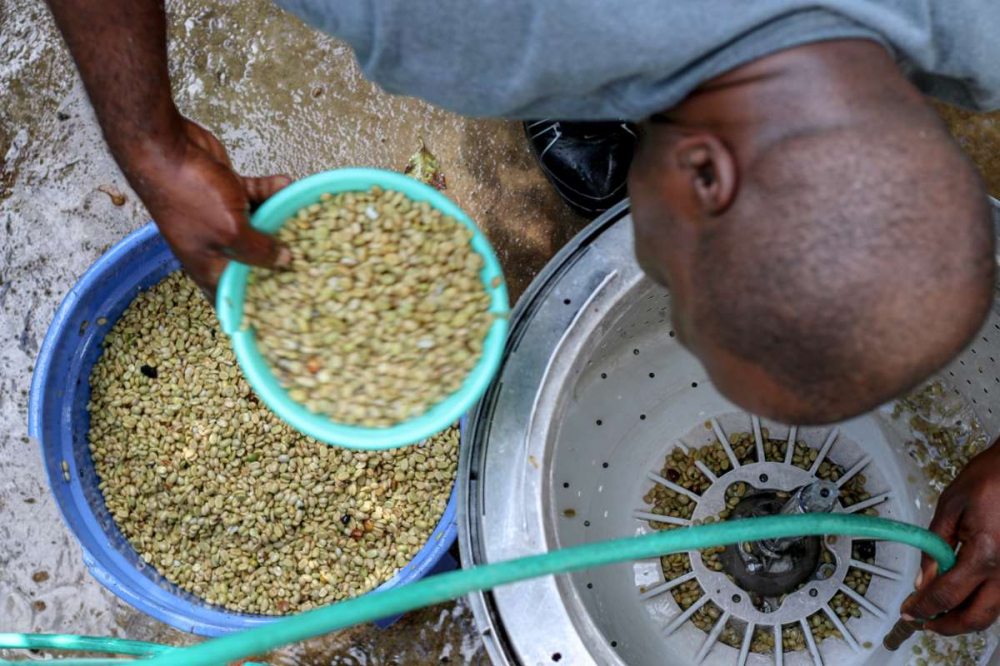
The variety of Blue Mountain coffee is Typica. The higher the growing altitude, the more outstanding Typica's flavor expression. But Typica has poor disease resistance and is very susceptible to illness, and its yield per tree is low, so it requires more manpower and careful care. In addition, the terrain at Blue Mountain's high altitudes is rugged, making management and picking difficult and demanding extremely high proficiency from pickers, further affecting yield. In recent years, less than 15% of Jamaican coffee beans can bear the Blue Mountain coffee label, about 900 tons. After picking, the coffee cherries are immediately transported to processing plants, where they are washed to remove the pulp and then dried.
Is there Blue Mountain coffee in China?
Next, Front Street will talk about the real current situation of Blue Mountain coffee. That veteran player was right: the Japanese did occupy the lion's share of Blue Mountain quotas, and still do today. But that data is from 1992. You can now check the official Jamaican coffee website: China is already the fourth-largest buyer of Blue Mountain coffee, with the top three being Japan, the United States, and the United Kingdom.
China formally established its Blue Mountain import channel in 2011. Here we need to mention a key time point—2008. 2008 coincided with the economic crisis, Japan's priority purchasing rights expired, and the Jamaican government, to be safe, extended an olive branch to China. In 2010, the Hangzhou Coffee and Western Food Industry Association was invited to visit Jamaica and signed a letter of intent for cooperation as the general agent for Blue Mountain coffee in Eastern Europe and China. The owner of the Weibo name "Lou Boyin" was exactly the association's chairman at the time.
So, starting in 2011, mainland China had independent import batches of Blue Mountain coffee beans. Blue Mountain coffee beans are indeed expensive, but not to the extent everyone imagines. Front Street Coffee has also purchased entire barrels of Blue Mountain coffee beans; the estate it works with is Clifton Farm, which has long supplied China. The farm's owner, the Sharp family, is a major coffee specialist in the Blue Mountain area. Front Street's roasted Blue Mountain coffee beans are priced at 158 yuan/100g, and a cup tastes 60 yuan in-store. This price has also raised many customers' doubts—they think Blue Mountain cannot possibly be this cheap.
How do you identify real versus fake Blue Mountain coffee?
Of course, because the price is lower than competitors, some friends suspect Front Street's Blue Mountain coffee beans are not real. In response, Front Street can not only show everyone the original Blue Mountain barrels, but also the Blue Mountain coffee sales certificate issued by Clifton Farm.
If everyone still feels uneasy about this price, Front Street will do the math for you: open Taobao and search for green Blue Mountain coffee beans; 1 kg costs 550 yuan. Assuming 1 kg of green beans can roast into 800 grams of roasted beans, the green bean cost converted at retail green bean prices is 68 yuan/100g. Of course, buying in large quantities and skipping middlemen lowers the cost further. Seen this way, Front Street's 158 yuan/100g is very reasonable.
Now it is Geisha's world, and Blue Mountain coffee's high price can only exist in the past—the times have changed. Still, people who love Blue Mountain coffee remain devoted to it to this day, because Blue Mountain coffee's balanced taste and mellow body cannot be imitated by other coffees.
For professional coffee knowledge exchange and more coffee bean information, please follow Coffee Workshop (WeChat public account: cafe_style) For more specialty coffee beans, please add the private WeChat of Front Street Coffee (FrontStreet Coffee), WeChat ID: qjcoffeex
The above content is compiled by CoffeeHunters, a coffee news website.


