







What Gives Yunnan Baoshan Coffee Its Flavor?
Yunnan Baoshan coffee tastes nutty, chocolatey and balanced, with mild acidity rather than the bright citrus found in Yirgacheffe. The flavor comes from three things: the Catimor variety that dominates local planting, the subtropical highland terroir around Baoshan, and washed processing that removes fruit before drying and keeps the cup clean and steady.
Coffee reached Yunnan in 1904, when a French missionary planted Typica in Zhukula Village, Binchuan, Dali. Typica is an Arabica variety with weak rust resistance and low yield, so from the 1980s Catimor largely replaced it. Catimor brings stamina and volume but also a bitter, earthy edge that careful washing and roasting help soften.
When you mention Yirgacheffe, you think of white florals and citrus lemon acidity; when you talk about Panama Geisha, complex fruit and honey pomelo sweet-tartness come to mind; Blue Mountain is balanced and full-bodied with nutty chocolate notes. But when asked what Yunnan coffee tastes like, many people are momentarily at a loss for words. What exactly determines the flavor of Yunnan coffee? This article, from the perspective of Front Street, sorts through the origins of coffee cultivation in Yunnan, the genetic characteristics of the Catimor variety, the natural conditions of the Baoshan production area, the washed processing workflow, and the flavor performance in cupping and pour-over practice, helping coffee enthusiasts build an overall understanding of Yunnan Catimor coffee and also understand why Front Street chose Baoshan small-bean coffee as its everyday beans.
Front Street has noticed that many friends who drink coffee regularly can, when a classic coffee name is mentioned, immediately picture in their minds what it tastes like—for example, Yirgacheffe is white florals and citrus lemon acidity, Panama Geisha is complex fruit and honey pomelo sweet-tartness, and Blue Mountain coffee is balanced and full-bodied with nuts and chocolate. So when Yunnan coffee is mentioned, what does it taste like? People seem to hesitate: "What flavor would Yunnan coffee have?"
Next, Front Street will first look at several aspects to understand what influences the taste of Yunnan coffee. First, let's start with coffee cultivation in Yunnan.
When did Yunnan start growing coffee?
In 1904, a French missionary planted the first Arabica coffee tree in Zhukula Village, Binchuan, Dali, and from then on coffee, this "imported product," began to take root in China.
According to later research, what the missionary planted at the time was the Typica variety (because the beans are much smaller than Robusta beans, Yunnan coffee is also often called "small-bean coffee"), while today the vast majority of coffee grown in Yunnan is the Catimor variety. Because Typica coffee plants have weak disease resistance and are prone to coffee leaf rust, and their yields are very low, if farmers relied on growing coffee for a living, it would be very difficult for them to make ends meet.
By the 1980s, major coffee-producing regions around the world had suffered from leaf rust, and coffee people everywhere began trying every possible way to solve this problem. In 1990, promoted by the foreign-owned company Nestlé, Yunnan introduced the Catimor variety from Brazil, which had better disease resistance and higher yields, to replace the "unprofitable" Typica coffee trees. Catimor began to be planted on a large scale in Yunnan, and production continued to rise and break through, but flavor did not receive much attention. In addition, local green bean processing techniques in Yunnan at the time were not refined enough, so the coffee batches produced were often exported at low prices to Europe and became one of the ingredients in instant coffee.
Characteristics of the Catimor variety
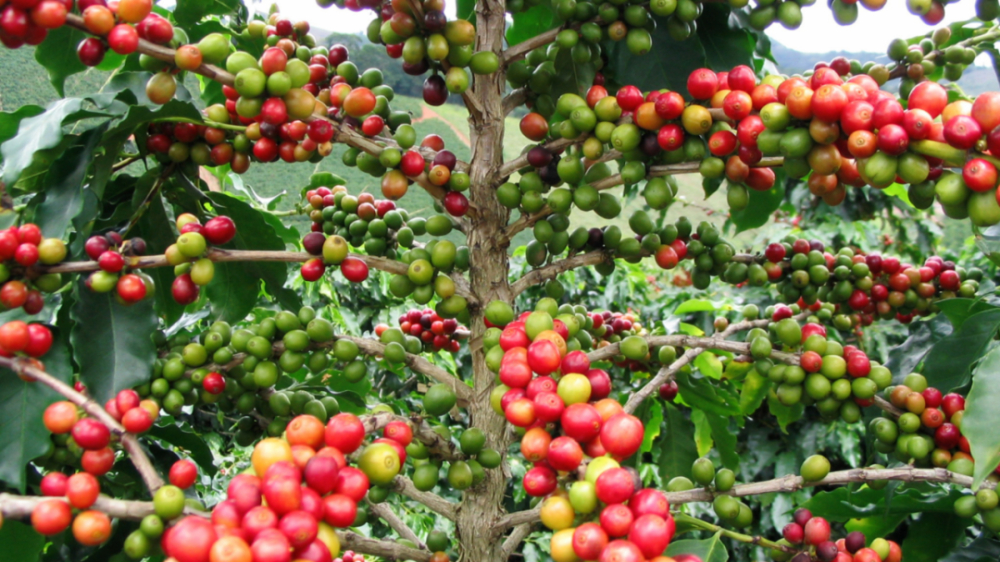
Genetically speaking, Catimor is a combination of the Arabica variety and Robusta, a descendant of the natural Bourbon variant Caturra and Timor (a Robusta species), carrying 25% Robusta genes.
Friends who have a rough understanding of coffee varieties surely know that Robusta beans are the "devil's flavor" of coffee. Catimor inherits both Robusta genes and Arabica genes, so it has strong disease resistance and high yields. After roasting, the coffee beans carry rich oils, and in flavor they can also have the acidity of native Arabica varieties.
We all know that good Arabica coffee mostly requires a high-altitude growing environment. When Yunnan farmers plant Catimor on slopes above 1,200 meters, Yunnan's land provides fertile soil, sufficient sunlight and rainfall, and the significant temperature differences brought by high altitude, giving Catimor plants here ideal growing conditions. As mentioned earlier, Catimor carries Robusta genes, so while it has disease and pest resistance and yield, it also lacks the refined flavor of pure Arabica beans. Therefore, in cupping, it often fails to receive the high scores and praise of varieties such as Caturra and Catuai at the same high altitude.
Yunnan Baoshan coffee production area
At present, Catimor coffee grown in Yunnan is mainly distributed across 8 production areas: Nujiang, Dali, Baoshan, Dehong, Lincang, Pu'er, Wenshan, and Xishuangbanna. Among them, Baoshan is the most famous, with a long history of cultivation. Large-scale coffee tree planting began in the 1950s. In 2010, Baoshan small-bean coffee also obtained A-level certification and passed the procedures of China's National Standards Administration, and is regarded as a product reflecting China's national geographical indication.
The coffee-growing areas in the Baoshan production region are mainly distributed between 800-1400 meters, and the better-quality small-bean coffee mainly comes from above 1200 meters, accounting for a relatively small proportion. This place has a subtropical monsoon climate, with an average annual temperature of around 21 degrees Celsius, sufficient sunshine and rainfall, and most crucially, no frost throughout the year (coffee trees are not cold-tolerant). It is known as one of the best production areas for high-quality small-bean coffee. Whether in output or quality, Baoshan coffee occupies a very important position in Yunnan coffee, which is also why Front Street's Yunnan everyday beans choose small-bean coffee from Baoshan.
Processing methods for Yunnan Catimor coffee
When recommending a coffee bean to customers, Front Street often suggests starting with washed processing. Front Street believes that the washed processing steps allow the coffee bean's flavor expression to be more faithful to itself, and the quality is also more stable.
The local harvest season in Yunnan is usually in winter, so sunlight is difficult to guarantee sufficiently and stably (traditional natural drying generally requires more than 20 days). Therefore, most coffee uses washed processing. After ripe coffee cherries are hand-picked, they are placed in a basin of water to remove floating defective cherries. Then the qualified coffee cherries are machine-depulped to remove the skin and pulp and put into a tank to ferment for about 24 hours. The acidic substances produced during fermentation separate the mucilage layer. Then the surface is repeatedly rubbed and washed with clean water. Finally, the parchment beans are spread out to dry, and after drying is completed they are packed and stored.
Of course, many novel green bean processing methods have appeared on the market at this stage, making the aroma of coffee beans more prominent, but Front Street feels that if you want to understand the characteristics of a coffee production area, you should first taste the production area's basic flavor. Think about it: if you first drink a prominently aromatic flavor and then return to the clean taste of washed processing, you will feel it is "not flavorful enough."
Therefore, the Yunnan everyday beans launched by Front Street also use washed processing, hoping that friends who want to get started with coffee can drink the most original flavor of Yunnan Catimor coffee at the lowest price. In addition, Front Street's everyday beans come in 100g small packages, hoping to eliminate the phenomenon of waste from being unable to finish drinking them.
The overall flavor of Yunnan Catimor coffee
Through comparative cupping tests, Front Street found that Yunnan Catimor coffee has aromas of nuts and brown sugar, with a bit of soft plum acidity in terms of acidity, and a relatively balanced mouthfeel. Therefore, for roasting, Front Street chooses a medium roast to highlight the nutty aroma while retaining some fruit acidity.
Since in cupping we can taste that Yunnan Catimor coffee has a nutty tone with a small amount of acidity, Front Street believes that the flavor of Yunnan Catimor coffee should lean toward a balanced mouthfeel, that is, not too high in acidity and not heavily bitter. Here the barista at Front Street Coffee (FrontStreet Coffee) uses a V60 dripper for brewing. In order to highlight a rich mouthfeel while avoiding over-extraction, Front Street uses a medium-fine grind size and a medium water temperature for extraction.
Many friends who bought coffee beans from Front Street's online store forgot to note that they needed grinding. In fact, Front Street's store does provide grinding service. Just tell us your brewing method and we can help you choose the grind size. It should be noted here that after coffee beans are ground into powder, aromatic substances volatilize faster, so everyone needs to use them as soon as possible. Otherwise, if left too long, the coffee grounds easily develop a woody taste, and it becomes very difficult to brew out aroma again. If conditions permit and you hope to drink the most complete flavor of the coffee beans, Front Street suggests equipping grinding equipment at home, as freshly ground and freshly brewed coffee has a better flavor.
Pour-over parameters: 15g coffee grounds, 1:15 coffee-to-water ratio, 90 degrees Celsius water temperature, medium-fine grind size (80% passing rate on China No. 20 standard sieve), V60 dripper, three-stage extraction
Use three-stage extraction: use 30 grams of water for blooming for 30 seconds, then pour in a small stream in circles until 125 grams for the stage break. When the water level is about to expose the coffee bed, continue pouring until 225 grams and stop pouring. When the water level is about to expose the coffee bed, remove the dripper. (Start timing from the beginning of blooming.) The extraction time is about 2 minutes.
Flavor description: Yunnan Catimor coffee has the aroma of roasted nuts, with herbs and chocolate. When the temperature drops slightly, you can taste plum acidity and a caramel sweetness in the finish. The overall mouthfeel is very balanced.
For professional coffee knowledge exchange and more coffee bean information, please follow Coffee Workshop (WeChat public account cafe_style)
For more specialty coffee beans, please add the private WeChat Front Street Coffee (FrontStreet Coffee), WeChat ID: qjcoffeex
The above content is compiled by CoffeeHunters, a coffee news website.


