







Why Is Central American Coffee Often Caturra and Catuai?
Caturra and Catuai are the two varieties most widely planted across Central America, which is why they so often share a variety column on a bag. Caturra, found in Minas Gerais, Brazil, in 1915, is a natural Bourbon mutation with a compact tree, close secondary branches and good yields in direct sun from roughly 700 to 1,700 meters.
The pairing makes practical sense on estates: both varieties ripen around the same time, so they can be harvested together and processed in one lot. Comparing them side by side shows differences in bean shape and cup profile, and many Central American coffee beans sold for pour-over list this pair in their variety information.
When buying coffee beans from Central American origins, the names Caturra and Catuai often appear in the variety column. Why are they always planted together and harvested together? If separated out individually, what differences are there in appearance and cup profile? From the perspective of Front Street Coffee, this article sorts out the origins, plant characteristics, and disease resistance of Caturra and Catuai, compares their bean shapes and flavor directions, and explains why they are often cultivated together on Central American estates. The article will also mention several Front Street Coffee beans that contain this pair of "brother" varieties, helping beginners new to pour-over coffee understand variety information more clearly and make choices that suit them.
For more specialty coffee knowledge, please follow the WeChat public account: FrontStreet Coffee
When buying Central American coffee beans, the names Caturra and Catuai can often be seen in the variety column. They can be considered the two most widely planted varieties in Central America, but why are they often planted together and harvested together? If the two are separated out individually, what differences in appearance and flavor would they show? Today, Front Street Coffee will talk about Caturra and Catuai.
Caturra Coffee Variety
Caturra was first discovered in 1915 in a coffee farm in Minas Gerais, Brazil, and it is a natural mutation of the Bourbon variety. It came into people's view because the plant is shorter than Bourbon, like a short person standing next to a tall one. Because of its petite size, locals named it using the Guarani word "Caturra (petite)." By 1937, when the Agricultural College of São Paulo State in Brazil (IAC) was screening coffee varieties as research subjects, it included Caturra in mass selection—that is, selecting a group of individuals based on excellent traits to serve as mother plants for breeding new varieties.
The Caturra tree is not large, so it can be planted more densely; in addition, because the secondary branches are closely spaced, the same area can bear more fruit and produce more coffee beans. Its strengths do not stop there: compared with old varieties such as Typica and Bourbon, Caturra does not depend on shade trees and still grows vigorously under direct sunlight. It can be planted from 700 to 1,700 meters above sea level, showing strong environmental adaptability; the higher the altitude, the better Caturra's flavor expression usually is.
Catuai Coffee Variety
The name Catuai sounds close to Caturra, but in fact it was bred by the Agricultural College of São Paulo State in Brazil by crossing Yellow Caturra with the Mundo Novo variety, and Mundo Novo itself is the product of a natural cross between Bourbon and Typica. Catuai inherits both Mundo Novo's high yield, strong disease resistance, and good flavor, and Caturra's characteristics of a short plant, tolerance to strong sun, and excellent acidity.
So Catuai's stress resistance is quite good, especially resistance to wind and rain. Because the tree is small, planting density can be increased to twice as much, and because the plant is short, pest and disease control is relatively labor-saving. Catuai grows vigorously and is relatively short, but it is susceptible to coffee leaf rust. Because this variety performs more outstandingly, locals also named it very directly, using the Guarani word "catuai (very good)" to refer to it.
How to distinguish the two coffee varieties Caturra and Catuai, and what are their respective flavor expressions?
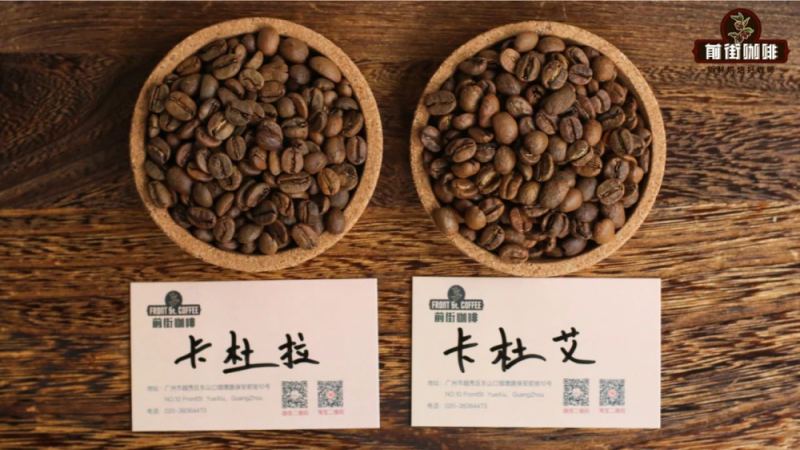
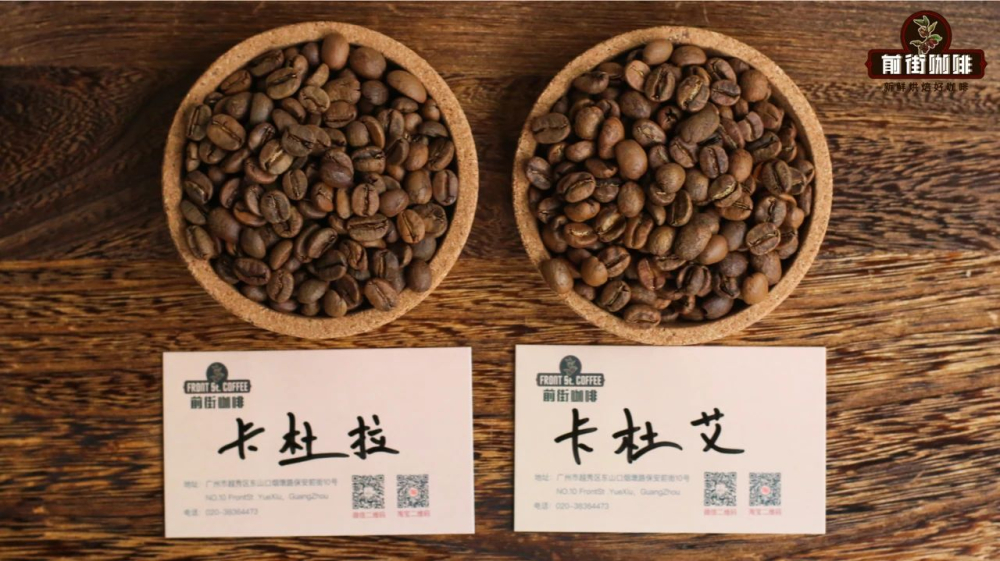
Caturra's bean shape is round and somewhat elongated, with a curve at the tail end of the bean. When Front Street Coffee cupped Caturra separately, it found it to have a bright and clean mouthfeel, with a fairly prominent sweetness.
Catuai's beans are oval and flat, with a relatively slender tail end. When Front Street Coffee cupped Catuai separately, it found it to have soft acidity, a clean mouthfeel, and rich fruit aromas.
Why are Caturra and Catuai mostly planted mixed together?
According to research in Honduras and Costa Rica (the Honduran Coffee Institute IHCAFe once conducted tests, selecting two lines and beginning cultivation), no obvious productivity difference was observed between Caturra and Catuai. Central American coffee estates originally planted Caturra to replace Bourbon, and later introduced Catuai for localized cultivation; Catuai itself carries Caturra's genes, and the biological habits of the two have gradually become closer. If one still insists on distinguishing them, it is not only of little significance but also increases the cost of manual sorting.
Therefore, on many estates in Central America, the two varieties are often mixed-planted and mixed-harvested. Many well-known coffee beans on the market also contain this pair of "brothers," such as Front Street Coffee Honduras barrel-fermented Sherry coffee beans (Pacas, Caturra, Catuai), Front Street Coffee Panama Butterfly coffee beans (70% Geisha, Caturra, Catuai), Front Street Coffee Costa Rica Baha coffee beans (Caturra, Catuai), and so on.
The above content is compiled by CoffeeHunters, a coffee news website.


