








Which African Origins Sit Inside the Coffee Belt?
Africa's coffee-growing countries sit largely within the coffee belt, the band between the Tropic of Cancer and the Tropic of Capricorn. Ethiopia's Yirgacheffe, Kenya's AA grade, Yemen's Mocha and Tanzania's Kilimanjaro each show the fruit acidity and regional character that define African coffee.
Growing conditions there run from about 25 degrees north to 30 degrees south of the equator, with average temperatures of 16 to 25 Celsius, no frost, and 1,600 to 2,000 millimeters of annual rainfall. Africa and the Arabian region account for roughly 20 percent of world production, and Ethiopian coffee processing methods help shape how those flavors reach the cup.
As the continent of coffee's origin, Africa—with its unique climate and terrain—nurtures coffee beans of highly distinctive flavor. From Ethiopia's Yirgacheffe to Kenya's AA grade, and from Yemen's Mocha to Tanzania's Kilimanjaro, each region displays alluring fruit acidity and regional character. This article systematically reviews the cultivation history, varieties, processing methods, and flavor characteristics of Africa's major coffee-producing countries, with information on various cooperatives and representative beans, ideal for coffee lovers who want an in-depth understanding of the full picture of African specialty coffee.
When it comes to Africa, most people picture labels like desert, drought, tribes, and poverty. Yet it is precisely this climate that makes Africa an ideal place for coffee trees to grow. Today, let's walk together into several key coffee-producing countries in Africa and learn about their respective characteristics.
The "Coffee Belt" and "Coffee Production"
Global coffee-growing regions are mostly concentrated between the Tropic of Cancer and the Tropic of Capricorn—that is, the tropics and subtropics—specifically from about 25 degrees north of the equator to 30 degrees south. These places have average annual temperatures between 16 and 25 degrees Celsius, no frost, and annual rainfall between 1,600 and 2,000 millimeters. More than seventy countries currently produce coffee, most planted at elevations of 300 to 400 meters, though some are cultivated at 2,000 to 2,500 meters. Experience shows, however, that coffee from hillsides above 1,500 meters often has better quality.
Coffee trees grow on farms in tropical and subtropical countries centered on the equator, in what is called the "Coffee Belt."
In terms of production, Central and South America account for about sixty percent of the global total, Africa and the Arabian region together about twenty percent, and the remaining 20% is distributed across Asian countries and islands.
★
African Coffee
Flavor characteristics: alluring fruit acidity
Africa is the birthplace of coffee and holds a pivotal position in the entire coffee industry. Although commercial cultivation has developed for hundreds of years, Africa still retains a vast number of wild coffee varieties, resources that are invaluable to coffee researchers. African coffee is generally known for its rich aroma and alluring fruit acidity—bright, lively, and invigorating—but its body tends to be thin, and its sweetness is not always prominent. Due to drought and water scarcity, Africa often uses the natural process for green beans, so bean shapes are often uneven and the defect rate is relatively high.

Ethiopia
Ethiopia is a country full of magic and legend; the Arabica coffee we have drunk and have not yet drunk all originated here.
Ethiopia's recorded coffee history can be traced back to the 4th to 5th centuries AD. At that time, intertribal wars spread coffee to Yemen on the Arabian Peninsula through conquest and migration. Later, with the rise of the Ottoman Empire and the spread of Islam, coffeehouses appeared in Europe under various circumstances, and coffeehouse culture gradually took shape. After that, Central America began growing coffee, and India and Indonesia in Asia joined the ranks of large-scale commercial cultivation. It took hundreds of years to reach today's third wave of specialty coffee.

Ethiopian coffee origin and spread
Earliest origin in the Makira primeval forest
Ethiopia's climate
Ethiopia's climate is polarized: half is humid rainforest, and half is arid desert and gobi.
This is also why coffee cultivation is mainly concentrated in the southern SNNPR and Oromia regions.
Ethiopia's main rainy season is the three months of June, July, and August, and annual precipitation in the main coffee-growing areas is 1,000 to 2,000 millimeters.
The coldest months are December and January, and the hottest are March, April, and May.
The average annual temperature in the main coffee-growing areas ranges from 15 to 30 degrees Celsius.
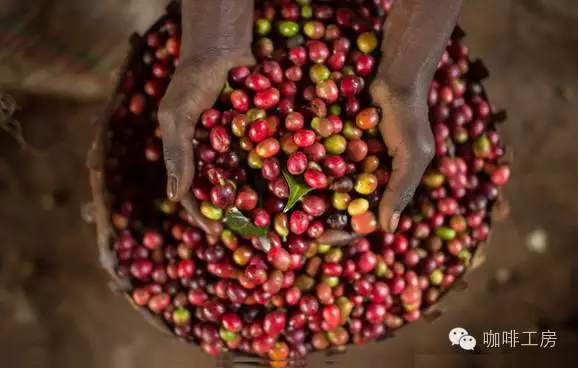
Coffee cultivation in Ethiopia
Around 1995, Ethiopia redrew its administrative regions. The greatest impact on coffee-producing areas was that the former Sidamo Province was split into the new Sidama (only a small part of the former province), with most of it incorporated into Oromia; and Yirgacheffe, formerly part of Sidamo Province, is now assigned to the new Gedeo Zone. As a result, Ethiopian coffee items circulating on the market often mix old and new region names. Here we use the new regional divisions as the basis and combine them with administrative regions to understand Ethiopia's coffee-growing map.
Coffee cultivation in Ethiopia is mainly in the western and southern regions. Smallholder families account for 90% of all cultivation, with nearly 1.2 million smallholder families making a living from coffee. Each household cultivates less than 4 hectares, at elevations between 1,000 and 2,300 meters, with a planting density of 1,000 to 1,800 coffee trees per hectare and a yield of about 600 kilograms per hectare.
By scale and model, Ethiopian coffee cultivation can be divided into:
● Forest coffee (8-10%): coffee trees coexist with other crops in primeval forest, with no artificial management; farmers periodically pick coffee cherries
● Semi-forest coffee (30-35%): the growing area lies between the forest and the surroundings of farmers' living areas; coffee trees grow naturally like forest coffee, and farmers manage the growing area and plant other cash crops
● Garden coffee (50-55%): coffee trees are planted around farmers' living areas, mostly planted by the farmers themselves
● Plantation coffee (5-6%): large private growers with more processing facilities and production capacity
Coffee varieties
Ethiopia has nearly 2,000 recorded coffee varieties (including 1,927 native varieties and 128 introduced foreign varieties).
In appearance, Ethiopia's coffee varieties are a veritable "grand garden": long, short, thin, fat—there is everything you could imagine.
The full family tree of Ethiopian native varieties
Long-shaped beans are distributed across coffee-growing areas throughout the country. In terms of actual proportions, the western Jimma region (including Limmu and Kaffa) has more long-shaped varieties, while Sidama or Yirgacheffe has fewer.
Small-bean varieties are rounder in shape and very small in size, mostly between screen sizes 14 and 15. This is the variety everyone knows best and is often seen in Sidama and Yirgacheffe. I have also seen it in Harrar samples and in green coffee sold locally in Jimma. Compared with other regions, Sidama, Yirgacheffe, and the surrounding Arsi and Guji grow more of these small-bean native varieties.
Processing methods
Ethiopian coffee processing methods include:
● Natural: the most traditional processing method. Because Harrar is especially dry and has no water source for washing, it produces entirely natural beans. Other regions such as Sidama, Yirgacheffe, Guji, and Jimma also produce natural coffee.
● Washed: higher requirements for processing equipment, water sources, and the processing station environment, but it can produce high-quality coffee relatively consistently. All producing regions except Harrar have washed processing.
● Honey: in the past two years, items labeled Kochere honey process have gradually appeared on the market; for now, let's put a question mark on that.
Flavor characteristics
● Washed: citrus fruits, similar to lemon, tangerine, orange, grapefruit, and sweet pomelo. Flavor intensity ranges from relatively obvious citrus peel aroma to fruit acidity of varying intensity—from soft little tangerine to medium-strength orange, and then to the more refreshing acidity of lemon and grapefruit.
● Natural: ripe yellow, red, and black fruit aromas, similar to apricot, peach, cherry, strawberry, cranberry (dried), blueberry (dried), plum, etc., accompanied by varying degrees of vinous aroma, like rum, whiskey, and even red wine aromas (beaujolais).
Ethiopian coffee grades
The definition of Ethiopian coffee grades is rather complicated.
First, under the Ethiopian Ministry of Agriculture there is a department called the Cupping and Liquoring Unit (CLU), specifically responsible for approving the quality of exported coffee, which includes the important duty of grade definition. The CLU existed before the ECX appeared.
Before the ECX appeared, export grades for washed coffee were divided into G1 and G2; export grades for natural coffee were G3, G4, and G5—that is, the highest grade for natural coffee was G3.
After the ECX appeared, grading was redefined. There was no difference in the names of washed grades, but for natural coffee, G1 appeared for the first time. This is why the market now has Ethiopian natural G1 and G2, while G3 is gradually becoming less common.
Ethiopia's nine major specialty production regions
Yirgacheffe (specialty region): elevation 1,800-2,000 m | garden coffee system |
Yirgacheffe belongs to the Sidamo production region but was separated out because of its unique flavor. In addition to the town of Yirgacheffe, it also includes three sub-regions nearby: Wenago, Kochere, and Gelena/Abaya. Therefore, in the new Yirgacheffe grading system, Yirgacheffe A, Wenago A, Kochere A, and Gelena/Abaya A are more expensive than the same-name B. Besides washed and natural, semi-washed Yirgacheffe has recently been introduced and is also worth trying.
Sidamo (specialty region): elevation 1,400-2,200 m | garden coffee system |
Its flavor is similar to Yirgacheffe. Finely washed or natural Sidamo also has floral and orange aromas, and its value is no less than Yirgacheffe's. These two regions have similar varieties; beans are medium-sized, but there are also short, small-bean varieties that farmers often sell separately. The common Kurmie has poor disease resistance; Wolisho is tall and robust; Deiga has a medium tree shape. These three types are the main force in the specialty natural series Biloya and Aricha.
Limu (specialty region): elevation 1,200-2,000 m | garden, forest, semi-forest, and plantation coffee systems |
Production is relatively small, mainly exported to European and American markets. It is not easy to buy in Taiwan, but it is very popular in Europe and the United States. It has three processing methods: washed, natural, and semi-washed. Limu's viscosity is noticeably lower, and its floral and citrus expression is inferior to Yirgacheffe and Sidamo, but it has an extra grassy aroma and brown sugar aroma, with bright fruit acidity.
Harrar (specialty region): elevation 1,500-2,400 m | garden coffee system |
Harrar is exclusively natural. It is an ancient eastern city, but coffee is not grown in the urban area. So-called Harrar coffee refers to coffee produced in the high and low areas of Harrarghe in Greater Harrar. Because annual rainfall is only 1,000 millimeters, all of it uses the natural process. In flavor, Harrar coffee has long been famous for its special "wild mixed aroma," a typical example of ancient early flavors, and it stands alongside Yirgacheffe as the "twin stars."
If Harrar's defective beans can be sorted out cleanly, it is easy to taste berry aromas, with a slight pleasant fermented wild mixed aroma. However, due to various factors, Harrar coffee quality has been unstable in recent years, and the grading system is not reliable, so when buying, be sure to cup or taste it.
Jimma (large commercial bean production region): elevation 1,350-1,850 m | forest/semi-forest system |
Jimma is the capital of the Kaffa forest or Kaffa Province. The English spelling is very messy: maps mostly use Jimma, but coffee burlap bags spell it Djimmah. This is Ethiopia's largest coffee-producing region, accounting for one-third of exports.
The Kaffa forest is known for its primitive wild varieties. Jimma is the collection and distribution center for Kaffa in this region. Farmers habitually transport forest-picked coffee to Jimma, then mix hundreds or thousands of varieties together and sell them as commercial beans, which masks the aroma of many delicious varieties.
Although washed specialty Jimma lacks Yirgacheffe's orange aroma and floral charm, its flavor profile is quite clean and translucent, similar to Central American specialty coffee. Commercial-grade specialty Jimma is very common in Taiwan. With luck, you can also buy good-quality Jimma at a low price, with a fresh lemon-peel aroma that is not inferior to Sidamo. Overall, Jimma is better in flavor than Brazil's large commercial bean Santos and is a good mid- to low-priced blend bean.
Illubabor (large commercial bean production region): elevation 1,350-1,850 | forest/semi-forest coffee system |
This region is located in western Ethiopia, right on the border with Sudan, and is the westernmost production region. Its coffee gene complexity is second only to the Kaffa forest, and its beans are noticeably larger than Yirgacheffe and Sidamo. Fruit acidity is relatively low, viscosity is good, and the flavor is balanced. Coffee from here is mostly transported to Jimma for blending and is rarely sold independently.
Gimbi, Lekempti (large commercial bean production region): elevation 1,500-1,800 | forest/semi-forest coffee system |
This region has both natural and washed beans. The beans resemble Harrar's long beans, and there are also a few specialty-grade lots that are quite popular in Europe and the United States. Most are called "the poor man's Harrar." Their fruit acidity and fruitiness are inferior to Illubabor, and the flavor is bright.
Tepi, Bebeka (large commercial bean production region): elevation 500-1,900 m | garden/forest/semi-forest coffee system |
The two production regions are very close, with Tepi north of Bebeka. There is an enterprise-managed coffee plantation that has promoted the garden system in recent years to increase farmers' income, with annual output of about 3,000 tons. Both places have wild coffee, output is not high, and the flavor is very different from Harrar and Yirgacheffe. Low fruit acidity is the biggest feature, making it suitable for blend beans. It has both natural and washed.
Lake Tana area (alternative production region): elevation 1,840 m | forest system |
Monastery coffee. The surrounding forest coffee has extremely small annual output, less than 10 tons. In fact, it cannot really be called a production region. The Orthodox monasteries, churches, religious murals, and myths clustered around the lake make it the world's most "divine-flavored" coffee.
European monastery monks opened up the local coffee-growing industry, which later was run by coffee communities or cooperatives in villages around the town. There are no dedicated plantations here; coffee trees are naturally scattered in forests and gardens. During harvest season, the Ethiopian Coffee Trading Company goes to the town to buy coffee beans collected by farmers.
In addition to the town of Yirgacheffe, it also includes three nearby sub-regions: Wenago, Kochere, and Gelena/Abaya.
Names and introductions of Ethiopian coffee cooperatives
Sigiga Cooperative (1,600-2,500 m)
Production region: Gedeo-Kochere
Members: 1,862
Soil type: red-brown soil
Certifications: Fair Trade, UTZ sustainable cultivation, Organic
Finchewan Cooperative (1,450-2,000 m)
Production region: Gedeo-Wenago
Members: 1,271
Soil type: red-brown soil
Certifications: Fair Trade, Organic
Konga Cooperative (1,750-2,300 m)
Production region: Gedeo-Yirgacheffe
Members: 1,556
Soil type: red-brown soil
Certifications: Fair Trade, Organic
Hafursa Cooperative (1,750-2,300 m)
Production region: Gedeo-Yirgacheffe
Members: 1,975
Soil type: red-brown soil
Annual green coffee production: 798,000 kg
Average farm size: maximum 4 hectares, annual yield about 600 kg per hectare
The cooperative has a washing station
Certifications: Fair Trade, Organic
Resa Cooperative (1,000-1,400 m)
Production region: Gedeo-Wenago
Members: 2,719
Soil type: red-brown soil
Can provide two sets of coffee processing equipment
Certifications: Fair Trade, Organic
Addis Katema Cooperative (1,000-1,400 m)
Production region: Gedeo-Wenago
Members: 891
The cooperative has a washing station
Soil type: red-brown soil
Certifications: Fair Trade, Organic
Biloya Cooperative (1,600-2,500 m)
Production region: Gedeo-Kochere
Members: 1,203
Soil type: red-brown soil
Provides two sets of coffee processing equipment
Certifications: Fair Trade, Organic
Worka Cooperative (1,650-2,700 m)
Production region: Gedeb
Members: 305
Soil type: red-brown soil
Annual green coffee production: 457,000 kg
Average farm size: maximum 4 hectares, annual yield about 699 kg per hectare
The cooperative has all processing equipment
Certifications: Fair Trade, Organic
Koke Cooperative (1,750-2,300 m)
Production region: Gedeo-Yirgacheffe
Members: 828
Soil type: red-brown soil
Can provide one set of processing equipment
Certifications: Fair Trade, UTZ sustainable cultivation, Organic
Hama Cooperative (1,600-2,500 m)
Production region: Gedeo-Kochere
Members: 1,505
Soil type: red-brown soil
Can provide one set of processing equipment
Certifications: Fair Trade, Organic
Chichu Cooperative (1,410-2,000 m)
Production region: Gedeo-Dila
Members: 1,675
Soil type: red-brown soil
Average farm size: maximum 4 hectares, annual yield about 591 kg per hectare
Can provide one set of processing equipment
Certifications: Fair Trade, Organic
Michile Cooperative (1,410-2,000 m)
Production region: Gedeo-Dila
Members: 1,206
Soil type: red-brown soil
Average farm size: annual yield about 592 kg per hectare
Can provide one set of processing equipment
Certifications: Fair Trade, UTZ sustainable cultivation, Organic
Hase Haro Cooperative (1,450-2,000 m)
Production region: Gedeo-Wenago
Members: 1,519
Soil type: red-brown soil
Average farm size: maximum 4 hectares, annual yield about 591 kg per hectare
Can provide one set of processing equipment
Certifications: Fair Trade, Organic
Dumerso Cooperative (1,750-2,300 m)
Production region: Gedeo-Yirgacheffe
Members: 246
Soil type: red-brown soil
Can provide two sets of processing equipment
Certifications: Fair Trade, Organic
Tumticha Cooperative (1,410-2,000 m)
Production region: Gedeo-Yirgacheffe
Members: 960
Soil type: red-brown soil
Can provide two sets of processing equipment
Certifications: Fair Trade, Organic
Aramo Cooperative (1,750-2,300 m) (90+ Clinique production region)
Production region: Gedeo-Yirgacheffe
Members: 2,254
Soil type: red-brown soil
Can provide two sets of processing equipment
Certifications: Fair Trade, Organic
Edido Cooperative (1,750-2,300 m)
Production region: Gedeo-Yirgacheffe
Members: 1,044
Soil type: red-brown soil
Can provide one set of processing equipment
Certifications: Fair Trade, Organic
Adame Cooperative (1,000-1,400 m)
Production region: Gedeo-Wenago
Members: 533
Soil type: red-brown soil
Can provide one set of processing equipment
Certifications: Fair Trade, Organic
Belekara Cooperative (1,000-1,400 m)
Production region: Gedeo-Wenago
Members: 685
Soil type: red-brown soil
Can provide one set of processing equipment
Certifications: Fair Trade, Organic
Adado Cooperative (1,200-1,700 m)
Production region: Sidamo-Bule
Members: 1,128
Soil type: red-brown soil
Can provide one set of processing equipment
Certifications: Fair Trade, Organic
Haru Cooperative (1,200-1,700 m)
Production region: Gedeo-Yirgacheffe
Members: 1,187
Soil type: red-brown soil
Can provide one set of processing equipment
Certifications: Fair Trade, Organic
Representative: [Ethiopia Yirgacheffe Washed Yirga Native Variety Worka G1]
Distinct floral aroma; both dry and wet aromas have rich citrus notes; the front section has lemon, kumquat, white grape juice, and more—a colorful array of flavors; the middle and back sections have rich citrus sweetness and acidity, like a soda-like abundant sweetness; highly distinctive and outstanding, very rarely seen.
[Ethiopia Washed Sidamo G1 Honey Language]
Obvious wild ginger flower and bergamot, with blackcurrant notes; the finish has the sweetness of raisins; the overall flavor brings to mind Earl Grey tea.
2
Kenya
Kenyan coffee, also called Kenya coffee, is a specialty coffee long loved by many coffee friends; its bright and alluring fruit acidity is irresistible!
Kenyan coffee mostly grows at elevations of 1,500 to 2,100 meters and is harvested twice a year. Coffee industry insiders all consider Kenyan coffee one of their favorite products, because Kenyan coffee contains every feeling we want from a good cup of coffee. Kenyan coffee became even more famous after the sensation of the Hollywood film Out of Africa. It entered Kenya in the 19th century, when Ethiopian coffee beverages were imported into Kenya via South Yemen. But it was not until the early 20th century that Bourbon coffee trees were introduced by the St. Austin Mission.
The current situation of Kenyan coffee
Kenyan coffee beans. The Kenyan government takes the coffee industry extremely seriously; here, cutting down or destroying coffee trees is illegal. Buyers of Kenyan coffee are world-class quality coffee buyers, and no country can plant, produce, and sell coffee as continuously as Kenya.
All coffee beans are first purchased by the Coffee Board of Kenya (CBK), where they are appraised and graded, then sold at weekly auctions, with no further grading at auction. The Coffee Board of Kenya only acts as an agent, collecting coffee samples and distributing them to buyers so they can judge price and quality. The Nairobi auction is held for private exporters, and the Coffee Board of Kenya pays growers less than the market price.
The best coffee grade is Peaberry (PB), followed by AA++, AA+, AA, AB, and so on in order. Top-grade coffee is glossy and bright, delicious, and slightly vinous. Organizing auctions also serves the needs of blenders. Such auctions usually involve relatively small lots (3-6 tons each), with samples bearing grower marks for buyers to taste. After the auction, exporters package according to different flavors, different qualities, and the quantities required by blenders. This gives blenders great flexibility. Quality-focused Germans and Northern Europeans are long-term buyers of Kenyan coffee.
Representative: [Kenya Washed AA Grade Kirinyaga Region Kabarekon Fish Processing Station]
Strong dry and wet aromas of lemon and plum. When sipped at a light roast, it has surprising aromas such as floral and lemon, plus juicy sweet-tart notes like grapefruit green tea and citrus juice. With a slightly darker roast, it immediately shows flavors of honey and raspberry black plum, while the finish has the pleasing sweet-tart taste of DuoDuo green tea.
3
Burundi
Burundi is located in east-central Africa, south of the equator. It borders Rwanda to the north, Tanzania to the east and south, the Democratic Republic of the Congo to the west, and Lake Tanganyika to the southwest. The country has many plateaus and mountains, mostly formed by the highlands on the eastern side of the East African Rift. The national average elevation is 1,600 meters, earning it the name "Land of Mountains." More than half lies on the surface of the famous Lake Tanganyika. The capital is Bujumbura. The western lakeshore and river valleys, as well as the east, have a tropical savanna climate; the central and western parts have a tropical mountain climate. The average annual temperature is 20-24°C, with a maximum of 33°C. March-May is the long rainy season, October-December is the short rainy season, and other months are the dry season.
Burundi has one of the world's most diverse and successfully operated coffee industries, with its own characteristics. The country's coffee was introduced by Belgian colonists in 1930 and is now grown only on small farms. Unfortunately, many of these farms are in areas bordering war-torn Rwanda, which puts pressure on coffee production. Almost all coffee produced in Burundi is Arabica, and the coffee trees in Ngozi are planted at elevations of more than 1,200 meters. Burundi coffee is aromatic and full-bodied, with excellent acidity, and most products are exported to the United States, Germany, Finland, and Japan.
Burundi coffee has striking similarities to its neighbor Rwanda, and the coffees from these two countries are often confused. Burundi's coffee cultivation is mainly Bourbon, using traditional washed processing for coffee cherries. Its specialty coffee is mainly characterized by elegant sweetness and bright citrus aromas.
Representative: [Burundi Micro-lot Kayanza Province Natural Bourbon]
Flavor description: rich aromas of raisins, blackberry jam, and ripe peaches; the front section has sweet flavors of cranberry, citrus, and peach juice, while the rich sweetness of caramel and orange marmalade fills the whole cup; the fermented vinous aroma of the natural process is also very prominent, like orange wine or peach flavors—absolutely a uniquely styled Burundi specialty coffee.
4
Rwanda
Rwanda is divided into five major coffee-producing regions, and the coffee from these five regions differs slightly in aroma and mouthfeel. Rwandan coffee tastes relatively acidic, but the aftertaste is endless. "Good coffee is like Chinese tea; only after drinking it can you feel the sweetness." The famous coffee chain Starbucks also imports part of its raw materials from Rwanda.
Coffee cultivation in Rwanda
Rwanda is known as the "Land of a Thousand Hills." The country is mostly mountainous and plateau, and most areas have a tropical highland climate and tropical savanna climate, mild and cool. There are about 33,000 hectares of coffee plantations, and 500,000 people work in coffee cultivation. Rwanda is a country uniquely able to fully enjoy harmony among soil, altitude, and climate. Rwanda has exceptionally favorable conditions for growing Arabica coffee: fertile volcanic soil, abundant rainfall, and suitable temperatures year-round. These make our coffee's flavor distinctive.
The beautiful Land of a Thousand Hills, Rwanda, has a long and rich culture of growing highland coffee, mainly cultivating high-quality Arabica coffee. This specialty coffee accounts for 20% of Rwanda's total coffee production and is also very popular in international markets. In this unique growing environment, Rwanda's high-quality coffee has a distinctive mouthfeel and aroma. According to Karuritewa, marketing and promotion officer of the Rwanda Coffee Association, Rwanda plans to reach 3,000 tons of coffee exports this year, further increasing coffee production to meet growing market demand. Starbucks, the world's largest coffee beverage retailer, has also partnered with the Rwandan government to import Rwandan coffee, just as on the Rwandan coffee trademark, a coffee-colored dove flies up from a coffee cup against the words "Cup of Hope."
Like many African countries, Rwandan coffee is mainly produced by smallholders. Each year during harvest season, coffee growers gather ripe coffee cherries and send them to processing stations. The Mushonyi processing station has an astonishing award record: besides winning the COE Cup of Excellence championship in 2010, in 2011 alone it took first place, 12th place, 16th place, and 28th place with four lots!!! Each year during harvest season, farmers pick ripe coffee cherries and gather them at the processing station for processing. First, they are hand-sorted to ensure no unripe or damaged fruit is mixed in. Then the skin is removed, and after a 12-18 hour washing fermentation process in a cool, low-temperature environment, the adhering mucilage is cleaned off in channels. During drying on raised beds, members of the processing station turn the beans by hand and carefully tend them to ensure that, under full sun, the parchment green beans do not lose moisture or dry unevenly, until the moisture content of the green beans stabilizes below 14%.
Flavor of Rwandan coffee
The taste of Rwandan coffee is described as "grassy aroma," with tropical climate characteristics. Besides the fruit sweetness it presents, this coffee also lets people taste a refreshing, clear, and fresh feeling. The Bourbon coffee grown in Rwanda is amazing for its fruit sweetness; its aroma is rich and full, with no astringency at all, leaving a long aftertaste. This coffee has a delicious citrusy sweet aroma and a deep chocolate color, with red apple, cherry, cinnamon, and honey notes, excellent sweetness and balance, and a finish of cinnamon, almond, and chocolate.
Representative: [Rwanda Western Province Mushonyi Processing Station Washed Bourbon]
Red apple, cherry, cinnamon, and honey; excellent sweetness and balance; a finish of cinnamon, almond, and chocolate.
5
Yemen
Yemen produces Peaberry beans: these coffee beans are smaller and rounder than most coffee beans, looking like peas, and are sometimes also called Mocha coffee beans. Mocha coffee beans are also similar in appearance to Ethiopia's Harrar coffee beans: small in size, high in acidity, and mixed with a strange, indescribable spicy flavor. If you taste carefully, you can also detect a little chocolate flavor, so trying to add chocolate to coffee was a very natural development.
In Yemen, coffee growers plant poplar trees to provide the shade coffee trees need to grow. As in the past, these trees are planted on steep terraces to make maximum use of scarce rainfall and limited land resources. Besides Typica and Bourbon coffee trees, more than a dozen different coffee tree species native to Ethiopia are also grown in Yemen. Authentic "Mocha coffee" is produced only in the Republic of Yemen in the southwestern Arabian Peninsula, growing on steep mountainsides at elevations of 3,000 to 8,000 feet, and it is also the world's oldest coffee.
Classification of Yemen Mocha coffee
Mokha Mattari: the most prestigious market name for coffee from Bani Mattar (also spelled Bany Mattar), west of Yemen's capital Sana'a. It is high-altitude coffee, usually with good red wine aroma, dried fruit notes, a full mouthfeel, and often showing chocolate bittersweet notes at dark roast. Good-quality Mattari beans are small; the green beans have a pungent sweet wine aroma and a moderate ripe-fruit fermented note. It always wins because of a more obvious Yemeni style.
Mokha San'ani: a broad market name for coffee from several growing areas west of Yemen's capital Sana'a. It is a blend of beans from tens of thousands of small farms on hillsides near the capital Sana'a (left image: Sana'a, the capital of Yemen). The growing elevation is slightly lower than Mattari. Generally speaking, its mouthfeel is thinner than Mattari and its acidity is lower, but its fruit aroma is good, and it often has better ripe-fruit and wild notes than Mattari. In my experience, San'ani quality has varied greatly in recent years, with occasional inferior goods that are flat, earthy, or overly fermented. Careful cupping and selection is a required task for coffee merchants and absolutely cannot be neglected.
Mokha Ismaili: one of the traditional ancient varieties, a market name for a famous coffee from central Yemen, also described as a traditional botanical classification of Yemeni coffee, with relatively high beverage quality. It is grown at very high elevations, above 6,500 feet. Its characteristic is rounder bean shape, smaller than Mattari, with a full mouthfeel and high complexity. Generally speaking, it often performs better than Mattari. This is the least produced and most expensive Yemen Mocha (Yemen Mocha was already not cheap). High-quality Mokha Ismaili is produced in the high mountain slopes of the Hirazi region (although its fame is as loud as Bani Matar's, it is the region with the best local reputation in Yemen), and the highest elevation in Hirazi reaches 8,000 feet!
Mokha Rimi: produced in the Djebel Remi (also known as Raimi, Rayma) region; quality is similar to San'ani. Mokha Rimi's fermented note is usually slightly heavier, and occasionally an amazingly rich raisin sweetness appears. If roasted properly, the coffee beans smell like opening a bottle of rich jam.
Mokha Yafeh: produced in Yemen's southern Yafeh (also known as Yaffe) province, it is an uncommon Yemen Mocha and Yemen's only "southern taste." Production is also low, and it is almost all sold to the neighboring United Arab Emirates, so it is rarely seen in the international specialty coffee market.
Arabian Mocha: a single-origin coffee from the mountains of Yemen on the southwestern end of the Arabian Peninsula bordering the Red Sea. It is among the world's best cultivated coffees, famous for its high viscosity and its special, richly vinous acidity.
Yemen Mocha has developed different schools depending on the growing region, just like MATTARI Mocha's chocolate and acidity, and SANANI Mocha's wildness and fragrance.
Characteristics of Yemeni coffee
Although Yemeni coffee is top quality, smooth, and aromatic, there are also unsatisfactory aspects: quality cannot be consistently guaranteed, and the grading of its coffee beans is also uncertain. Traditionally, Yemen's best coffee beans are considered to come from Mattari, followed by Sharki, and then Sanani. These coffee beans are low in caffeine. Dark-roasted Yemeni coffee often shows a chocolate-like bittersweet charm, influencing today's flavored coffees made with chocolate sauce, which are also labeled "Mocha." Yemeni coffee has the world's most unique, rich, and fascinating complex aroma: red wine, wildness, dried fruit, blueberry, grape, cinnamon, tobacco, sweet spices, raw wood, and even chocolate. You can see all kinds of adjectives applied to Yemen Mocha. Just as Mocha has many meanings, the English spelling of Mocha also has various forms: Moka, Moca, and Mocca are common spellings. On Yemeni coffee sacks and documents, local spellings number as many as four: "Mokha," "Makha," "Morkha," and "Mukha," all meaning the same thing.
6
Tanzania
Source of Tanzanian beans: In 1898, Bourbon coffee was introduced to Tanzania's Kilimanjaro region by Catholic missionaries. Then Kent was also introduced in 1920. Therefore, to this day, Tanzanian coffee is still mainly Bourbon and Kent.
Coffee varieties:
Arabica 70%, grown between 1,000-2,500 meters
Robusta 30%, grown between 800-900 meters
3 major growing regions:
North: 1 and 2 Harvest season: July-December
West: 3 and 4 Harvest season: May-October
South: 5 and 6 Harvest season: July-December
Total growing area about 250,000 hectares
Coffee taste:
Tanzania is a typical East African country, bordering Kenya and Uganda to the north, Malawi, Mozambique, and Zambia to the south, and Rwanda and Burundi to the west. Many people like to compare Tanzanian coffee with its neighbor Kenya's. Compared with Kenya's high-quality coffee beans, Tanzanian coffee has a little less bright acidity, showing more of a soft and gentle beauty, with more sweet aroma. A strong red wine note is also a characteristic of Tanzania.
In northeastern Tanzania stands Mount Kilimanjaro, Africa's highest peak. After World War I it was a mandate territory and was once under British colonial rule; it became independent in 1964. Bourbon coffee was first introduced for cultivation as early as 1893. Green bean processing is mainly washed. Good-quality high-altitude Tanzanian coffee, like Kenya's, has lively, bright acidity.
In Tanzania's coffee-producing regions, the north includes production areas such as Moshi and Mbeya around the highlands at the foot of Mount Kilimanjaro, while to the south the main area is the Songea-Ruvuma zone through which the Ruvuma River flows. Because of differences in growing terrain, styles differ slightly. Coffee produced in the Ruvuma region in southwestern Tanzania has vinous and fruity aromas, different from coffee in the northern area near Mount Kilimanjaro.
Mount Kilimanjaro, a volcano, is in northeastern Tanzania and is also Tanzania's largest coffee-producing region, accounting for 75%. Generally speaking, Tanzanian coffee beans have extraordinary quality. Important production areas are in the northern mountains near Kenya. Smallholder coffee farmers account for 85% of coffee cultivation, with local smallholders growing coffee between 1,300-2,000 m. Its coffee flavor is different from the characteristics of neighboring Ethiopia and Kenya; it has features of both countries, with good body and both fruity and floral aromas. It is a coffee worth trying.
Northern coffee is full of aroma, with bright acidity and a mellow mouthfeel, and thanks to fertile volcanic soil, it has a mineral-water-like sweetness.
Southern coffee has rich floral aromas, with a smooth mouthfeel and elegant fruit acidity.
Coffee-growing regions in Africa—Tanzanian coffee comes from the fertile soil of the East African Rift Valley and is an outstanding representative of high-quality coffee from this region. Its refreshing acidity and medium body complement sweet citrus and floral aromas.
END
Finally
Africa is very large, and many producing regions turn out excellent beans. Due to space limitations, I cannot introduce them all one by one. If there are any inaccuracies, please point them out.
Please follow Front Street Coffee's bean tastings and let you taste the world's best and most richly flavored coffee.
The above content is compiled by CoffeeHunters, a coffee news website.


