








The key to a delicious latte lies in the fusion state of milk and coffee and the temperature at the moment it enters the mouth. This article will systematically explain the scientific principles of milk frothing, the factors affecting the degree of fusion between milk foam and coffee, and reveal the differences in milk foam persistence at different frothing temperatures through experimental data. At the same time, it provides cause analysis and solutions for common problems in daily operations, such as milk foam not fusing and milk foam floating up during latte art. Combining the practical experience of Front Street Coffee, the article also explains why around 60°C is the optimal flavor temperature range for milk coffee, and how to judge whether the degree of milk foam fusion meets the standard.

Frothing milk to achieve the ideal texture is a basic skill that every barista must master. Front Street Coffee believes that whether milk can be steamed to just the right state directly reflects a barista's professional level. Taking a latte as an example, the milk foam should be relatively thin and smooth and delicate on the palate. Therefore, when steaming milk for a latte, avoid making the foam too thick; the finished surface should appear glossy, with no obvious large or small bubbles, and should be delicate and uniform overall.
The core principle of milk frothing is to use steam to impact the milk, introducing air into the liquid milk, and relying on the surface tension of milk proteins to form numerous tiny bubbles, causing the liquid milk to expand in volume and transform into a foam-like structure.
During the frothing process, lactose dissolves in the milk as the temperature rises and is sealed inside the bubbles through frothing; milk fat helps stabilize the fine bubbles. When drinking, these tiny bubbles burst in the mouth, allowing flavors and aromatic substances to be better released and amplified, giving the milk a sweet, rich taste and mouthfeel. When milk is mixed with coffee, the intermolecular bonding force is stronger, and coffee and milk can fully combine; their respective characteristics are both highlighted and integrated, achieving a mutually complementary effect.
Front Street Coffee is here to answer some common questions encountered when frothing milk!
Why does the frothed milk foam not fuse?
First, for the milk foam and coffee to fuse perfectly, the prerequisite is that the coffee beans are fresh enough. Beans that have been stored too long may produce espresso with yellow crema on the surface, but the texture is rather hard, the aroma is insufficient, and the flavor is relatively mediocre.
For beginners, it is suitable to choose Front Street. Front Street Classic Blend, a medium-dark roast with the roasted aromatic flavors of spices, dark chocolate, maple syrup, and roasted hazelnut. It has low acidity and is suitable for friends who prefer strong coffee. It can provide rich crema while giving the coffee a higher body. Front Street Coffee ships within 5 days of fresh roasting, ensuring a longer optimal tasting period when received.
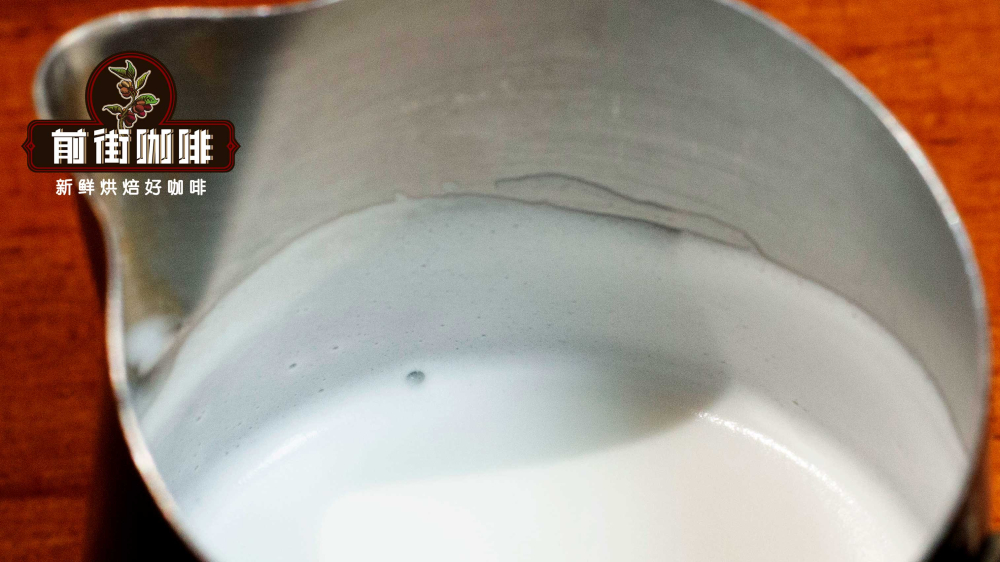
After the milk foam is poured into the espresso, it immediately blends into the coffee. Not to mention drawing patterns, it cannot even retain lines and simply disperses; or the earlier fusion stage may be acceptable, but once latte art begins, the milk foam clumps and floats on the surface. Front Street Coffee first explains the first situation: this is because the amount of aeration is insufficient and the milk foam is too thin, so the main body is just hot milk and naturally cannot take shape. In this case, please boldly increase the amount of aeration.
So why does the fusion seem fine, yet the milk foam floats on top during latte art?
The main reason is that the degree of fusion between the milk and milk foam is poor, causing the two to separate, and ultimately the milk foam floats on the surface of the coffee. This situation can only be adjusted during the texturing stage.
What determines the degree of fusion between milk foam and milk? It mainly depends on the following two points:
1. The steam wand pressure. The steam wand pressure affects the degree of rolling of the milk foam during frothing. The greater the pressure, the higher the degree of fusion.
2. The fineness of the milk foam. The finer the milk foam produced, the less air contained in each individual bubble, resulting in higher density and less buoyancy; the coarser the milk foam, the more air contained in each individual bubble, resulting in lower density and greater buoyancy. If the milk foam is coarse, it will quickly float to the surface of the milk, resulting in a low degree of fusion; if the milk foam is fine, it rises slowly, resulting in a higher degree of fusion.
Why is a high degree of fusion between milk and milk foam required? The higher the degree of fusion between milk foam and milk, the clearer and more delicate the lines of the latte art pattern; conversely, the lines will be blurry and rough.
How should the degree of fusion of milk and milk foam be judged?
Front Street Coffee teaches you how to judge the degree of fusion of milk and milk foam: pour the frothed and fully fused milk and milk foam into a glass and let it stand, observing the time required for separation. The length of the separation time reflects the degree of fusion.
If separation occurs within 30 seconds, it is poor; if within 30 to 60 seconds, it is medium; if after 60 seconds, it is excellent.
In addition, never set the frothed milk foam aside to use later, as that will also cause separation.
Some may ask, why control the temperature when frothing milk?
Front Street Coffee usually heats milk to around 60°C, but it must not exceed 70°C, otherwise the protein structure in the milk will be destroyed.

Front Street Coffee previously conducted experiments, frothing milk to different temperatures:
The 90°C case: above about 70°C, even without deliberately frothing, the foam rapidly expands, and with the high temperature constantly rolling, by nearly 90°C the milk has already overflowed the milk pitcher (as shown above), finally stopping at 94°C. After about 1 minute and 30 seconds, obvious signs of foam dissipation appeared.
The 60°C case: this is the temperature we commonly use. Froth the milk foam according to normal operation and stop when it feels hot to the touch; the temperature is about 63°C. After about 10 minutes and 50 seconds, obvious signs of foam dissipation appeared.
The 30°C case: froth according to the usual technique and stop when it feels warm to the touch; the temperature is about 33°C. After about 4 minutes and 20 seconds, obvious signs of foam dissipation appeared.
The 12°C case: directly use milk taken from the refrigerator, operate with a manual frother, with a pouring temperature of 8°C and 12°C after frothing. After about 5 minutes and 15 seconds, obvious signs of foam dissipation appeared.
Milk foam in the 50 to 70°C range has the best persistence, whether in pure milk form or after being added to coffee, for two reasons: first, after frothing there is sufficient time for mixing and texturing between the milk foam and the liquid milk; second, it is at the stage where the milk begins to denature but has not yet reached irreversible denaturation, resulting in higher stability.
When milk foam is frothed to around 80 to 90°C, irreversible denaturation of the milk occurs. There are mainly two types of protein in milk: whey protein and casein; whey protein begins to denature above 60°C. Therefore, when frothed to around 90°C, the protein has insufficient elasticity and the foam dissipates quickly.
When milk foam is frothed to around 30 to 40°C, the foam dissipates relatively quickly because, after frothing, there is insufficient time for mixing and texturing between the milk foam and the liquid milk.
Frozen milk foam dissipates quickly because we use a manual frother, whose degree of mixing cannot compare with the fusion effect of high-speed mixing by a steam wand, so the degree of fusion is inherently not high; in addition, during the transition from low temperature to room temperature, the milk foam undergoes warming, is pressured by external heat, and the internal gas expands with heat, so bubble bursting is more obvious.
The above content is compiled by CoffeeHunters, a coffee news website.


