








For a delicious latte, Front Street believes the most important things are the quality of the coffee beans and milk, the ratio of coffee to milk, and the pouring and blending technique.
Why is a latte so simple, yet basically every coffee bean menu has it as a staple, but every shop's latte never tastes exactly the same? One of the main reasons is that the milk and coffee beans used are all different.

However, the choice of milk is also very important. For whole fresh milk alone, there are more than 10 common types on the market. Among these milks, some have a strong milky taste, some are thick in mouthfeel, and some are light, like water. The standard for choosing milk is not simply to pursue the thickest or most obviously milky one, but to choose one that pairs well with coffee. A strong milky taste will mask part of the coffee's flavor, while milk with an obvious watery feel will also make the latte watery.

Front Street believes there is no fixed ratio for a latte; everything depends on how the espresso's flavor performs and how well it pairs with the milk. However, there is a rough range: 1:5 to 1:8.

The espresso beans currently used by Front Street are called Sunflower Warm Sun blend coffee beans, blended from Yirgacheffe Red Cherry and Honduras Sherry. The bitterness is moderate, and the flavor leans toward sherry wine aroma, chocolate, vanilla cream, and brown sugar. These coffee beans are not as strong and bitter as traditional espresso beans, and when paired with the right ratio of milk, you can taste a dense milk chocolate flavor. When Front Street uses these coffee beans to make a latte, the coffee-to-milk ratio is 1:6, with 40g of espresso liquid plus 240ml of steamed milk.
Point 3: The specific steps
Extracting a qualified espresso and steaming fine, dense milk foam are the foundation of making a delicious latte. For the espresso extraction parameters, Front Street recommends extracting 40g of coffee liquid from 20g of coffee, with the time controlled at 25-30 seconds. For milk steaming, the desired thickness is to steam milk from the 5-point line to the 6-point line, and the milk temperature is recommended to be between 55-60 degrees.

Next is blending. Only when the milk and espresso are fully blended can the coffee taste consistent. If the blending is uneven, the first sip may taste strongly of milk while the next tastes strongly of coffee.
Good blending starts with the coffee crema on the surface and the milk foam blending evenly. This shows in the consistency of the color on the surface of the liquid, which is what we often call the "golden ring." Second, the surface of the coffee liquid should be fine and smooth, with no large bubbles.

Blending techniques
① First, the "hardware" must be up to standard! That is, the quality of the espresso and milk foam must be good. The espresso should have rich, viscous crema, and the milk foam should be fine and highly fluid. Many times, poor blending is caused by milk foam being steamed too thick, resulting in poor fluidity, so the milk foam floats on the surface. Before blending, swirling the coffee cup and milk pitcher once to increase the fluidity of the liquids inside will also raise the success rate of blending.

② The height of the pitcher spout during blending. We all know that when pouring latte art, the pitcher spout must be lowered close to the surface of the coffee liquid so that white milk foam appears. The principle is similar here: if it is too low, a large amount of milk foam will float on the surface, causing uneven blending. If it is too high, the problem described above will occur, and bubbles will appear on the surface of the liquid.
Generally, the distance between the pitcher spout and the surface of the coffee liquid is about 5 to 10 centimeters. Everyone's habits are different, so there is no completely fixed standard for height and distance.
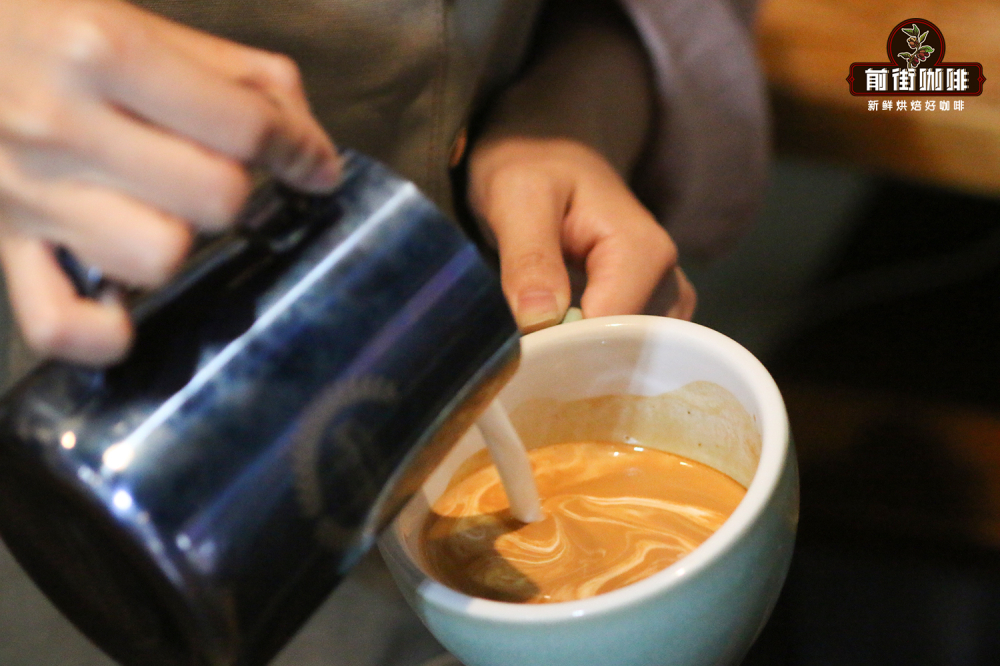
③ Blending motion. The usual blending motion is stirring in one direction. Hold the coffee cup with your left hand and the latte art pitcher with your right hand, and offset the two hands by half a circle to make relative circular movements, with one higher and one lower. This stirring force can easily mix the coffee and milk thoroughly. As for how large a circle to make, Front Street suggests making the largest circle possible without touching the wall of the cup. The hand holding the coffee cup should be careful to slowly straighten it.
For professional coffee knowledge exchange and more coffee bean information, please follow Coffee Workshop (WeChat public account: cafe_style)
For more specialty coffee beans, please add the private WeChat of Front Street Coffee (FrontStreet Coffee), WeChat ID: qjcoffeex
The above content is compiled by CoffeeHunters, a coffee news website.


