







Why Do Classic Coffees Like Blue Mountain and Mocha Endure?
Jamaica Blue Mountain, Indonesian Mandheling, and Yemeni Mocha are three classic coffees defined by their terroir and processing. Blue Mountain grows in the Blue Mountains, whose highest point reaches 2,400 meters, on fertile new volcanic soil rich in nitrogen and phosphorus, with steady rainfall and cloud cover that blocks intense sunlight.
Blue Mountain belongs to the Typica variety, which has bronze-colored top leaves, oval or slender pointed beans, a tall tree, and branches set at roughly a 50 to 70 degree angle. Terroir and variety together shape each coffee's aroma and flavor, which is why these three names have stayed recognizable for so long.
In the world of specialty coffee, Jamaica Blue Mountain, Indonesian Mandheling, and Yemeni Mocha have always been three unavoidable peaks. Each carries its own unique terroir and processing methods, shaping distinctly different aromas and flavors. Front Street Coffee has shared these three classic coffees many times before. This article will go through their origins and key identifying points one by one—from growing environment, variety characteristics, and processing methods to flavor expression—to help coffee enthusiasts more systematically understand why they have endured.
For more specialty coffee knowledge, please follow: Front Street Coffee (Frontsteet Coffee)
Longtime friends of Front Street know that we have introduced a fairly rich range of coffee categories, and each one has its own distinct personality. Among them are many familiar names such as Front Street Blue Mountain Coffee, Front Street Geisha Coffee, Front Street Yirgacheffe Coffee, Front Street Mandheling Coffee, and Front Street Mocha Coffee. However, when it comes to coffee with a rich, full-bodied flavor and strong aroma, what first comes to many people's minds is still Jamaica Blue Mountain, Indonesian Mandheling, and Yemeni Mocha. Today, let's take a closer look at the origins of each of these three coffees.
Jamaica Blue Mountain Coffee
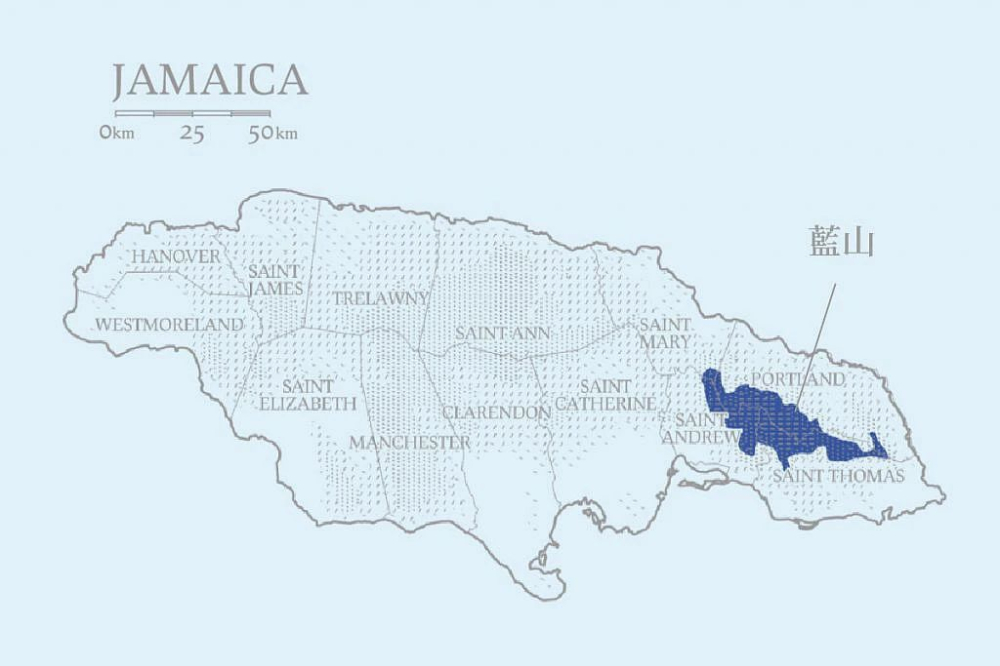
Jamaica is an island nation in the Caribbean Sea, and the famous Blue Mountains are located there. The highest point of the Blue Mountains reaches 2,400 meters, making it the tallest peak in the Caribbean region.
This area happens to lie within the coffee-growing belt, with fertile new volcanic soil, clear and clean air free of industrial pollution, abundant rainfall year-round, relatively high humidity, and a notable temperature difference between day and night. The soil is rich in nitrogen and phosphorus, providing ideal conditions for coffee cultivation. The fertility of the volcanic soil, stable rainfall, and the clouds and mist that linger over the island year-round and block intense sunlight—all these favorable factors combined are what create the unique quality of Blue Mountain Coffee.
Introduction to the Blue Mountain Coffee Variety
Blue Mountain Coffee belongs to the Typica variety. Typica has bronze-colored top leaves, oval or slender pointed bean shapes, a relatively tall tree body, and slightly angled branches with an angle of about 50 to 70 degrees. Its flavor is elegant, but the plant itself is somewhat weak, has poor disease resistance, very low yield per plant, and produces few cherries.
Typica has a clear identifying feature: the tips of its leaves are copper-red, which is why it is also called Red Tip Coffee. The opposite leaves of the coffee tree are long oval-shaped, with smooth surfaces, and the terminal branches are longer with few branches. The flowers are white and bloom where the leaf stalk meets the branch. The ripe coffee fruit resembles a cherry and is bright red in color.
Characteristics of Front Street Authentic Blue Mountain Coffee
1. Appearance: Green beans of Blue Mountain Coffee are green in color, uniform in appearance, medium-small in size, and slightly upturned at both ends. After roasting, they expand noticeably in volume and the beans become very plump.
2. Grinding: Authentic Blue Mountain Coffee comes from high-altitude regions, and its cell structure is relatively loose. When grinding by hand, it feels crisp, smooth, and continuous, without any obvious resistance.
3. Aroma: The aroma is rich and dense. Those so-called Blue Mountain coffees made from blends will not have this kind of aromatic expression.
4. Taste: Real Blue Mountain Coffee has a balanced, full-bodied mouthfeel, without any one flavor standing out too much or any obvious missing note. This is precisely what makes it difficult for other coffee beans to match, and it is also the most critical point when identifying it. Blue Mountain estate beans have a more restrained aroma and a relatively stronger mouthfeel.
Indonesian Mandheling Coffee
Indonesia straddles the equator and is made up of many large and small islands. Its coffee production ranks third in the world, most of which is Robusta. Arabica is also grown on Java, Sulawesi, and Sumatra. In particular, Mandheling Coffee produced in Sumatra can be called the representative of Indonesian coffee, and GRADE 1 is the top grade with the fewest defective beans.
When it comes to "Golden Mandheling," PWN must be mentioned first. This abbreviation often appears together with the name Mandheling Coffee, and it is actually the short name of a company—Pwani Coffee Company.
This company is a very famous coffee buyer locally in Indonesia, and its main business is purchasing Mandheling Coffee. It has taken in almost all of Indonesia's best-producing regions, so most of the beans produced by PWN are unique specialty lots. Golden Mandheling is a product launched by this company. After the green beans are purchased, they still undergo multiple rounds of manual hand sorting to select plump, flawless beans. Only excellent beans that pass this layer-by-layer screening can be classified as Golden Mandheling.
Wet Hulling, also called wet shelling, is known locally as Giling Basah and is a traditional Indonesian coffee processing method. Judging by the name alone, wet hulling seems very close to wet processing (that is, the washed method), but the flavors of the two in cupping are completely different. Coffee processed by wet hulling usually has a full-bodied, intense mouthfeel and a very distinct character.
The variety of Golden Mandheling is also Typica. The green beans are basically 19 screen or above, darker green in color, and neatly shaped flat beans. A relatively large number of peaberries may be seen among them, but this is not considered a defect. The reason is that when wet hulling removes the parchment, the coffee beans still have a moisture content as high as 20% to 24%, whereas general processing methods wait until the moisture content drops to 10% to 12% before hulling. In this "semi-dry" state, the parchment easily sticks to the surface of the green beans, making it much harder to remove than in a "fully dry" state, and the hulling process requires greater friction.
Golden Mandheling Coffee Beans
Layered and changeable, clean, balanced, with a lasting caramel sweetness in the finish. The mouthfeel is high in sweetness and rich and full-bodied, with flavor notes of baked toast, pine, caramel, cocoa, and a slight herbal earthy note.
Aroma: None Cleanliness: Medium Sweetness: Medium Acidity: None Intensity: Strong Bitterness: Medium Aftertaste: Strong After cooling: None
Mocha Coffee
First, we need to briefly understand the place called Mocha. Mocha is a port city on the Red Sea coast in southern Yemen. In the past, it was an extremely important transportation hub, no less significant than the Port of Shanghai today. This is because it was the only waterway connecting the Red Sea and the Indian Ocean, and all merchant ships traveling from the Indian Ocean to the Mediterranean, Europe, and other places had to pass through this checkpoint.
In addition, the Port of Mocha was also the earliest coffee trading distribution center and the largest international coffee trading hub at the time. From the 15th century to the early 18th century, over these more than three hundred years, the vast majority of the world's coffee was exported from the Port of Mocha. From Yemen's national emblem, one can see how important coffee is to this country. And the famous Mocha coffee beans are named precisely after the Port of Mocha.
Although Mocha itself does not grow coffee, the coffee it exported mainly came from the central region of Yemen, the country to which it belonged (though of course not entirely). It is worth mentioning that Yemen was the first country to cultivate coffee on a large scale as an agricultural product. After coffee was exported through the Port of Mocha to places around the world, it became widely praised for its unique chocolate-like character. But at the time, the only traceable information about the coffee was that it "came from the Port of Mocha," so people simply collectively called coffee beans exported from the Port of Mocha "Mocha Coffee (Beans)."
As coffee quickly became popular in Europe, afterward all coffee exported from the Port of Mocha was sold under the name "Mocha Coffee." This was also related to the policies of the time: all coffee sacks exported through the Port of Mocha were printed with the word "Mocha," further deepening people's impression of Mocha Coffee. So we can understand that the original "Mocha Coffee" referred to coffee beans exported from the Port of Mocha, and more specifically referred to that type of Mocha coffee bean grown in Yemen with a chocolate-like character.
The above content is compiled by CoffeeHunters, a coffee news website.


