







What grind size suits your coffee brewing method?
Coffee brewing begins with grinding the beans, and each variety has its own requirement for how fine the powder should be. On a manual hand grinder, the crank assembly usually holds five parts: the grind size adjustment screw, the check fixing ring, the A-shaped adjustment fixing screw, the crank and the main fixing screw. Turning the screw clockwise yields finer powder, counterclockwise coarser particles.
Some hand grinders must be fully disassembled before the adjustment screw can be turned, then reassembled; others adjust by turning the screw directly. Beyond grind size, the coffee-to-water ratio, water temperature and extraction time shape the cup. A full demonstration with Panama Diamond Mountain beans shows how these variables combine into a repeatable pour-over routine.
To make a good pour-over at home, controlling the grind size is often the first hurdle. Compared to pricey electric grinders, manual hand grinders have become the go-to entry choice for many enthusiasts, but many people aren't clear on how to properly adjust their grind size parameters. In this article, Front Street Coffee starts with the disassembly steps of a manual hand grinder, explains one by one the relationship between the rotation direction of the adjustment screw and the grinding effect, and provides the corresponding grind standards for different brewing methods. At the same time, combining variables such as coffee-to-water ratio, water temperature, and extraction time, a complete brewing demonstration is done using Panama Diamond Mountain coffee beans to help readers build a reproducible brewing approach.
Before brewing pour-over coffee, you must first grind the coffee beans into powder, and different varieties of beans have different requirements for the degree of grinding. Because of this, almost every coffee shop is equipped with an electric grinder. However, electric equipment is rather expensive, so many coffee enthusiasts turn their attention to manual hand grinders. So how exactly should a manual hand grinder be operated? Front Street Coffee (FrontStreet Coffee) will chat with you about this topic today.
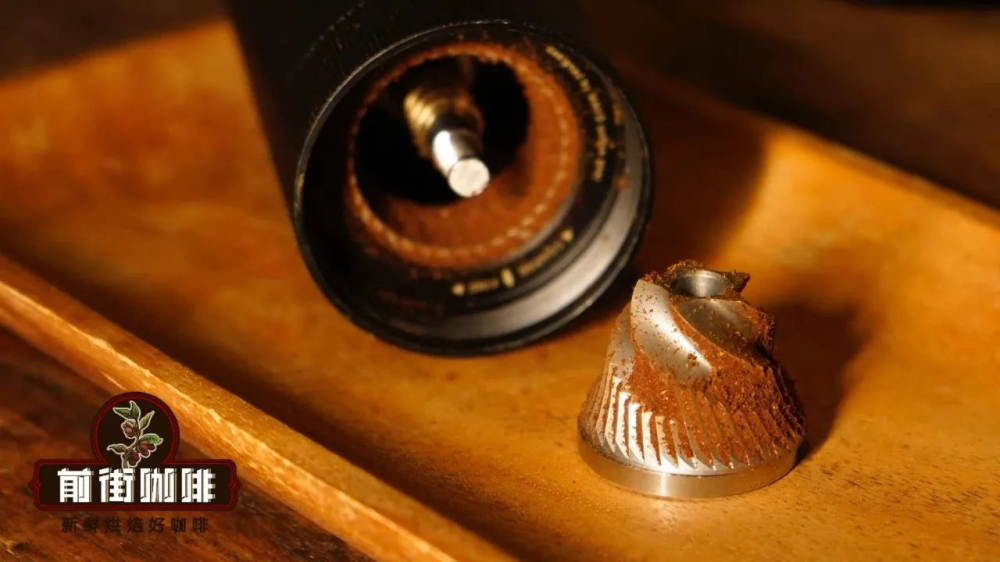
First, let's get to know the structure of the crank part of a manual hand grinder. It usually consists of five components: the grind size adjustment screw, the check fixing ring, the A-shaped grind size adjustment fixing screw, the crank, and the main fixing screw. Designs differ across models—some models require fully disassembling all the above parts before you can operate the grind size adjustment screw, and after adjusting you have to reassemble everything; other models support adjusting by directly turning the screw. The operating principle is intuitive: turning the grind size adjustment screw clockwise produces finer powder; turning it counterclockwise gives coarser particles.
If you're using a rotary-wing electric grinder, the key to getting uniform particles is to keep shaking the body up and down during grinding. While observing the grinding state, adjust the coffee powder to the ideal size—this is the core essential. Once you're skilled enough, you can judge the coarseness of the particles just from the sound made while shaking. This may sound a bit like advertising copy, but it's really true—the finer the particles, the softer the sound.
Below is a step-by-step explanation of the disassembly and assembly process of a manual hand grinder:
1. Unscrew the metal nut on top of the grinder
2. Remove the crank
3. Remove the fixing metal clip above the fineness adjustment screw
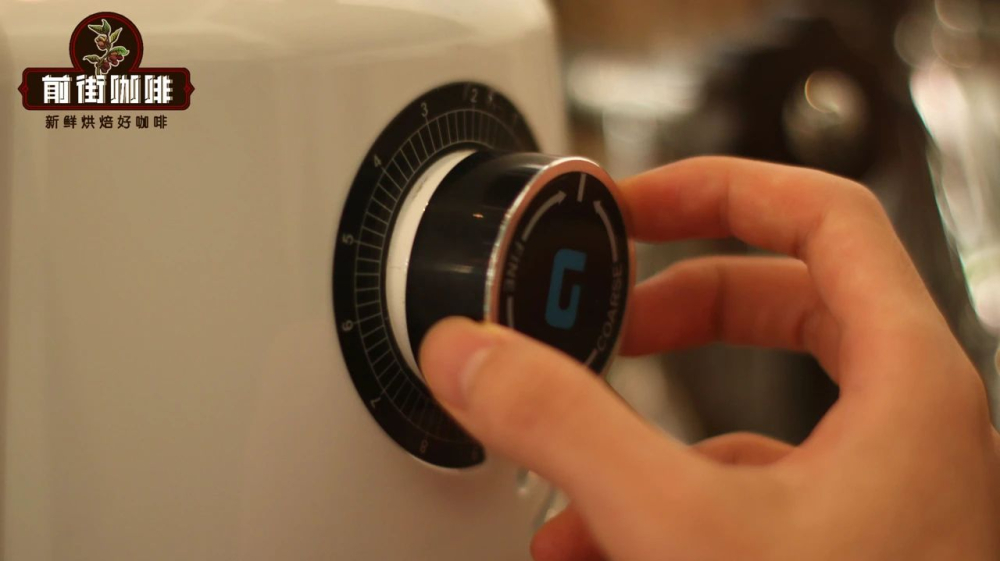
4. With your left hand, firmly grip the fixing column in the middle of the body to stop it from turning along, and use your right hand to rotate the grind size adjustment nut. Turning it downward makes the grind finer; turning it upward makes the grind coarser. During this process, repeatedly reattach the crank, put in a few beans and test grind to see whether the coarseness meets expectations.
5. Reattach the crank and tighten the top nut back into place.
Once the grind size is set, you can formally grind the beans. A manual hand grinder can meet the needs of the vast majority of pour-over coffee, but it can't handle espresso—espresso must be ground with an espresso grinder, and the required grind size is extremely fine. The grind size for pour-over is considerably coarser than for espresso; the specific choice still depends on what beans you have on hand.
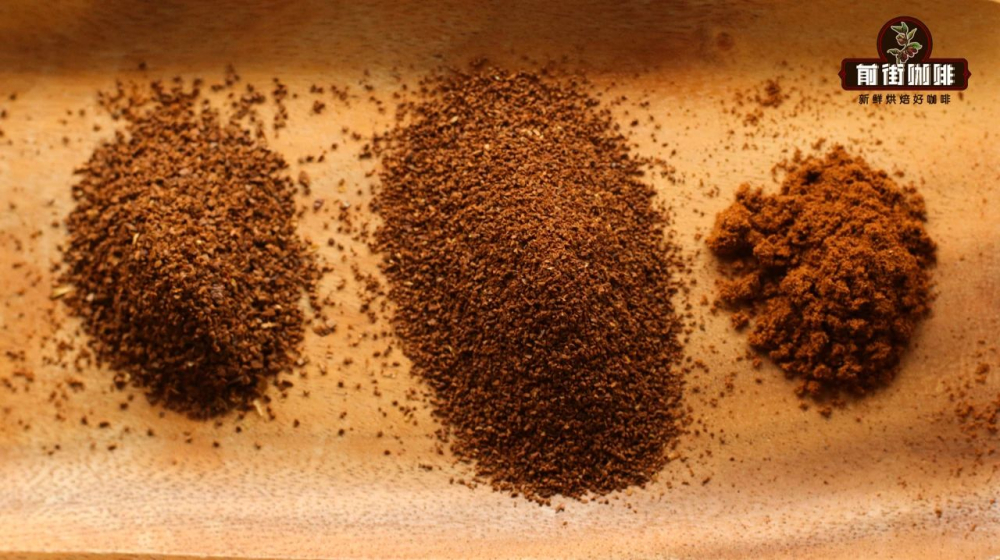
Front Street Coffee (FrontStreet Coffee) usually uses a medium grind size when making pour-over. One step coarser is suitable for siphon, and the coarsest grind size is reserved for French press. Front Street Coffee (FrontStreet Coffee) has also summarized the standard sieve pass-through rate patterns for grind coarseness across different brewing methods:
Cold drip > pour-over, siphon 80% > moka pot, American drip 75-80% > cupping 70-75% > French press 65-70%.
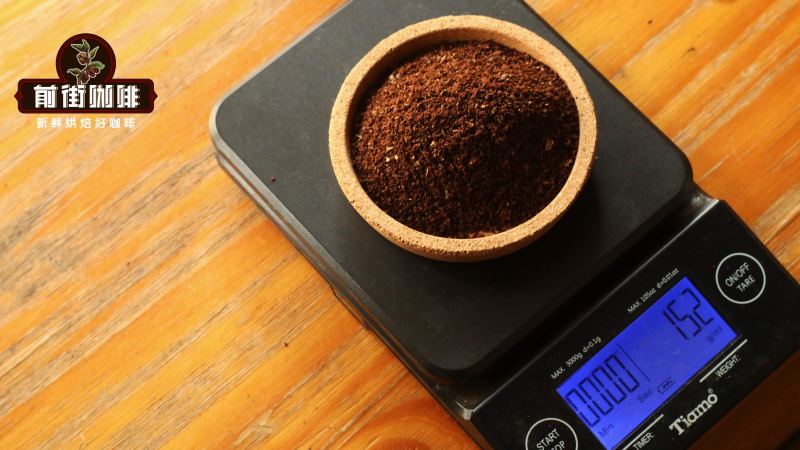
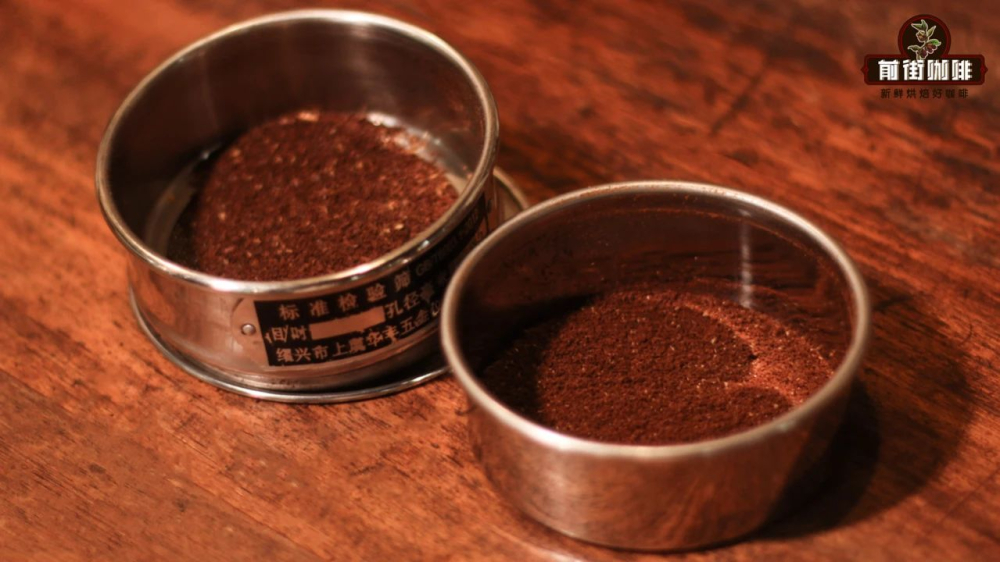
When Front Street Coffee (FrontStreet Coffee) gets a new bean and needs to determine the grind size, it uses a 0.80mm standard sieve to test. Particles with a diameter smaller than 0.80mm will fall through to the lower layer. The specific method is to weigh 10 grams of coffee beans and grind them into powder, pour it into the upper layer of the sieve, shake repeatedly many times to let the fine powder smaller than 0.80mm fall into the lower layer, then weigh the powder in the lower layer. Front Street Coffee (FrontStreet Coffee) recommends controlling the pour-over grind size at a medium-fine level, with a sieve pass-through rate of about 80%, meaning about 8 grams of powder can be sifted from 10 grams of beans. This grind size can serve as the baseline for pour-over.
If the sifted powder is less than 8 grams, it means the grind is too coarse and needs to be adjusted finer; if it's more than 8 grams, it means the grind is too fine and should be adjusted coarser.
You may find this process a bit cumbersome, but once you're skilled at it, it naturally becomes easy. Pour-over coffee is itself a matter of detail—the coffee-to-water ratio, grind size, water temperature, and extraction parameters all influence the final flavor performance. It is precisely for this reason that the taste brewed by each barista differs, and even the same person brewing at home each time may get a different flavor.
So in the process of continuous exploration, Front Street Coffee (FrontStreet Coffee) records and organizes the applicable grind size, water temperature, and brewing time for each bean. Taking the coffee-to-water ratio as an example, the pour-over ratio range recommended by Front Street Coffee (FrontStreet Coffee) is 1:14 to 1:18; currently, 1:15 is used for serving, that is, 15 grams of coffee powder with 225 grams of water. A higher ratio makes the taste lighter, while a lower ratio makes it stronger.
Water temperature also greatly affects the pour-over result. The higher the temperature, the more flavor substances are extracted; the lower the temperature, the lower the extraction efficiency. When brewing light-roasted beans, Front Street Coffee (FrontStreet Coffee) uses 90 degrees Celsius, and for dark-roasted beans, 88 degrees Celsius. Extraction time refers to the duration from when the coffee powder contacts water to when the dripper is removed—the longer the contact, the more extract; if the contact is too short, the taste will be bland. Front Street Coffee (FrontStreet Coffee) controls the brewing time at about 2 minutes.
After saying so much theory, let's actually do it. Front Street Coffee (FrontStreet Coffee) uses a Panama Diamond Mountain coffee bean for the demonstration.
Front Street's brewing parameters are as follows: Hario V60 dripper, 90°C water temperature, 15 grams of powder, 1:15 coffee-to-water ratio. The technique uses Front Street's simplest three-stage method: in the first stage, use 30 grams of water to completely wet the coffee bed, making it puff up into a "hamburger" shape, and bloom for 30 seconds; then enter the second stage of pouring, and when the timer reaches 54 seconds, add water to 125 grams, then pause, and wait until the water level drops to two-thirds of the coffee bed before pouring the third stage (the purpose of this stage is to extract the sour and sweet flavor substances); in the third stage, when the timer reaches 1 minute 40 seconds, add water to 225 grams, with a total extraction time of 2 minutes 10 seconds. After extraction, gently shake the sharing pot to mix the coffee liquid evenly before tasting.
This Diamond Mountain bean from Panama's Hacienda La Esmeralda has berry acidity along with citrus and chocolate notes, rich in layers, with a smooth mouthfeel. Front Street believes that Panama's washed processing method presents a clean and balanced mouthfeel, with bright acidity while retaining caramel-like sweetness.
For more specialty coffee beans, please add the private WeChat Front Street Coffee (FrontStreet Coffee), WeChat ID: kaixinguoguo0925
The above content is compiled by CoffeeHunters, a coffee news website.


