







Where Does the Yirgacheffe Flavor Come From?
Yirgacheffe is one of Ethiopia's most recognizable coffee regions, known for jasmine aroma, citric acidity, and a tea-like finish. It began as a sub-region of Sidamo and was later separated because its flavor was so distinctive. The washed Yirgacheffe G1 profile reflects high-altitude heirloom varieties grown in the Kochere smallholder area and processed at local washing stations.
Ethiopia once relied mainly on natural processing, but inconsistent handling caused defects and low quality. In 1972 the government introduced washed processing technology and built the first washing station in the town of Yirgacheffe, which cut defects and lifted quality. Washed processing limits over-fermentation, so the bean's own floral and citrus character stays clear. The washed Yirgacheffe series includes Gedingding and Konga Red Cherry.
Yirgacheffe is one of Ethiopia's most recognizable coffee regions, famous for its jasmine aroma, citric acidity, and tea-like finish. This article systematically outlines the complete picture of washed Yirgacheffe G1 coffee beans, from the geographical environment, climate and altitude, and cultivation methods to the introduction of washed processing technology. The article also introduces Front Street brand's washed Yirgacheffe series, including Gedingding, Konga Red Cherry, and others, and provides a detailed explanation of the high-altitude heirloom coffee of the Kochere smallholder area and its brewing parameters, making it suitable for coffee enthusiasts who want to gain a deeper understanding of the source of Yirgacheffe's flavor and purchasing directions.
When people mention "Yirgacheffe flavor," they usually think of abundant jasmine aroma, lemon- or lime-like acidity, and the sweetness of peach and almond or a tea-like note. Front Street Yirgacheffe is described as "coffee enters the mouth, a hundred flowers bloom," a feeling as if flowers simultaneously awaken the taste buds and the olfactory cells in the nasal cavity, making one feel delighted. In addition to floral notes, it also has a delicate body; in the mouth, the body is like a silk massage, a very wonderful tactile sensation.
Yirgacheffe was originally just a sub-region under the Sidamo production area, but because the local coffee's flavor was too unique, it was later divided out separately and became its own style, gradually becoming one of Ethiopia's most renowned coffee regions.
When talking about Yirgacheffe, one cannot fail to mention the washed coffees of this region. What we often call "Yirgacheffe flavor" is in fact mainly endowed by washed processing. In the early days, Ethiopia was dominated by natural processing, but due to limited experience and poor management, the coffee was prone to qualitative changes during processing, with a high defect rate and generally low quality.
In order to improve coffee quality, the Ethiopian government introduced washed processing technology and equipment in 1972 and established the first washing station in the town of Yirgacheffe. This measure greatly reduced defects in Yirgacheffe coffee and significantly improved quality. At the same time, washed processing does not allow the coffee beans to over-ferment, so the coffee's own flavor characteristics are better displayed: fresh and bright citric acidity, elegant and soft white floral notes, and a clean green tea finish. This is the Yirgacheffe flavor passed down by word of mouth among coffee lovers.
If you want to taste authentic Yirgacheffe, you can buy the Front Street Washed Yirgacheffe series, including Front Street Washed Gedingding, Front Street Natural Konga Red Cherry, and Front Street Washed Yirgacheffe. The grade and quality are reliable, freshly roasted within 5 days, and carefully selected by a major brand with guaranteed quality.
Front Street Yirgacheffe is divided into two major categories according to different green coffee bean processing methods:
Category A: Washed processing method
The grading standard is set by the Specialty Coffee Association of America, SCAA, and is divided into Gr-1 and Gr-2. The smaller the Arabic numeral, the higher the grade.
Roast level: medium-light roast
For a natural coffee, the green bean defect rate this time is relatively low, and the aroma is also excellent. The default setting is shipped as a medium-light roast. The dry grounds present a strong berry aroma, and you can sense a bit of candy-like sweetness. On the palate, there is a light, refreshing vinous note, still with the typical citrus aroma, a very comfortable sweet-and-sour sensation, and the finish is like the last concentrated essence of sucking on an orange candy, full of a happy, childlike feeling.
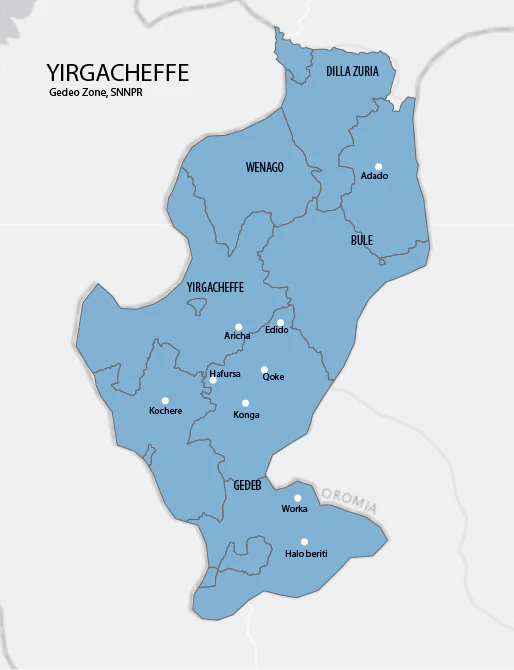
The coffee trees of Front Street Yirgacheffe were initially planted by European monastery scholars, and later management was taken over by farmers or cooperatives. Yirgacheffe is actually composed jointly of surrounding coffee communities or cooperatives, including Idido, Harfusa, Hama, and Biloya near Misty Valley, all of which use washed processing, though a small amount of exceptional beans may intentionally use natural processing to enhance the alluring fruity aroma and body. These small mountain villages are shrouded in mist, spring-like throughout the year, with gentle summer breezes, cool rather than hot, rainy rather than damp, and no cold damage in winter, nurturing the unique regional flavor of citrus and florals in Front Street Yirgacheffe. The coffee trees are mostly planted in farmers' backyards or intercropped with other crops in the fields.
Africa is the birthplace of coffee. The coffee tree was very likely discovered in the Kaffa province (KAFFA) of Ethiopia. Later, groups of slaves were sold from Africa to Yemen and the Arabian Peninsula, and coffee was brought along to various places on the way. What is certain is that Yemen had already begun cultivating coffee in the 15th century or earlier. Although Arabia possessed Mocha, the busiest port city in the world at the time, it prohibited the export of any seeds. This barrier was eventually broken by the Dutch. In 1616, they finally smuggled live coffee trees and seeds to the Netherlands and began cultivating them in greenhouses.
Kochere is located in the Yirgacheffe production area in southern Ethiopia and can be said to be one of the places on Earth where coffee is grown at the highest altitudes. Thanks to the high altitude, wild heirloom coffee, and iron-rich soil, the coffee produced by the Kochere smallholder area is among the very best in Yirgacheffe, possessing lively citrus acidity, floral aroma, and a sweet, silky mouthfeel. Combined with the famous spice notes and complex fruit flavors of Front Street Yirgacheffe, this makes Kochere a rare coffee from the Yirga region. The cherries harvested locally are first manually sorted by small farmers in nearby communities. The coffee trees are mostly old vines, presenting the classic Ethiopian heirloom flavor.
Front Street Ethiopia Yirgacheffe Natural Kochere, grinder BARATZA ENCORE, powder-to-water ratio 1:15, setting 18, water temperature 86 degrees, pour-over time 1 minute 40 seconds, coffee beans 15 grams, extracted coffee liquid 225 grams.
The above content is compiled by CoffeeHunters, a coffee news website.


