








Latte, cappuccino, and flat white are the three most common milk coffees in coffee shops, yet many people still can't tell them apart. This article will start with the historical origins of the three, tracing the evolution of cappuccino from Viennese Kapuziner to Italian espresso coffee, as well as the background of flat white's birth in Oceania. Then it will compare them one by one across dimensions such as cup size, number of espresso shots, milk quantity, milk foam thickness, and flavor and mouthfeel, helping readers establish clear criteria for distinguishing them. The article also introduces the recipe and roasting characteristics of Front Street Coffee's classic Italian blend coffee beans, and answers the question of whether these three milk coffees can be made iced, while recommending Dirty coffee as an alternative to iced milk coffee.

Latte, cappuccino, and flat white—these three milk coffees are practically standard products in every coffee shop. The purpose of this article is to help everyone clarify the differences between these three coffees.
Considering that most people have more or less tried these three milk coffees, let's first briefly talk about their origins. Modern latte and cappuccino both originated in Italy and belong to the most common and most favored types of milk coffee in the Italian espresso coffee system. Latte is the transliteration of the Italian word "latte," whose original meaning is "milk," so latte coffee is essentially a combination of milk and coffee; the Italian latte method is to mix espresso with milk.
Cappuccino comes from the transliteration of "Cappuccino," while "Capuchin" refers to the small white hood on the robe of the Franciscan order. Cappuccino got its name because the layer of white milk foam on the surface of the coffee looks very much like the hood worn by monks.
The original name of flat white, "Flat White," may be more familiar to people. In addition, 馥芮白, 澳瑞白, 平白咖啡, and 小白咖啡 are also Chinese translations of "Flat White." This coffee originated in Oceania, and whether it specifically comes from Australia or New Zealand is still debated today. To some extent, flat white can be understood as an Australian-style latte.

To help everyone grasp the differences between latte, cappuccino, and flat white, Front Street Coffee (FrontStreet Coffee) decided to start from their respective origin stories, then compare them in terms of ingredient composition, cup size, milk foam thickness, and flavor and mouthfeel.
Before formally distinguishing them, let's first talk about the coffee beans used to make these three coffees. There are currently many products on the market to choose from, but if you want latte, flat white, and cappuccino all to present a rich flavor, Front Street classic Italian blend coffee is recommended. This recipe is composed of coffee beans from three origins: Brazil, Indonesia, and Vietnam. It uses deep roasting, which can maximize the release of the coffee's mellow aroma and also makes it easy to extract a rich and dense layer of crema. Whether making an Americano diluted with water or a latte paired with milk, it is very suitable. Online, it can be purchased through the Front Street Taobao store or the Front Street Tmall flagship store.
How did the old-style cappuccino come about?
To be honest, it is now difficult to verify who first made cappuccino. However, by consulting materials, we can find that the word "Cappuccino" comes from "Kapuziner," which in German means "monk" and also refers to an old-style coffee drink.
It is said that this beverage first appeared in Viennese coffeehouses in the 18th century. At that time, coffee was drunk together with the grounds and water. To make it smoother, a Polish man named Kulczycki used a cloth bag to filter out the coffee grounds, then poured the coffee liquid into a glass and added honey, spices, and cream. This not only improved the flavor but also gave the drink a unique reddish-brown color, which looked very similar to the color of the robes of the Order of Capuchin Friars Minor, so the Viennese called it "Kapuziner."
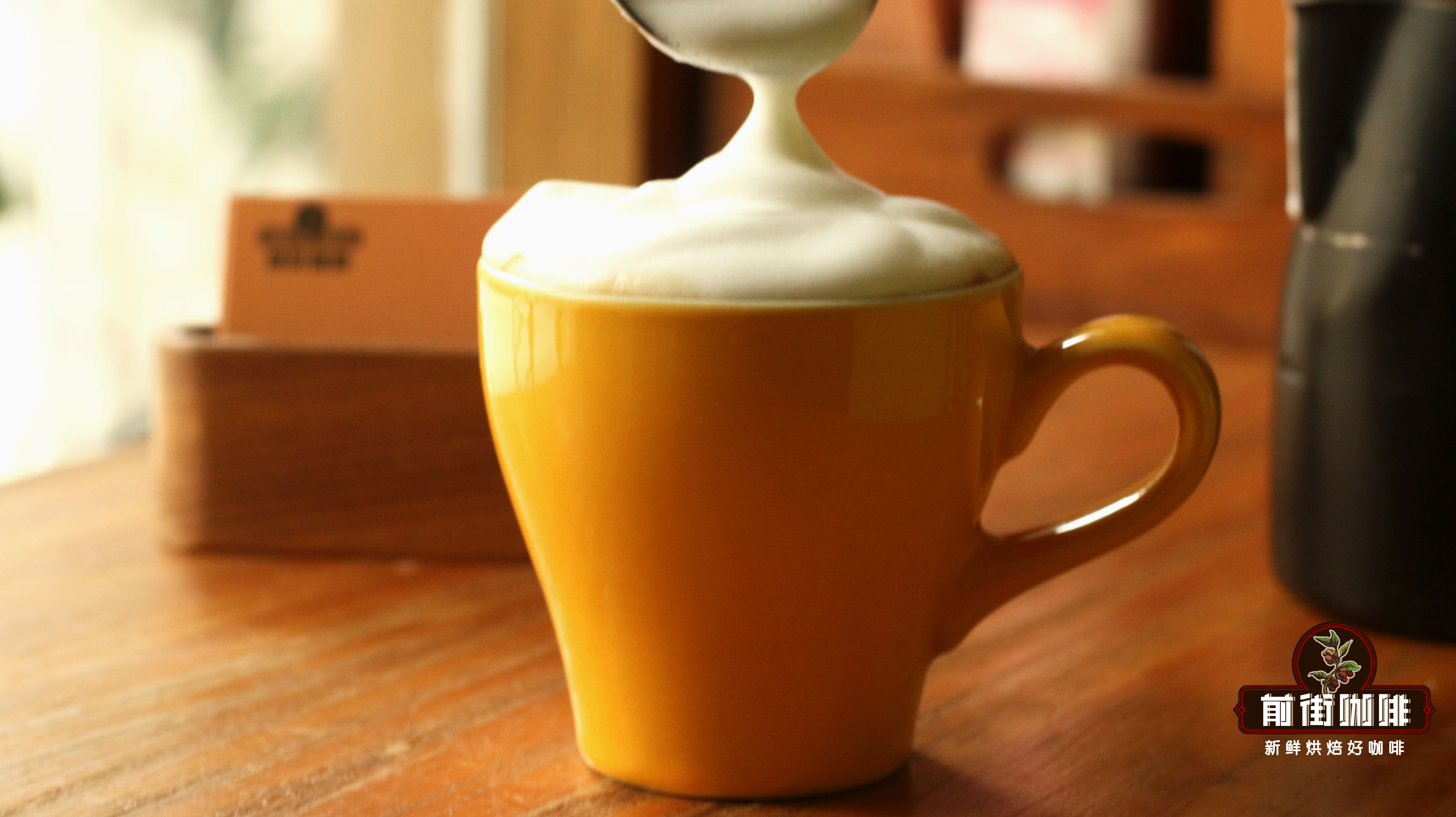
Later, this beverage spread to Italy. With advances in pressurized coffee machine technology, Italians began using espresso as the base, replacing cream with milk whipped into a dense foam, and then using a spoon to shape the surface foam into the shape of a pointed hat. Over time, it acquired its own Italian name—Cappuccino. As for its "predecessor," Kapuziner, people are more accustomed to calling it Viennese Coffee.
Where does flat white come from?
Regarding who invented flat white, Australians and New Zealanders each have their own claims, both insisting that this beverage comes from their own country, and the recipes used by baristas in the two countries to make flat white are also different from each other. Although it is indeed impossible to determine which country flat white originated from, what is certain is that the emergence of this beverage came from people's pursuit of higher-quality coffee.
Before the 1970s, Australian coffee shops mainly made black coffee with French presses and manual pour-over. In the early 1970s, Italians brought espresso machines to Australia, setting off a new wave of coffee. Compared with traditional lattes and cappuccinos, Australians preferred milk drinks with thinner milk foam and a stronger coffee taste. As a result, milk coffee was continuously improved in Australia, New Zealand, and other places, and the milk foam on the surface became thinner and thinner, eventually leaving only a thin layer of milk foam, with the liquid surface completely level with the rim of the cup, hence the name Flat White. Flat means "level," while White refers to white coffee with milk added.
Entering the 1980s, Australians began to put Flat White on regular menus, and before long it spread to coffee shops in Europe and America. The reason Flat White became a popular product in China is thanks to Starbucks introducing it in 2015 and naming it "馥芮白" as one of its main promoted drinks, which also meant that this milk coffee had entered the mainstream.

What are the differences in how the three coffees are made?
First, cup size. According to Front Street's serving standards, latte uses a 300ml wide-mouthed ceramic cup, cappuccino uses a 180ml narrow-mouthed ceramic cup, and flat white uses a 210ml glass. Next, let's look at the composition of the three coffees. Latte is made up of 2 shots of espresso (40g) plus 260ml steamed milk and milk foam. Cappuccino is made up of 1 shot of espresso (20g) plus 160ml steamed milk and milk foam. Flat white is made up of 2 shots of ristretto (30g) plus 180ml steamed milk and milk foam. Among these, ristretto is taken from the front-middle section of the espresso extraction and has a richer and more intense flavor.
Milk foam thickness has always been an important indicator for distinguishing latte, cappuccino, and flat white. Among the three, cappuccino has the thickest milk foam (about 1-1.5cm), and its most notable feature is being "11 out of 10 full," meaning that cappuccino's milk foam rises above the rim of the cup, presenting a burger-like domed shape; the thinnest milk foam is flat white (about 0.3cm), and precisely because the milk foam is extremely thin, the liquid surface is basically level with the rim of the cup, which is why it is called "flat white"; latte's milk foam thickness falls between the two (0.5cm), and this thickness is very suitable for latte art. One of the reasons for choosing a wide-mouthed cup is that it makes it convenient to create latte art patterns.
In terms of taste and mouthfeel, latte has the highest proportion of milk, so the milky flavor is more prominent; flat white, because it uses ristretto and less milk, has a more obvious rich coffee aroma; cappuccino falls between the two. In terms of mouthfeel, cappuccino is the fullest, thanks to its fine and abundant milk foam, which, after merging with the coffee crema, appears especially smooth, silky, and mellow. Next is flat white, and last is latte.
Can these coffees all be made iced?
Usually when ordering a latte, we tell the barista whether we want it iced or hot, but traditional cappuccino and flat white are only served hot. This is mainly because, during their invention and popularization, baristas did not "also invent" an iced version, and by default served them hot. Second, baristas hope that with every sip, the drinker can taste both the milk foam and the milk coffee beneath it. Only when the milk foam is sufficiently dense, relatively thin, and at a pleasant temperature can it be drunk quickly before the milk foam separates, so that every sip delivers both milk foam and rich coffee liquid. After ice cubes are added, the cooled milk coffee will be diluted to a certain extent and cannot achieve the above effect.
If you really want a cup of rich milk coffee with an iced texture, Front Street Coffee (FrontStreet Coffee) suggests trying Dirty coffee, which has become very popular in recent years. The method is to drip freshly extracted espresso onto the top layer of chilled fresh milk or purified milk, creating a "dirty" visual effect, and the alternating hot-and-cold mouthfeel is very unique.
The above content is compiled by CoffeeHunters, a coffee news website.


