








How Does Yirgacheffe Get Its Flavor From What Coffee Is Made Of?
Yirgacheffe's signature citrus-lemon acidity and jasmine aroma come down to three things: high-altitude growing conditions in Ethiopia, washed processing that preserves the bean's own aromatics, and a light roast that keeps those delicate compounds intact. Coffee trees planted above roughly 1,700 meters mature slowly, giving the fruit more time to build aromatic substances, and the harvest typically runs from October through January.
The washed method separates the fruit from the bean soon after picking, which cleans up the cup and lets floral and citric notes read clearly rather than being masked by fermented fruit tones. Natural-processed batches from the same region swing sweeter and berry-forward while keeping the underlying Yirgacheffe character. A V60 with a three-pour structure is the common way to pull out those aromas and the sugarcane sweetness that follows.
Yirgacheffe, with its bright citrus-lemon acidity and delicate jasmine aroma, has become the starting point for many people's journey into light-roast specialty coffee. Why does it develop such an iconic flavor? This article, from Front Street's perspective, reviews Yirgacheffe's growing conditions, the evolution of processing methods, and roasting approaches, explaining how high-altitude cultivation, washed processing, and light roasting each contribute to its flavor, while also introducing the stylistic differences of natural batches. At the end, we'll share Front Street baristas' V60 brewing parameters and three-pour extraction steps for Yirgacheffe, helping you more fully experience this bean's floral and fruity aromas and sugarcane sweetness.

Front Street has noticed that for many friends, the first light-roast specialty coffee bean in their life is Yirgacheffe. Its bright citrus-lemon acidity, combined with its subtle jasmine fragrance, makes it a highly representative presence in specialty coffee, always holding a place in the hearts of coffee lovers worldwide. To understand the characteristics of Yirgacheffe coffee, let's first follow Front Street and sort out: exactly which conditions shape its unique flavor.
Yirgacheffe comes from the birthplace of coffee
The Yirgacheffe growing region is located in Ethiopia, the birthplace of coffee. The altitude is quite high, the temperature is cool and pleasant, and rainfall is moderate without being too humid—perfect for a sensitive crop like the coffee tree. Local farmers grow coffee trees in misty mountains, mostly using garden-style cultivation, interplanted with other cash crops; coffee trees can often be seen beneath banana trees.
The high altitude brings pronounced day-night temperature differences. Coffee trees grow slowly here, and the fruit takes longer to mature, thereby accumulating richer aromatic substances, with the harvest season correspondingly later. Usually from October to January of the following year, farmers can be seen busily moving through the mountains and their own backyards picking coffee cherries, and the next year's Yirgacheffe lots gradually come into being.
Washed processing elevates Yirgacheffe's flavor
What truly made Yirgacheffe famous far and wide is how washed processing restores the coffee bean's own aroma. In the past, Yirgacheffe used the natural method, with relatively rough techniques, difficult quality control, and a high defect rate; the finished product often carried earthy and rotten-fruit flavors. Such lots could often only be sold off at low prices, making it hard to bring local growers the returns they deserved. To improve quality, the Ethiopian government introduced more advanced washing technology and supporting equipment from Central and South America in 1972.
Compared with the traditional natural method, washed processing can remove defective cherries at multiple stages. After picking, coffee cherries are first immersed in water, using buoyancy to separate out beans that are insufficiently dense and float on the surface; then the skin and pulp are removed with a pulper, and the beans are placed in fermentation tanks for 18 to 36 hours to let the mucilage layer break down (the specific duration depends on local temperature and humidity); next, the parchment beans are scrubbed for 30 to 60 minutes through washing channels. With the help of specially designed channels and the scouring of water flow, beans with lower density and poorer quality are eliminated, while the remaining high-quality parchment beans are drained and spread on African raised beds to dry for about 14 days, then bagged and stored once they reach the target moisture content.
Washed processing gives Yirgacheffe a fresh citrus-like character and elegant white floral notes, bright and delicate overall, performing strikingly in cupping. Yirgacheffe therefore became independent from the Sidamo region and became the well-known region it is today in the coffee world.
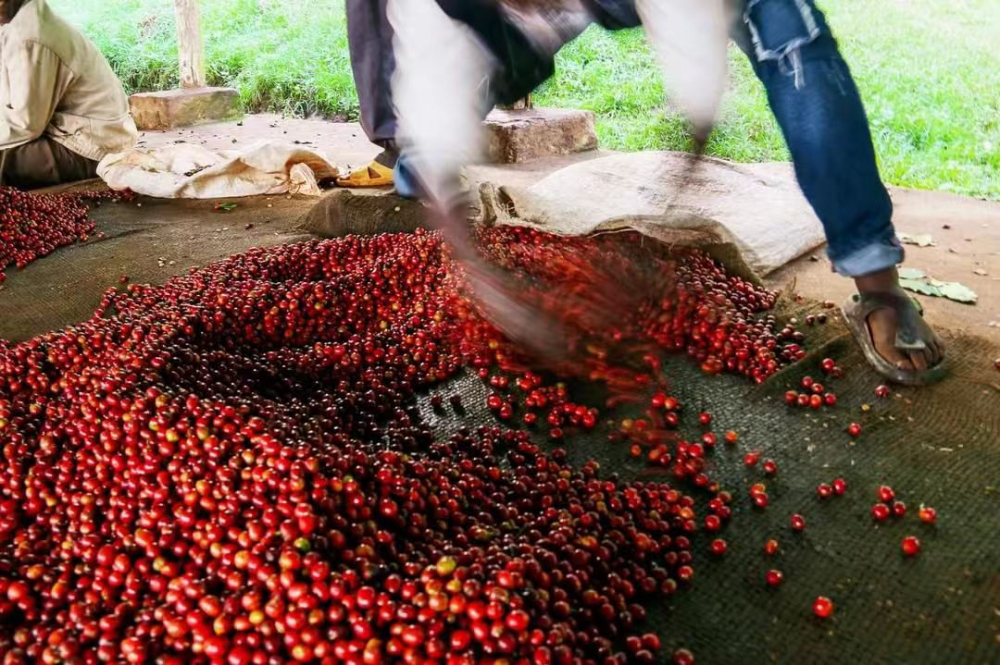
Of course, Yirgacheffe also has no shortage of high-quality natural lots, such as the Natural Red Cherry on Front Street's bean list, which is dried in the sun with skin and pulp still attached and requires regular manual turning to prevent the coffee cherries from over-fermenting and developing negative flavors. Natural processing gives Yirgacheffe coffee beans fermented fruity aromas and a clear sweetness.
Light roasting preserves more bright acidity
Unlike the era when "coffee should be bitter," light-roasted Yirgacheffe can be said to have opened a new stage for "fruity-acid coffee." The reason coffee is strong and bitter is mainly that roasters roast the beans dark, with flavor tending toward nuts and dark chocolate. With the rise of the specialty coffee concept, in order to preserve more acidity, roasters roast Yirgacheffe only to an appropriate light level, allowing it to show pleasant fruity sweet-tartness and white floral notes.
A preference for sweetness and a dislike of bitterness happens to match the general public's taste tendencies, which is precisely one reason Yirgacheffe is so popular around the world. With Yirgacheffe coffee being so popular, Front Street naturally includes it in its coffee introductory daily-bean series. Front Street's daily beans let friends who are just getting into coffee appreciate the region's basic flavors at a fairly low price, and the small-package design also avoids waste from not being able to finish a larger bag.
Yirgacheffe tastes better brewed this way
No matter which flavor type of coffee bean you brew, Front Street recommends choosing freshly roasted beans so you can taste the complete flavor. Coffee beans enter their optimal tasting period 4 to 7 days after roasting; once that window is missed, the aroma will dissipate more quickly. The coffee beans sold by Front Street are all freshly roasted within 5 days, so you can start brewing and drinking as soon as you receive the beans.
Coffee produced at high altitude is relatively hard in texture, and light-roasted Yirgacheffe coffee beans have not been greatly changed, so Front Street Coffee's baristas use a relatively high water temperature to extract more aromatic substances. To avoid over-extraction while also making Yirgacheffe full-flavored, Front Street uses a medium-fine grind size. In addition, Front Street Coffee's baristas want to highlight Yirgacheffe's richer layered aromas, so they choose the V60 dripper for brewing. The dripper's spiral rib design helps the coffee grounds release gas and maximizes the volatilization and dissolution of aromatic acids.
Dripper: V60 Water temperature: 91-92°C Dose: 15g Coffee-to-water ratio: 1:15 Grind size: medium-fine (sift to 78% through a No. 20 sieve)
With three-pour extraction, first bloom with 30 grams of water for 30 seconds, then pour in a slow circular stream until 125 grams and pause for a stage; when the water level drops and is about to expose the coffee bed, continue pouring until 225 grams and stop. After all the coffee liquid has dripped through, remove the dripper. (Timing starts from the beginning of the bloom.) The extraction time is 2'00".
After grinding the washed Yirgacheffe daily beans, you can smell delicate floral and fruity aromas. On the palate, there is immediately a bright, uplifting acidity like lemon and berries, with prominent sugarcane sweetness. As the temperature drops, it takes on a green-tea-like mouthfeel, with a long-lasting finish.
For professional coffee knowledge exchange and more coffee bean information, please follow Coffee Workshop (WeChat public account: cafe_style)
For more specialty coffee beans, please add the private WeChat of Front Street Coffee (FrontStreet Coffee), WeChat ID: qjcoffeex
The above content is compiled by CoffeeHunters, a coffee news website.


