








Kenyan coffee occupies a unique position in the world of specialty coffee thanks to its bright, intense fruit acidity and full, rich body. Among them, Kenya AA is often mentioned as a representative grade, but what exactly does AA mean? And what does it have to do with flavor? This article, from the perspective of Front Street Coffee, systematically reviews Kenya's coffee-producing regions, main varieties, grading system, and classic washed processing method, and provides specific pour-over parameters and brewing suggestions for the Front Street Cherry Tomato bean. If you are looking for an African bean with bright acidity and rich layers, this article can serve as a reference from beginner to advanced.

For more specialty coffee knowledge, you can follow our WeChat public account: Front Street Coffee (FrontStreet Coffee). Kenyan coffee has always won the affection of a large group of coffee lovers with its distinct fruit acidity and solid, rich body. When many friends come to Front Street to order single-origin coffee, if they want a bean with acidity but don't really want to choose Ethiopia, Kenya is often a very reliable alternative. When people mention Kenyan coffee, the first thing many think of is Kenya AA coffee beans. So what exactly does AA mean? In this article, Front Street will talk about Kenya AA coffee beans. Kenya is located in eastern Africa, with the equator passing through the middle of the country and the East African Rift Valley running north to south. It borders Somalia to the east, Tanzania to the south, Uganda to the west, Ethiopia and Sudan to the north, and the Indian Ocean to the southeast. The country's terrain is mainly plateau, with an average elevation of about 1,500 meters. In the center, Mount Kirinyaga (Mount Kenya) rises to 5,199 meters, with year-round snow at its summit, making it the second-highest peak in Africa. Kenyan coffee beans usually display fascinating aromas, balanced acidity, uniform bean size, and excellent fruity notes. Front Street once compared beans from Kenya with those from neighboring Ethiopia. Although both center on fruit acidity, their styles differ clearly: Kenya's acidity is stronger and heavier, while Ethiopia's is softer and more transparent. If you are new to African coffee beans, Front Street suggests starting with Ethiopia and then gradually transitioning to Kenya.
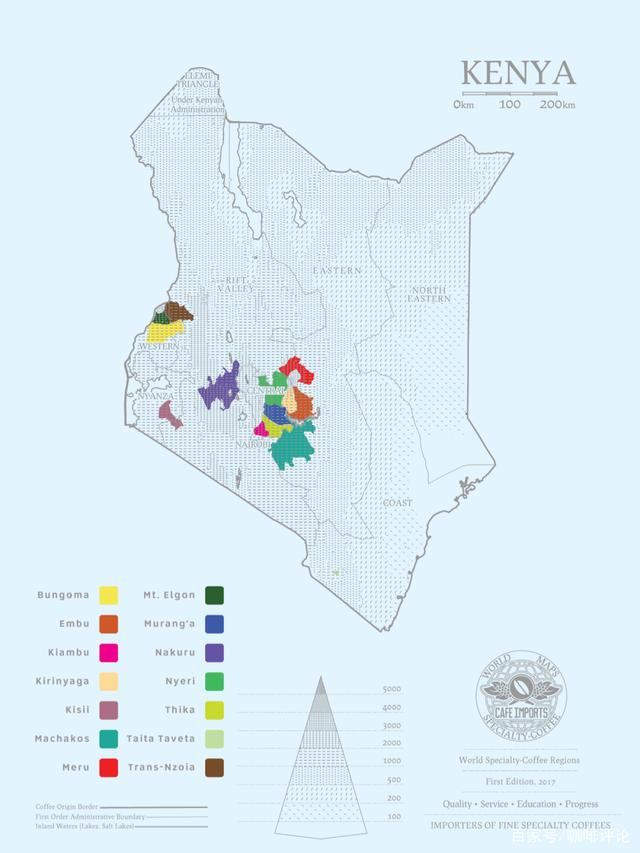
Kenya's coffee-producing regions are mainly concentrated in the central and western areas, covering Thika, Kirinyaga, Mt. Kenya West, Nyeri, Kiambu, and Muranga. These six major regions have two harvest windows each year: the main season from October to December and the secondary season from June to August. Among these regions, Thika and Kirinyaga best represent the typical flavors of African producing areas. Thika Thika is a small town near Kenya's capital, Nairobi, with a large number of coffee fields around it. Although it is itself an industrial town, it is surrounded by agricultural land and waterfalls. There are about two thousand coffee growers in the Thika area. The local history of coffee cultivation can be traced back to the late nineteenth century, with planting stock introduced from neighboring Ethiopia to the north. After subsequent local variety improvement, common varieties now include Bourbon, Kents (Kents, SL34, SL28), Typica, and Riuri 11. Today, about ninety percent of the planted varieties are SL34 and SL28. The new variety Batian, released in 2007, has not yet been widely promoted. The flavor profile of the Thika region shows bright fruit acidity, a thick berry-juice sensation, and honey-like sweetness. The elevation is about 1,550 to 1,750 meters, and the main varieties are SL-28 and SL-34.
Kirinyaga The Kirinyaga producing region is located on the slopes of Mount Kenya, adjacent to the Nyeri region. It is known for its strong flavor, rich layers, and solid body, and together with Nyeri it is currently one of Kenya's two best producing regions. Local producers are mostly smallholders who join cooperatives. The cooperatives provide centralized washing stations, and farmers deliver harvested coffee cherries to the stations for processing. The flavor profile of this region shows bright fruit acidity, medium oiliness, and delicate sweetness. The elevation is about 1,300 to 1,900 meters, and varieties include SL-28, SL-34, Ruiru11, and Batian.
Nyeri Nyeri is located in central Kenya and is home to the extinct volcano Mount Kenya. The red soil here is considered to produce Kenya's highest-quality coffee. Agriculture holds an extremely important place locally, and coffee is its most important crop. Common cooperatives formed by smallholders are more common than large estates. The area has two harvests a year, but the coffee quality from the main season is usually higher. In flavor, it shows bright berry-juice notes accompanied by citrus and faint floral aromas. It is precisely the beans produced here that made Kenyan coffee famous worldwide. The elevation is about 1,200 to 2,300 meters, and the varieties are SL-28, SL-34, Ruriu11, and Batian. In terms of coffee varieties, Kenya mainly grows SL28, SL34, and Ruiru11. SL28 and SL34 are genetic variants and account for the vast majority of Kenya's high-quality coffee production, though these two varieties are susceptible to leaf rust. SL34 has French missionary, Bourbon, and more Typica lineage. Its bronze leaves and broad-bean-shaped seeds bring excellent sweetness, balance, and complex, changeable flavors, with distinct citrus and smoked plum characteristics.
Ruiru 11 was developed in 1985 against the backdrop of a global rust outbreak. It is a hybrid variety developed by Kenya to cope with disease, emphasizing yield rather than quality. Its flavor is far inferior to SL28 and SL34, so it has not become widely adopted in the specialty coffee field. However, some suppliers of famous imported coffees still mix this hybrid bean into blends to reduce costs. Earlier we mentioned Kenya AA coffee beans. In fact, AA is a grading mark for Kenyan coffee beans. Next, let's look at how Kenyan coffee is graded. Kenyan coffee is mainly graded by bean size and is usually divided into eight grades.
AA Plus (AA+): AA grade with particularly excellent cup quality (flavor, body). AA: Screen size 17 to 18. AB: Screen size 15 to 16, accounting for most of production. C: Smaller than AB. TT: Lighter beans blown out from AA and AB beans by an airflow sorter. T: Lighter beans blown out from C-grade beans by an airflow sorter. E Elephant Bean: Large mutant beans formed by two beans joined together, also called Elephant ear. PB Peaberry: Classified by shape, unrelated to flavor or weight. Coffee Bean Processing Methods The process of the traditional washed processing method is not complicated: flotation, pulping, fermentation, washing, drying, hulling, and packaging. But implementation requires sufficient water sources and relies heavily on mechanical assistance, so producers using washed processing also need enough funds to buy equipment. The rise of the washed method coincided with capital building early American plantations, with ample operating funds. In addition, pulpers and hullers that met the needs of the times were invented one after another, and the washed method thus spread widely in the Americas.
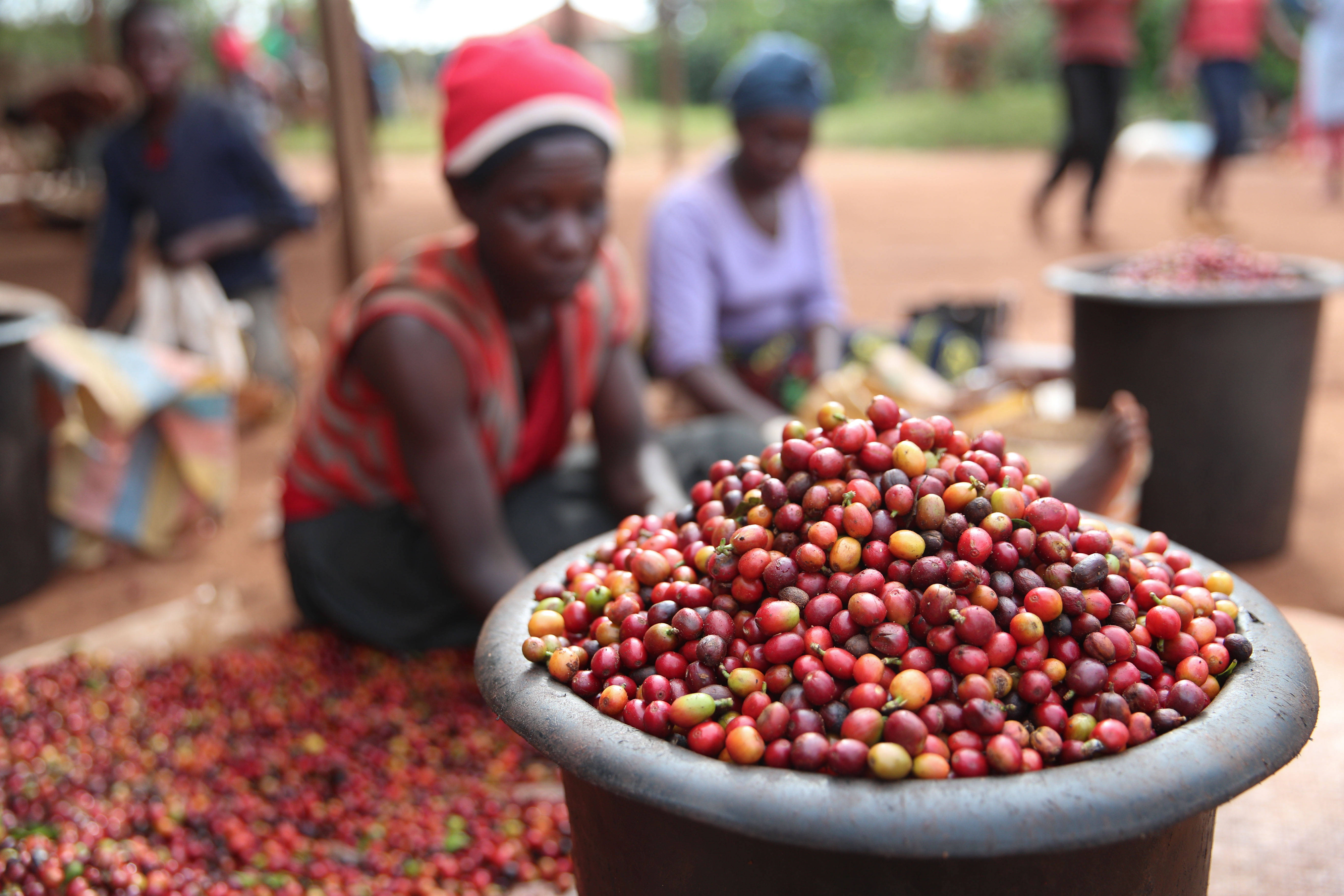
The original wet processing method was to wash the coffee parchment once with clean water after fermentation was completed, rinse off the mucilage, and then send it directly to the drying yard to dry and pack. But in Kenya, coffee that has been washed once is immersed again in a pool of clean water, then taken out for a second wash, and only after that sent to the drying yard for dehydration. Kenya initially changed conventional washing to "second soaking" not out of a pursuit of flavor, but because local drying yards were insufficient. Kenya is a typical cooperative operating model in Africa. During each harvest season, smallholders deliver fresh cherries to processing stations all day long. The pulping and fermentation process itself does not take long, but each batch of fermented beans needs at least 5 to 7 days to dry. Sometimes when the processing volume is too large, there is nowhere to dry the washed beans. So people could only pour the wet beans back into the pool and let them "cool off" first to avoid spoilage or contamination, then take them out once space in the drying yard became available.
This form of washed processing with a second soaking is called "Double Washed," and at origin it is also called "Fully Washed." Because Kenya was the earliest region where this processing method became popular, this type of washing is also called "Kenyan Process." Later people discovered that this locally adapted, twice-fermented washed bean not only helped stabilize quality control in production, but also gave the coffee a richly layered fruit acidity.
In addition to the two processing methods above, Kenya's most representative is undoubtedly the K72 washed method. The key to the washing process lies in controlling fermentation time: first conduct a 24-hour washed fermentation, then clean off the detached mucilage, ferment again in a clean water tank for another 24 hours, then clean off residual components again, introduce it into a tank filled with clean water for a final 24-hour fermentation, totaling 72 hours. This process gives Kenyan coffee its bright and clean high-quality fruit acidity. Front Street's regular offering Asalia uses exactly this washing technique. The brewed coffee shows acidity similar to cherry tomatoes and smoked plums, so we renamed it "Front Street Cherry Tomato." You can buy it at Front Street stores or the Front Street Tmall flagship store.
It is then fermented again for 24 hours with clean water, washed again, and after three cycles reaches 72 hours, so it is called the Kenyan-style 72-hour fermented washed processing method, abbreviated as [K72]. Front Street Coffee (FrontStreet Coffee) believes that compared with conventional washed processing, the K72 washed method can better enhance the acidity and cleanliness of coffee beans.
Front Street Kenya Cherry Tomato Coffee Beans Region: Thika, Kenya Processing Station: Asali Honey Processing Station Elevation: 1,550-1,750 meters Grade: AA TOP Varieties: SL28, SL34 Processing Method: Kenyan 72-hour washed Front Street Roasting Suggestions When roasting this Kenyan coffee bean, Front Street Coffee (FrontStreet Coffee) uses a medium-light roast in order to highlight its rich fruit acidity and full berry-juice body. Yangjia 800N: Charge when the drum temperature rises to 200°C, set airflow to 3, and heat to 160; the turning point is 1'34", and when the drum temperature is 147°C, lower heat to 130 and open airflow to 3.5; at this point the bean surface turns yellow, the grassy smell completely disappears, and the dehydration stage begins. At 171°C, lower heat to 80 and keep airflow unchanged.
At 8'28", wrinkles and dark streaks appear on the bean surface, and the toasted bread aroma clearly turns into coffee aroma, which can be defined as the prelude to first crack. At this time, listen carefully for the sound of first crack. First crack begins at 8'52". Adjust airflow to 5, develop for 2'10'' after first crack, and drop at 191.6°C. Front Street Cupping Report
Front Street Brewing Recommendation Considering that this bean uses a medium-light roast, Front Street Coffee (FrontStreet Coffee) uses a higher water temperature and a faster-flow dripper. The main purpose is to extract its bright acidity with high temperature while avoiding over-extraction caused by high temperature, so a faster-flow V60 dripper is chosen. Coffee-to-water ratio: 1:15 Dose: 15g Water temperature: 90°C~91°C Grind size: fine granulated sugar size (80% passing through a No. 20 standard sieve)
For the first pour, add 30 grams of water and bloom for 30 seconds, then pour 105 grams (the electronic scale shows about 135 grams), finishing in about 1 minute. When the water level drops to two-thirds of the coffee bed, pour the remaining 120 grams (the electronic scale shows about 255 grams), finishing in about 1 minute 45 seconds. Dripping is completed at 2'10", remove the dripper, and extraction is complete.
Brewed flavor: on the palate there are notes of smoked plum and cherry tomato; the acidity is strong and full, with a prominent sweetness in the middle and a juicy sensation; the finish carries berry aroma and brown sugar sweetness, along with green tea aroma.
The above content is compiled by CoffeeHunters, a coffee news website.


