







Jamaican Blue Mountain coffee is renowned worldwide, and Clifton Mount Estate, as one of the oldest coffee estates in the country, occupies a pivotal position in the Blue Mountain coffee landscape. Front Street Coffee provides an in-depth analysis of Clifton Mount Estate's terroir, cultivation history, Blue Mountain grading standards and certification system, and shares the washed processing method, roasting curve, and brewing parameters to help coffee enthusiasts gain a comprehensive understanding of authentic Blue Mountain coffee's flavor characteristics and identification methods.
For more specialty coffee knowledge, please follow the WeChat official account: Front Street Coffee
Among the many coffee estates in Jamaica, Clifton Mount Estate is one of the most historic. Front Street Coffee believes that this estate's position in Jamaica is comparable to that of Hacienda La Esmeralda in Panama.
Front Street Coffee often encounters customers asking: how can one distinguish authentic Jamaican Blue Mountain coffee from counterfeit? In fact, grasping the following three key points is sufficient: First, Jamaica is the only producing origin in the world that uses wooden barrels to hold green beans; Second, authentic Blue Mountain presents an extremely balanced and rich character in flavor; Third, the green beans have a shape with both ends slightly upturned, resembling a small boat. However, most consumers find it difficult to directly access green beans or participate in the opening process, and usually just drink the coffee directly. Therefore, to identify Blue Mountain's flavor, the key is to choose a merchant with reliable sourcing for tasting. The core reason Front Street Coffee selected Clifton Mount Estate's Front Street Blue Mountain No.1 coffee beans is that the Jamaican Blue Mountain coffee produced by this estate is consistently reliable in quality, and Clifton Mount Estate also holds Rainforest Alliance certification.
Front Street Jamaica Clifton Mount Estate Blue Mountain No.1
Jamaica Clifton Mount Estate
Estate owner: The Sharp family
Certification: Rainforest Alliance Certified
Location: Newcastle area
Total area: 250 acres
Coffee cultivation area: 180 acres
Altitude: 1310 meters
Processing method: Washed
Variety: 100% Arabica Typica
Flavor: Perfect balance of acidity, body, and aroma
Producing Region Introduction
The Blue Mountain range is located in the eastern part of the island of Jamaica. The Caribbean Sea surrounds this mountain. Whenever the weather is clear, sunlight shines directly on the azure sea surface, and the peaks reflect the brilliant blue light refracted from the seawater, which is how Blue Mountain got its name.
The main peak of Blue Mountain stands at 2,256 meters above sea level, making it both the highest point in the Caribbean region and a well-known tourist destination. This area lies within the coffee-growing belt, with fertile volcanic soil, crisp and pollution-free air, a humid climate, and year-round fog and rain (annual precipitation of approximately 1,980 mm, with temperatures maintained around 27 degrees). It is precisely these climatic conditions and extremely high altitude that together create the world-famous Jamaican Blue Mountain coffee.
Geographical Conditions
Jamaica is an island nation in the Caribbean Sea, and Blue Mountain is the highest peak in the western Caribbean region (2,256 meters above sea level). The unique flavor of Front Street Jamaican Blue Mountain coffee is closely related to Blue Mountain's irreplicable geographical location and climatic environment. Blue Mountain is situated in the coffee-growing belt at 25 degrees north latitude, with fertile new volcanic soil, fresh and pollution-free air, abundant year-round rainfall, high humidity, and significant temperature differences between day and night. The soil here is rich in nitrogen and phosphorus, very suitable for coffee tree growth. Fertile volcanic soil, regular rainfall, and the island's hazy cloud cover shielding against the scorching sun—the combination of these favorable factors is what nurtures the unique regional flavor of Front Street Jamaican Blue Mountain coffee.
Cultivation History
In 1725, Sir Nicholas Lawes, then Governor of Jamaica, introduced coffee seedlings from Haiti to Jamaica and conducted experimental cultivation at his private estate Temple Hall in St. Andrew. Thereafter, coffee trees gradually expanded to the more fertile Blue Mountain area, and large-scale cultivation began.
The Jamaican Blue Mountain range possesses unique soil and climatic conditions. The high-altitude mountain area is shrouded in clouds and mist year-round, creating an extremely ideal ecological environment for coffee growth. With its outstanding quality and balanced taste, Blue Mountain coffee propelled coffee cultivation into a pillar industry of Jamaica and rapidly emerged as another important cash crop after sugarcane and bananas.
By 1800, the number of coffee plantations in the Blue Mountain area, large and small combined, had reached 686. By 1814, Jamaica's coffee exports climbed to 15,199 tons, making it one of the most important coffee-producing countries in the Western Hemisphere at the time. After the slave trade was abolished in 1807, Jamaica's primary labor force was the black population, and the labor source for coffee plantations was completely severed, causing production to begin declining. In 1838, black slaves in Jamaica gained full emancipation. Many black people who had worked on the estates left in large numbers, heading to other areas of Blue Mountain to cultivate wasteland, settling down and growing various crops to make a living.
By 1850, Jamaica's coffee plantations had sharply decreased from the original 686 to 186, and coffee exports plummeted to 1,486 tons. Over the following hundred years, the business model of Blue Mountain coffee also underwent transformation, gradually evolving from large plantations to small-scale farmer cultivation. Unregulated cultivation practices brought disastrous consequences. The quality of Jamaica's coffee exports continued to decline, and eventually in 1943, Canada, one of the major importing countries of Jamaican coffee, was the first to announce it would no longer accept Jamaican coffee, and neighboring United States immediately stopped imports as well.
In 1944, the Central Washing Station was established. A.J. Wakefield, then Agricultural Inspector General of the British West Indies, strongly promoted the Jamaican government's formation of the Central Coffee Clearing House, and stipulated that all exported coffee must be uniformly purchased, processed, and graded through this institution before export.
Clifton Farm
The Blue Mountain region has only 6,000 hectares of cultivation area, a limited scale, and not all coffee labeled "Blue Mountain" is actually produced there. Today's Clifton Farm is the largest estate in this region, but by international standards it is still small-scale cultivation. Many local estate owners are small landowners whose families have farmed this land for as long as two centuries. Clifton Mount is an ancient coffee origin in Jamaica that is still in normal operation today, and Clifton Farm is the only estate in Jamaica with the "Rainforest" mark. This mark requires compliance with the "Sustainable Agriculture Standard" to obtain certification, and its wooden barrels bear the rainforest certification logo.
As early as the mid-eighteenth century (around 1750), Clifton Farm had already begun cultivating and producing coffee. The farm's cultivation and processing areas are at an average altitude of approximately 4,300 feet (1,310.64 meters). Sufficient altitude, gentle afternoon mist that shades the mountain forest, abundant sunlight, and mineral-rich soil provide superior growing conditions for coffee trees and also extend the maturation period of coffee cherries.
Jamaican Blue Mountain Coffee Grading
Coffee from Jamaica's Blue Mountain region is divided into three grades: Blue Mountain Coffee, Jamaica High Mountain Supreme Coffee Beans, and Jamaica Prime Coffee Beans. Among these, Blue Mountain Coffee and High Mountain Coffee are each further divided into two levels. Ranked from highest to lowest quality: Blue Mountain No.1, Blue Mountain No.2, High Mountain No.1, High Mountain No.2, Jamaica Prime Coffee.
In terms of quality from highest to lowest: NO.1, NO.2, NO.3, and PB, where PB refers to peaberry. According to CIB standards, the basic requirements for NO.1 Blue Mountain green beans are: beans of 17 screen size or above, defect rate below 3%, moisture content of approximately 13%, etc.
Jamaican Blue Mountain Certification
The Front Street Blue Mountain coffee purchased by Front Street Coffee holds official Jamaican certification. The authentic Blue Mountain coffee producing area certified by Jamaica covers four eastern administrative districts: St. Andrew, St. Thomas, St. Mary, and Portland, which happen to be the foothills that Blue Mountain spans. The altitude ranges between 1,000 and 1,700 meters, with an area of only about 6,100 hectares. Only coffee cultivated within this region and at altitudes of 1,000-1,700 meters can be called authentic Blue Mountain. Even if grown in the above four administrative districts, if the altitude is only 500-1,000 meters, it must be downgraded to Jamaica High Mountain Coffee; below 500 meters it is classified as the inferior Jamaica Prime Coffee. Coffee produced on the other 1.21 hectares of land outside this region certainly cannot bear the Blue Mountain name. The Jamaican government has strict regulations for Blue Mountain coffee, and only about 25% of Jamaican coffee qualifies as Blue Mountain.
The Front Street Jamaican Blue Mountain coffee beans purchased by Front Street Coffee come from the only producing origin among all coffees to this day that uses wooden barrels to load green beans; all other coffee exports use burlap sack packaging.
Green Bean Processing Methods
Blue Mountain coffee used only washed processing until the end of 2019, and natural processing was introduced in early 2020. Among these, the washed processing method uses washing and fermentation to remove the skin, pulp, and mucilage. Farms using the washed method must build washing channels and be able to channel a continuous supply of fresh water. During processing, the skin and pulp are first removed, allowing fermentation for 12 to 18 hours, then the fermented beans are moved into channels and pushed back and forth, relying on friction between the beans and the force of water flow to wash the coffee beans until smooth and clean.
After washing is completed, the coffee beans are still wrapped in the parchment layer, with a moisture content of about 50%, and must be dried to reduce moisture content to 12-14%. The coffee beans are then sorted and placed into dedicated storage silos. These steps must be strictly controlled, otherwise coffee quality will be greatly compromised.
Certification: Rainforest Alliance Certified. Products with the certification logo printed on coffee burlap sacks or wooden barrels are certified products. Farms must comply with the "Sustainable Agriculture Standard" to obtain certification (Rainforest Water Frog). Clifton Mount Estate is the only coffee estate to have obtained (RFA) Rainforest Water Frog certification.
How to roast to express the overall flavor of Front Street Jamaican Blue Mountain coffee?
Front Street Coffee believes that, in short, it is about roasting Front Street Blue Mountain thoroughly from inside to outside, and on the premise of being fully roasted, using appropriate roasting techniques to fully bring out the flavor characteristics of Front Street Jamaican Blue Mountain coffee.
The caramelization reaction has the most significant impact on coffee flavor. After six to seven minutes of roasting, green beans absorb a large amount of heat energy and trigger pyrolysis reactions, producing the first crack sound. Some sugars convert to carbon dioxide, moisture continues to evaporate, and new aromatic compounds are gradually generated, forming what is called coffee oil, which combines with hundreds of aromatic substances such as nicotinic acid, citric acid, quinic acid, malic acid, acetic acid, caffeine, and more.
Roasting curve: When the drum temperature rises to 170°C, charge the beans, set airflow to 3. After 1 minute, adjust the heat to 140°C, keep airflow unchanged. Roast until 5'10'', temperature 153°C, bean surface turns yellow, grassy smell completely dissipates, dehydration is complete, adjust heat to 115°C, change airflow to 4;
At the 8'00" mark, the bean surface shows wrinkles and dark streaks, and the toasted bread aroma clearly transitions to coffee aroma, which can be regarded as the prelude to first crack. At this point, carefully listen for the sound of first crack. At 8'12" first crack begins, reduce heat to 90°C, open airflow fully (adjusting heat must be done with extra caution, not so low that crack sounds cannot be heard), and drop at 201.3°C.
Front Street Jamaican Blue Mountain Coffee Cupping:
Cupping characteristics: Acidity, body, and aroma achieve a perfect and subtle balance. The acidity is bright and delicate, the body is velvety smooth, the aroma has a slight penetrating quality, accompanied by floral, spicy, and citric acid notes. After swallowing, a faint cocoa aftertaste lingers.
The taste is very clean, complex, and extremely mild, with a chocolate-like sweetness and an exceptionally strong body. The flavor is rich and mellow, with the coffee's sweet, acidic, and bitter notes perfectly balanced, with absolutely no bitterness, only a moderate and perfect acidity, and a long-lasting fruity finish.
Dry aroma: Roasted peanuts, hazelnuts, melon, chocolate
Wet aroma: Oolong tea, caramel, honey, chocolate, almond skin, silky mouthfeel, brightness
Front Street Jamaican Blue Mountain Coffee Brewing Parameters
Front Street Coffee recommends the following brewing parameters: 15 grams of coffee grounds, KONO dripper, coffee-to-water ratio of 1:15, grind size EK43s (grind size based on 70-75% passing through a Chinese standard No. 20 sieve), water temperature 86°C.
Brewing Method
Front Street Coffee uses a staged extraction: First, bloom with 30 grams of water for 30 seconds, then pour with a slow stream in the center to 125 grams for the first stage. When the water level drops and is about to expose the coffee bed, continue pouring to 225 grams and stop. When the water level drops and is about to expose the coffee bed, remove the dripper. Extraction time is two minutes.
Flavor Description
Front Street Jamaican Blue Mountain Coffee's flavor and mouthfeel : Dark chocolate, nuts, cream, balanced acidity-sweetness-bitterness, full-bodied
Teaching You How to Distinguish Real from Fake Blue Mountain
Blue Mountain coffee holds an extremely high status in the coffee world, and consequently a large number of imitation Blue Mountain-style coffees have emerged on the market. You may have drunk Blue Mountain coffee, but truly authentic Blue Mountain coffee is actually not easy to identify.
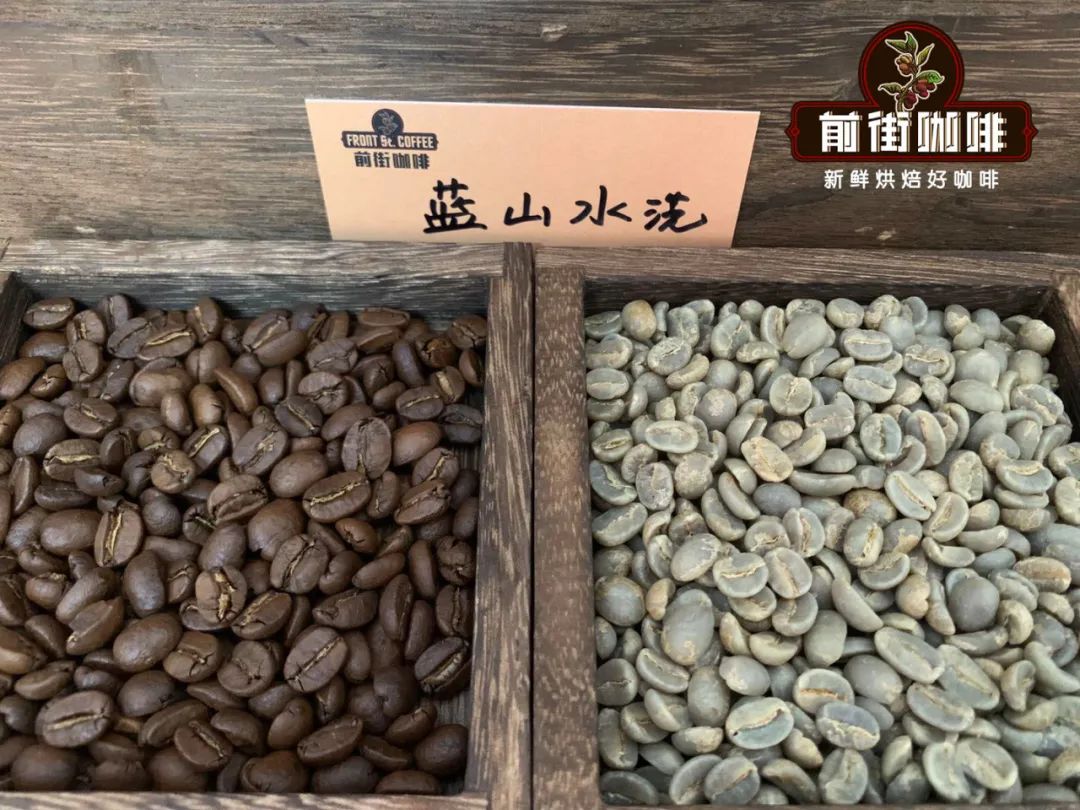
1. Appearance: Front Street Blue Mountain coffee's green beans are bluish-green, neat in appearance, medium to small in size, with both ends slightly upturned. After roasting, the volume expands greatly, becoming very plump.
2. Grinding: Authentic Front Street Blue Mountain coffee beans come from high-altitude regions, with a relatively loose cell structure. When hand-grinding, they feel crisp, smooth, and continuous, without producing resistance.
3. Aroma: The aroma is extremely rich and dense; so-called blended Blue Mountain coffee does not possess this aroma.
4. Taste: Authentic Front Street Blue Mountain coffee has a balanced, rich mouthfeel, without any single flavor being particularly prominent or noticeably missing. This is also something other coffee beans find hard to match, and is the most critical point of identification.
In addition, you can also identify whether it is truly Blue Mountain through the following three points: (the designated export company by the Coffee Industry Board), (the only producing origin that uses wooden barrels to hold green beans), (the frog rainforest certification on the barrel lid).
The above content is compiled by CoffeeHunters, a coffee news website.


