







Colombian coffee is renowned for its diverse styles, offering both consistent commercial flavors and the surprises of small-lot specialty beans. Since the 2008 volcanic eruption in the southern Huila province, coffees from this region have frequently won awards in international competitions, gradually establishing a specialty coffee image. Volcanic soil is rich in elements such as iron, calcium, magnesium, potassium, and phosphorus, providing ample nutrients for the plants and serving as an important foundation for the development of refined flavors. This article will systematically examine the characteristics of Colombian pour-over coffee from perspectives including varieties, origins, processing methods, and brewing parameters, introduce four Colombian specialty beans currently sold by Front Street Coffee along with their flavor profiles, and finally provide pour-over brewing steps for medium-roast Colombian coffee as a reference for coffee enthusiasts.
For more specialty coffee knowledge, please follow the WeChat public account: Front Street Coffee (FrontStreet Coffee)
The most prominent label of Colombian coffee is its rich diversity of styles. If compared to wine regions, it resembles the Champagne region's格局 where large estates and small farmers coexist—there are both standardized, consistently output commercial flavors and small-batch, distinctly individual star estates. Overall, Colombian coffee takes a fresh route with intense fruity aromas.
Before 2008, although Colombia consistently ranked third in global coffee production, it had long failed to receive due attention in the specialty coffee market. The turning point came in 2008, when a volcano erupted in the southern Huila province, and coffees from this region gradually rose to fame, with multiple Colombian estates achieving repeated success in coffee competitions.
The shift in flavor profile stems from the fact that coffee flavor development depends not only on varietal genetics but is also closely related to whether the plant's root system is well-developed and can obtain sufficient nutrients. Volcanic soil is formed by the weathering of volcanic lava and volcanic ash, and is rich in key nutrients such as iron, calcium, magnesium, sodium, potassium, phosphorus, sulfur, and silicon, as well as trace elements. This rich composition acts like a growth promoter for plants and is also an important condition for coffee to develop refined flavors.
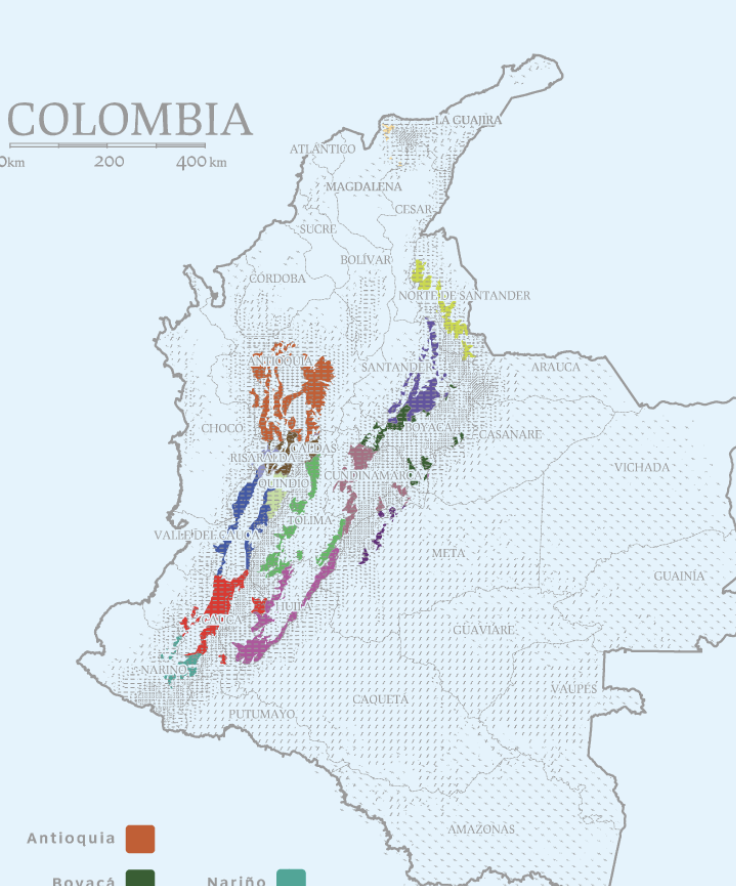
The wider the area covered by volcanic ash, the higher the soil fertility. Therefore, most Colombian specialty coffee producing regions are concentrated in the south, generally at altitudes above 1,500 meters, covering San Augustin in Huila, Popayan in Cauca, Narino, and Tolima.
The outstanding quality of the southern producing regions, in addition to the support of volcanic soil, is also due to their closer proximity to the equator and the fact that coffee is mostly grown in high-altitude mountainous areas. These conditions endow the coffee with bright acidity and unique floral and fruity notes, which is why coffees from the south enjoy high acceptance among enthusiasts.
Through cupping comparisons, Front Street Coffee (FrontStreet Coffee) has found that coffees from the above regions generally exhibit refined acidity and berry-like sweet-tartness, along with caramel aromas and outstanding sweetness. Whether using traditional processing methods or the later-emerging anaerobic processing methods, these beans can consistently express the distinctive flavor profile of their producing regions.
Currently, Front Street Coffee (FrontStreet Coffee) offers 4 Colombian specialty region coffee beans for sale, all medium-roasted. The purpose of this roast level is to enhance the coffee's body and fullness while preserving the soft acidity and pronounced sweetness of Colombian beans. All coffee beans ordered from the Front Street flagship store are shipped within 5 days after roasting is completed, ensuring they arrive in 100% freshly roasted condition.
The first is from the Huila region, grown at 1,500–1,800 meters, of the Caturra variety, washed processed. The washing process gives this "Huila Coffee Bean" a cleaner mouthfeel and best directly presents the pure taste of the bean itself. It carries the typical Huila region flavor: soft fruity acidity, nuts, dark chocolate, and caramel.
The second is also from the Huila region, at 1,800 meters, of the Caturra variety, anaerobically sun-dried, namely the "Flower Moon Night Coffee Bean." The anaerobic sun-dried steps intensify the fermentation aromas, giving this bean a fermented character reminiscent of strawberry wine or jam, with a caramel-chocolate-like sweetness in the finish.
The third is from the Monteblanco estate in the Huila region, at 1,900 meters, with varieties including Caturra, Catuai, and Geisha, washed processed, named "Hanami Coffee Bean." Its flavor profile features charming chamomile, slightly lively pink pepper spiciness, mandarin-like sweet-tartness, honey-like sweetness, and an almond-like finish.
The fourth is from the El Paraiso estate in the Cauca region, at 2,050 meters, of the Castillo variety, double anaerobic washed processed, namely the "Cherry Blossom Coffee Bean." The flavor presents layers of mugwort, berries, fermented aromas, spices, and strawberry jam.
How to brew medium-roast Colombian coffee beans for the best taste?
First, gather all equipment: freshly roasted coffee beans, a coffee-specific grinder, a pour-over kettle, a thermometer, a scale with timer function, filtered water, a V60 dripper, filter paper, a server, and an electric kettle for boiling water.
1. Fold the filter paper and place it in the V60 dripper, then evenly rinse it with hot water so it is completely wet and adheres to the dripper wall. The purpose of wetting the filter paper is to clean it, remove paper taste, and warm the equipment.
2. Weigh 15g of coffee beans, pour into the grinder, and adjust to the desired setting for grinding. During roasting, medium-roast beans decrease in density with heat exposure, becoming more porous, and soluble substances are more easily extracted. Therefore, Front Street Coffee (FrontStreet Coffee) recommends using a medium grind when brewing medium-roast Colombian beans, with a coarseness similar to granulated sugar (sifted through a Chinese No. 20 standard sieve, with a pass rate of about 75%).
3. Pour the ground coffee into the dripper and gently shake to level.
4. Separately prepare hot water and pour into the pouring kettle. Wait until the water temperature drops to 90–91°C before starting to brew. To achieve a more balanced taste, Front Street Coffee (FrontStreet Coffee) recommends a coffee-to-water ratio of 1:15, meaning 15g of coffee powder corresponds to pouring 225g of water.
5. Press the timer, first wet the coffee bed with twice the amount of water as coffee powder to form a dome and bloom for 30 seconds; then pour in a thin stream in a circular motion from inside to outside, pausing at 125g for a segmented pour. Wait until the coffee bed drops to half the height of the dripper, then pour the third segment with the same thin stream to 225g, until all the coffee liquid has filtered through. Remove the dripper. Total time is approximately 2 minutes.
6. After brewing is complete, gently swirl the server to fully blend the coffee, then pour into a warmed coffee cup. A fragrant cup of pour-over coffee is now ready. You may also add sugar or milk according to personal preference.
The above content is compiled by CoffeeHunters, a coffee news website.


