







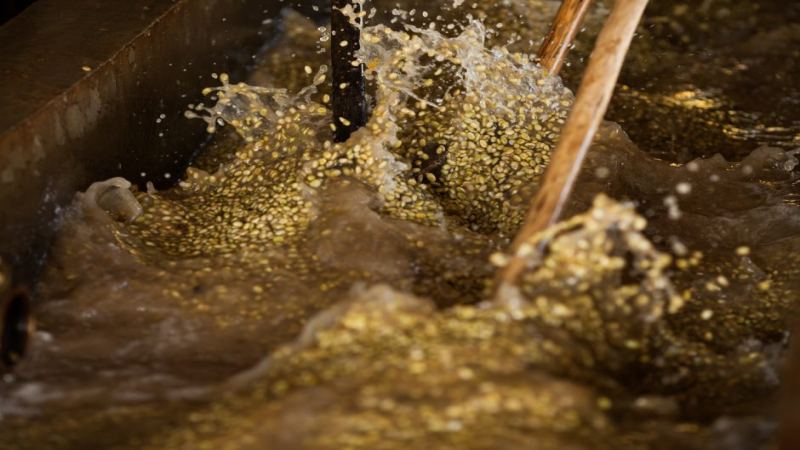
Although Latin America only began cultivating coffee in the 18th century, it rose to become the world's most important coffee-producing region thanks to its exceptional natural conditions. From Brazil's intense chocolate notes, to Colombia's balanced nutty flavors, to Panama Geisha's bright acidity, this land has nurtured specialty coffees of diverse styles. This article systematically reviews the coffee characteristics, grading systems, and processing methods of major Latin American producing countries, and combines them with the brewing parameters and flavor descriptions of several Front Street Coffee staple beans, providing coffee lovers with a complete guide to Latin American coffee.
For more specialty coffee knowledge, please follow: Front Street Coffee (Frontsteet Coffee)
The history of coffee cultivation in Latin America began in the 18th century, but thanks to abundant sunshine, mountainous terrain, fertile and humid soil, and rich and diverse microclimates, the region has now developed into the world's most important coffee-producing area. In Front Street Coffee (FrontStreet Coffee)'s staple bean product line, Front Street Brazil Red Bourbon presents cocoa-like flavor characteristics, while Front Street Costa Rica Tarrazu is known for its mild and smooth mouthfeel and nutty sweetness. Overall, Latin American coffee beans have a pleasant aroma and a very balanced flavor profile, often with cocoa notes accompanied by refreshing and lively acidity. Worth mentioning is Front Street Panama Hacienda La Esmeralda Geisha coffee; the Front Street Panama Hacienda La Esmeralda Natural Red Label on Front Street Coffee (FrontStreet Coffee)'s store menu has ginger lily and citrus notes in the dry aroma, with ripe fruit, black tea, and citrus flavors on the palate, interweaving sweetness and acidity like fruit tea, with berry sweetness in the finish and a lasting sweet aftertaste.
Characteristics of Latin American coffee beans: balanced, moderate acidity, and aromatic
In 1721, French naval officer Gabriel Mathieu de Clieu overcame numerous difficulties to bring the first coffee sapling from Africa to Martinique in Latin America, marking the beginning of coffee cultivation in Latin America. At the time, France was under Bourbon dynasty rule, so the Arabica coffee planted in Latin America acquired a name that persists to this day and is widely known in the coffee industry—"Bourbon." Today, Bourbon has become one of the important branches of Arabica coffee.
The overall flavor of Latin American coffee is known for its balance; almost all flavor types can be found in Latin American coffee. The widespread use of the washed method for green beans is also a notable feature of the region. Good processing procedures make Latin American coffee beans larger and more uniform than African coffee beans, with a relatively lower defect rate.
Representatives:
Brazil: intense mouthfeel with a chocolate aftertaste.
Colombia: relatively light taste, good balance, nutty flavors, fruity acidity in the aftertaste;
Jamaica Blue Mountain: balanced acidity, sweetness, and bitterness; mild, aromatic, smooth, with dark chocolate flavors.
Brazil (South America)
Coffee Producing Regions | Brazil Coffee Grading System and Four Common Processing Methods in Brazil
As the world's largest coffee producer, Brazil produces coffees of various grades and types, accounting for one-third of global consumption and occupying an important position in the international coffee trading market. Although Brazil faces natural disasters several times more frequently than other producing regions, its vast plantable area is enough to compensate for these losses.
Brazil has a wide variety of coffees, but industrial policy favors large-volume, low-cost production, so the proportion of specialty-grade coffee is not high. However, Brazilian beans are an excellent choice when blending with other coffees.
The most famous among them is Santos coffee, which has an aromatic flavor and neutral profile; it can be brewed alone or blended with other types of coffee beans into a composite coffee.
South Minas is located in hilly terrain at 700 to 1,200 meters above sea level and is Brazil's earliest coffee-producing area. Due to rising labor costs, mechanical harvesting is now mostly used. Other types of Brazilian coffee such as Rio and Parana, requiring less management, can be produced on a large scale; although their flavor is somewhat rough, their cost-performance ratio is quite high.
Because producing regions are spread across the country and quality varies, Brazil has its own independent rating standards (classified by impurity content from NO.2 to NO.8, by bean size from NO.13 to NO.19, and by flavor into six grades). Almost all Arabica varieties are of good quality, and prices are relatively stable. Among them, the most famous "Brazil Santos" has been an essential ingredient in coffee blends since ancient times and is well known to the public. In recent years, the "Cup of Excellence" evaluation has also been quite high.
[Front Street Brazil Queen's Farm Yellow Bourbon Coffee Beans]
Region: Mogiana, São Paulo State
Altitude: 1400-1950m
Variety: Yellow Bourbon
Processing Method: Natural
Brewing Parameters: Using Kono dripper, 88°C water temperature, 15g coffee dose, 1:15 coffee-to-water ratio, medium-fine grind (BG#6W)
Brewing Method: Using staged extraction, 30g water for 30-second blooming, pour in a small stream in circles until 125g and pause, then continue pouring until 225g when the water level is about to expose the coffee bed and stop. (Timing starts from the beginning of blooming.) Total extraction time is 2 minutes.
Flavor Description: The taste has obvious sweetness, with a faint lemon aroma, rich nutty flavors, and a distinct dark chocolate flavor in the finish. The overall impression is quite rounded.
Colombia (South America)
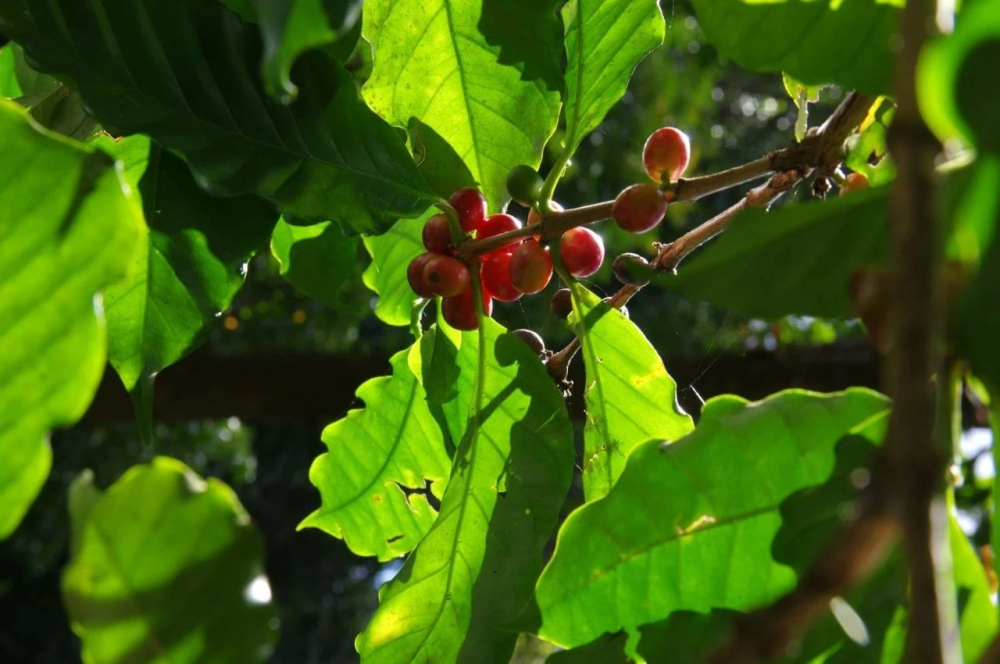
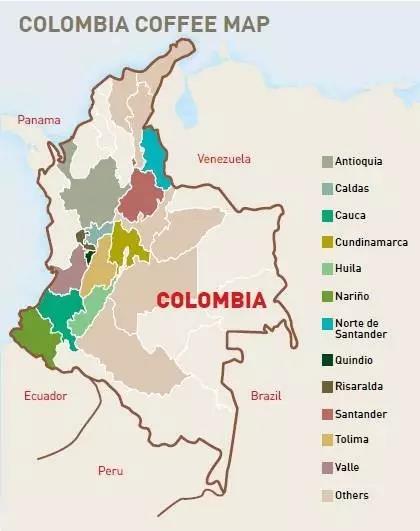
Colombia is one of the world's largest producers of high-quality coffee, a shining pearl on the world coffee map, and a coffee-producing region favored by God. Arabica coffee is grown on steep slopes at 800 to 900 meters above sea level in the foothills, all hand-picked and washed.
Colombian coffee has a balanced flavor and a relatively smooth mouthfeel, like a gentleman among coffees—proper and reliable. Its producing regions are widely distributed, with Medellin, Armenia, and Manizales being the most well-known, conventionally collectively referred to as [MAM].
Colombia's specialty bean producing regions are mainly in the south, at altitudes above 1,500 meters, including San Augustin in Huila, Popayan in Cauca, Nariño, and Tolima. Coffees produced in these places have delicate acidity and berry aromas, accompanied by caramel aroma and abundant sweetness. [Front Street Colombia Washed Huila]
Region: Huila
Altitude: 1500-1800
Variety: Caturra
Processing Method: Washed
Brewing Parameters: Using KONO dripper, 90°C water temperature, 15g coffee dose, 1:15 coffee-to-water ratio, medium-fine grind (BG#6S) Brewing Method: Using staged extraction, 30g water for 30-second blooming, pour in a small stream in circles until 125g and pause, then continue pouring until 225g when the water level is about to expose the coffee bed and stop. (Timing starts from the beginning of blooming.) Total extraction time is 2 minutes.
Flavor Description: Overall quite balanced with obvious sweetness; on the palate there are dark chocolate, nuts, and caramel, with a soft fruity acidity as the temperature changes.
Honduras (Central America)
Honduras is located in northern Central America, bordered by the Caribbean Sea to the north, the Gulf of Fonseca near the Pacific Ocean to the south, Nicaragua and El Salvador to the southeast, and Guatemala to the west. Its terrain is mainly mountainous and highland. The country has a tropical climate with moderate temperatures and abundant rainfall, making it an ideal region for coffee cultivation.
Honduras produces two types of exceptionally high-quality coffee that are highly praised by coffee lovers. One is "Highland Coffee" grown at 1,000 to 1,500 meters above sea level, and the other is "Special Selected Highland Coffee" grown at 1,500 to 2,000 meters above sea level, representing Honduras's highest grade. Most Honduran coffee is exported to the United States and Germany.
Twenty years ago, Honduras was virtually unable to compete with its neighbors in controlling processing details, maintaining the environment around processing stations, investing in processing equipment, export procedures, and green bean logistics and transportation, so the general green bean quality was naturally relatively rough, with only a few estates or CoE winning lots worthy of being called specialty. Starting in 2007, the situation began to improve. Led by the IHCAFE coffee bureau and many far-sighted dry processing stations, Honduras's active improvements in processing workflow optimization, investment in green bean processing equipment, and transportation and export gradually bore fruit. Even though international market awareness is still relatively low, proactive roasters have already begun going deep into Honduran producing regions, trying to uncover specialty coffee.
In terms of production, in 2011-2012 Honduran coffee even rose to first place among Central American producing countries, harvesting about three million bags (46kg) of coffee annually. In addition to quantity, IHCAFE has also partnered with like-minded producer associations and processing stations to implement a series of programs, hoping to provide international buyers with high-quality, excellent-flavored Honduran coffee.
Honduran coffee has a rich and full-bodied mouthfeel, with a taste that is neither astringent nor sour; both its body and aroma are high, making it quite suitable for beginners. Honduran coffee can bring out multiple layers of flavor depending on the roast level. Medium roast can maximize the beans' sweetness, while dark roast enhances bitterness, though the sweetness does not disappear. Generally speaking, medium roast has the best taste, with a rich and unique aroma, and is deeply favored by Honduran coffee lovers.
[Front Street Honduras Sherry Coffee Beans]
Region: Marcala
Farm: Moka Farm
Altitude: 1500-1700m
Variety: Caturra, Catuai, Pacas
Processing Method: Refined washed whisky sherry barrel fermentation
Brewing Parameters: Using Hario V60 dripper, 90°C water temperature, 15g coffee dose, 1:15 coffee-to-water ratio, medium-fine grind (BG#6S)
Brewing Method: Using staged extraction, 30g water for 30-second blooming, pour in a small stream in circles until 125g and pause, then continue pouring until 225g when the water level is about to expose the coffee bed and stop. (Timing starts from the beginning of blooming.) Total extraction time is 2 minutes. Flavor Description: On the palate there are vanilla and cream aromas, citrus and berry acidity, almond and dark chocolate flavors in the middle, maple syrup sweetness in the finish, and a vanilla aromatic aftertaste. The flavors are distinct and the mouthfeel is smooth. The flavor is relatively stable from hot to cold, with no off-flavors appearing.
Panama (Central America)
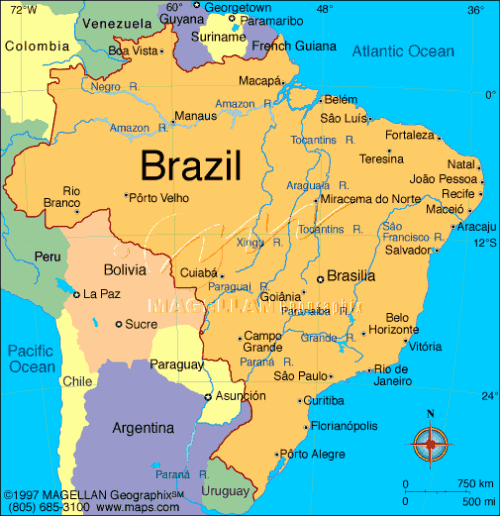
Panama is world-renowned for its Geisha variety, which is inseparable from the country's exceptional natural and geographical conditions. Panama is located at the southernmost part of Central America, bordered by the Caribbean Sea to the east, the Pacific Ocean to the west, Costa Rica to the north, and Colombia to the south. It is an important isthmus connecting North and South America. Due to its geographical location, Panama has complex and changeable microclimates, which have also created uniquely flavored Panamanian coffee.
Panama is roughly divided into four producing regions:
Boquete Boquete Region, altitude 1,450 meters
Coffee produced in this region represents Panama's largest coffee production and best quality area.
Volcan Volcan Region, altitude 2,000-3,000 meters
The coffee from this region is characterized by a mild and balanced flavor, and has recently gradually attracted the attention of international experts and coffee lovers.
Santa Clara Santa Clara Region, altitude 1,500 meters
This region is irrigated and nourished by the Chorerra Falls, and with the nearby Panama Canal, coffee from all of Panama can be conveniently shipped to all parts of the world.
Piedra de Candela Candela Region, altitude 1,200 meters
This region is the most promising potential producing area for developing high-quality specialty coffee.
In the development history of Panamanian coffee, the most prominent highlight is undoubtedly Geisha. Compared with the typical flavors of other Panamanian coffees, Geisha's distinctive characteristics are even more intoxicating. However, under everyone's expectations, its risks are also particularly high—extremely high mortality rate, low yield, difficult pruning, and it also requires complicated and costly processing methods to maintain its most original flavor.
Geisha stands out for its bright acidity. In the book "The Coffee Hunter," author Hsu Pao-Lin described it as, "If you have never known Geisha beans in your life, then even as a gourmet you are in vain," which shows its undisputed status in the coffee world. Is Geisha surnamed "expensive"? No, it is surnamed "Geisha"!
[Front Street Panama Hartmann Coffee]
Region: Volcan
Farm: Hartmann Estate
Altitude: 1250-1700m
Variety: Catuai
Processing Method: Red wine processing
Brewing Parameters: Using Hario V60 dripper, 90°C water temperature, 15g coffee dose, 1:15 coffee-to-water ratio, medium-fine grind (BG#6S)
Brewing Method: Using staged extraction, 30g water for 30-second blooming, pour in a small stream until 125g and pause, continue pouring until 225g and stop. (Timing starts from the beginning of blooming.) Total extraction time is 2 minutes.
Flavor Description: The texture is relatively full-bodied, with obvious sweet and sour notes; the palate is smooth with a very rich red wine mouthfeel, high sweetness, lively and bright acidity, and rich layers. Tropical fruit, nuts, red wine aftertaste, honey, and sucrose flavors are obvious. After completely cooling, there is a brown sugar flavor.
Costa Rica
Coffee beans produced in Costa Rica's high-altitude regions enjoy a global reputation for their rich flavor and mild taste, but extremely high acidity. Local coffee beans all undergo refined processing, which is precisely what creates high-quality coffee. The most famous coffee comes from the Central Plateau, where the soil consists of successive thick layers of volcanic ash and volcanic dust.
High-quality Costa Rican coffee beans are called "Strictly Hard Beans," with the following classification standards:
Strictly Hard Beans SHB (Strictly Hard Beans), altitude above 1,200 meters (3,900 feet)
Good Hard Beans GHB (Good hard Beans), altitude 1,000-1,200 meters (3,300-3,900 feet) Medium Hard Beans MHB (Medium Hard Beans), altitude 500-1,000 meters (1,600-3,300 feet)
Coffee produced using Costa Rica's most mature processing method [honey processing] usually has an excellent balance of sweetness and fruity acidity. The flavor is generally not as intense as natural coffee, but is more refreshing and aromatic. The key to this flavor difference comes from the sugars and acids in the mucilage layer—during sun exposure, the sugars in the mucilage layer gradually concentrate and penetrate into the interior of the coffee bean.
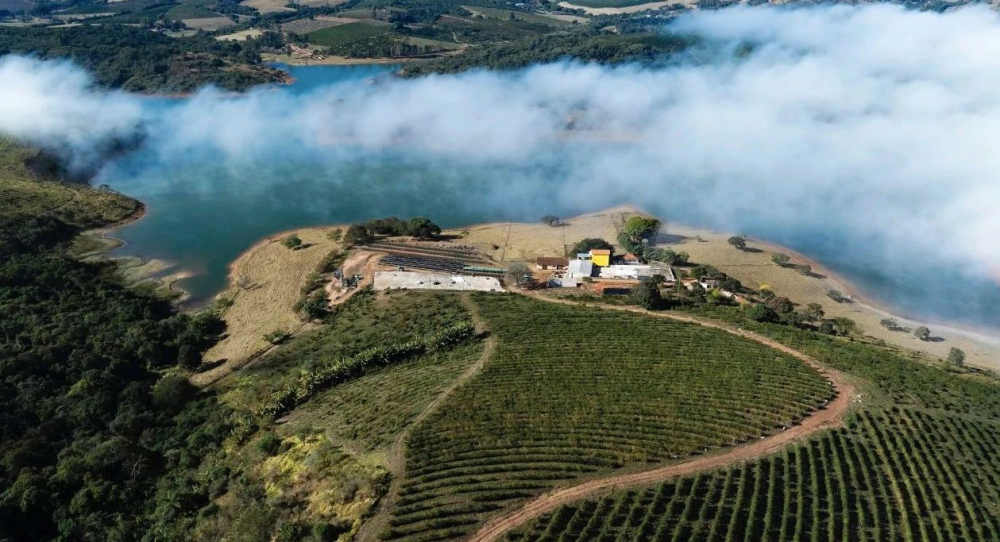
Its three most well-known producing areas are: Tarrazu, located south of Costa Rica's capital San José, as well as the Central Valley and Western Valley producing regions. Natural processing is a very traditional method that consumes the fewest resources, but because there are too many uncontrollable factors, doing it well is extremely difficult.
Bean varieties grown in Costa Rica include Caturra, Catuai, and Villa Sarchi, and a small amount of Kenyan varieties such as SL28 and Obata have also been introduced.
Villasarchi Villa Sarchi
This variety was born in Costa Rica and is a mutation of Typica. Like Typica, the angle between the branches and the trunk is 60 degrees, and the leaves are bronze-colored.
[Front Street Costa Rica Canet Estate Musician Series Mozart Coffee Beans]
Region: Tarrazu
Farm: Canet Estate
Altitude: 1950m
Variety: Caturra, Catuai
Processing Method: Raisin honey processing
Brewing Parameters: Using Hario V60 dripper, 90°C water temperature, 15g coffee dose, 1:15 coffee-to-water ratio, medium-fine grind (BG#6S) Brewing Method: Using staged extraction, 30g water for 30-second blooming, pour in a small stream in circles until 125g and pause, then continue pouring until 225g when the water level is about to expose the coffee bed and stop. (Timing starts from the beginning of blooming.) Total extraction time is 2 minutes. Flavor Description: On the palate there are complex floral notes and fermented sauce aromas, with raisin and dried fruit-like sweetness, starfruit and berry acidity, and a sucrose sweet aftertaste.
Guatemala
Flavor characteristics: bitter and aromatic, good mouthfeel Central Guatemala grows world-renowned, excellent-flavored coffee. The coffee beans here often carry charred notes and cocoa aromas, though the acidity is slightly stronger. Slightly acidic, aromatic, and smooth, it is the best material for making blended coffee. Its classification is divided into seven grades according to altitude. Coffee from highlands has a more aromatic flavor, while coffee beans from lowlands are of lower quality. [Pacamara]: A coffee variety, a hybrid discovered in El Salvador in the 1950s between Pacas (a natural mutation of Bourbon) and Maragogype (elephant bean).
[Guatemala Producing Regions]
Guatemala is divided into eight major producing regions—five volcanic regions and three non-volcanic regions—namely Antigua, Traditional Atitlan, Coban Rainforest, New Oriente, San Marcos Volcano, Acatenango Valley, Vivette Plateau, and Fraijanes Plateau.
Even within the same producing region, flavors are not necessarily the same. For example, in the Vivette Plateau, after crossing a mountain ridge, the coffee flavor can immediately change greatly. Coupled with increasingly diverse varieties and processing methods, coffee flavors present a scene of a hundred schools of thought contending.
[Non-Volcanic Producing Regions]
Vivette Plateau producing region, among Guatemala's three major non-volcanic coffee producing regions, has the driest climate and the highest altitude. The coffee beans from this region are characterized by high acidity, bitterness with rich aroma, a wine-like aftertaste, and a good mouthfeel.
Coban Rainforest producing region: the biggest feature of this area is the rainforest, with two seasons a year—the major rainy season and the minor rainy season. The tropical rainforest in this area brings high humidity and abundant nutrients. The most distinctive feature of the coffee flavor is relatively intense fruity aroma, which is closely related to the local high humidity.
New Oriente producing region, located in easternmost Guatemala, had the latest start in coffee cultivation and was once Guatemala's most remote and poorest area. Its rainy and foggy characteristics make it somewhat similar to the Coban rainforest, but with slightly less moisture and rainfall. The soil is rich in minerals and nutritionally balanced. The coffee beans from this region are characterized by a balanced mouthfeel, full body, and chocolate notes, but the fruity acidity is the lowest among Guatemala's eight producing regions. Chocolate aroma is the main characteristic of New Oriente.
[Volcanic Producing Regions]
Antigua producing region, one of Guatemala's most famous coffee producing regions, with the highest frequency of awards, crowned with the name "classic." Its most important features are rich volcanic soil, lower humidity, abundant sunshine, and large temperature differences between day and night. This producing region is surrounded by three volcanoes: Agua, Fuego, and Acatenango. Among them, Fuego is one of Guatemala's three most active volcanoes. Due to frequent local volcanic activity, volcanic pumice can retain moisture, continuously providing volcanic ash and minerals to the soil in this area, overcoming the shortcoming of relatively low rainfall in the Antigua region and creating the local coffee's extremely balanced flavor profile of acidity, sweetness, bitterness, and aroma.
Acatenango Valley producing region, with altitudes up to 2,000 meters, dense shade, and a unique ecology. Nearby volcanoes erupt continuously, enriching the soil with fertile minerals and becoming the best natural fertilizer for the area. Coffee processing mainly uses traditional family methods. The coffee beans from this region are characterized by flavors similar to Antigua, but with slightly lower fruity acidity, prominent and pleasant dry and wet aromas, full body, a clear aftertaste, and a refreshing aroma.
Traditional Atitlan producing region, among the five major volcanic regions, has the most abundant organic components in its soil. The area has long accumulated excellent cultivation and processing techniques. 90% of the coffee is grown on the steep volcanic slopes along the shores of Lake Atitlan, at altitudes of about 1,300-2,000 meters. The coffee beans are characterized by mild acidity, bright orange peel aroma, and good body.
Fraijanes Plateau producing region: a volcanic producing region with high altitude and soil rich in minerals. The coffee beans tend toward a balanced flavor, but compared with Antigua they have a more unique aroma and flavor.
[Front Street Guatemala Antigua Flower God Coffee Beans]
Region: Antigua
Farm: La Minita Estate
Altitude: 1850m
Variety: Bourbon, Caturra, Catuai
Processing Method: Washed processing
Brewing Parameters: Using Hario V60 dripper, 90°C water temperature, 15g coffee dose, 1:15 coffee-to-water ratio, medium-fine grind (BG#6S)
Brewing Method: Using staged extraction, 30g water for 30-second blooming, pour in a small stream in circles until 125g and pause, then continue pouring until 225g when the water level is about to expose the coffee bed and stop. (Timing starts from the beginning of blooming.) Total extraction time is 2 minutes.
Flavor Description: Citrus acidity is relatively obvious, with rich floral aromas, pleasant sweetness, medium body, and a slight caramel note in the finish. Overall balanced and clean, with a smooth texture.
Peru Peru
Peruvian coffee carries obvious chocolate, cream, and herbal notes. The main bean varieties are Typica, Bourbon, and Catuai.
Peru's Main Producing Regions Northern Peru: nearly 70% of Peru's coffee comes from here, mainly organic cultivation.
Central Peru: this area is located at high altitude (1200-2000m). Most of the coffee produced is also organically grown, with elegant and smooth acidity and a layered mouthfeel.
Peru adopts planned cultivation for coffee, which greatly increases coffee production. Its rich acidity and full, smooth body are its most prominent features. Peruvian coffee has soft acidity, medium body, and good flavor and aroma, making it an indispensable component in blended coffee. Outstanding-quality Peruvian coffee has a rich aroma, a smooth and layered mouthfeel, rich sweetness, and beans with soft fruity acidity and rich, premium dark chocolate notes.
Ecuador Ecuador
Its varied ecosystems create Ecuador's rich coffee flavors, but most still display classic South American characteristics, such as medium body, layered acidity, and relatively high sweetness. Most coffee is organically grown, and coffee from high-altitude areas has good coffee quality.
Ecuador's Main Producing Regions
Manabi Province, a dry coastal area at moderate altitudes of 300-700m, is Ecuador's largest coffee producing region, with its Arabica production accounting for half of the national total.
Zamora Chinchipe Province, located in southeastern Ecuador at high altitudes of 1,000-1,800m, mainly produces washed Arabica, with a distinct, sweet flavor and berry notes.
Loja Province and El Oro Province: 20% of the nation's Arabica comes from this area. Due to the dry climate, the coffee beans are almost all naturally processed.
Jamaica Blue Mountain

When it comes to drinking coffee, many friends will immediately say, "Give me a Blue Mountain." Jamaican Blue Mountain coffee is highly famous, low in production, and has a long history. It can be said that even if you have never drunk specialty coffee, you have still heard of Blue Mountain coffee.
The Three Major Producing Regions of Blue Mountain Coffee
The Blue Mountain area is a small place with only 6,000 hectares of planting area; it is impossible for all coffee labeled "Blue Mountain" to be grown there. Another 12,000 hectares of land are used to grow two other types of coffee (non-Blue Mountain coffee): Jamaica High Mountain Supreme Coffee and Jamaica Coffee.
Its grades are divided by bean size into NO.1, NO.2, NO.3, and hand-selected PB. Among them, the basic standards for NO.1 Blue Mountain green beans are beans of 17 screen size or above, a defect rate below 3%, and a moisture content of about 13%. In addition, to date, the only green bean processing method for Jamaican Blue Mountain coffee is washed; there is no natural or other processing method.
Jamaican Blue Mountain Coffee Bean Processing Method Front Street Jamaican Blue Mountain coffee beans mainly use the washed method. This is to ensure the standard flavor of Blue Mountain coffee, but this year everyone can also enjoy a treat—the natural version of Blue Mountain coffee has been successfully produced. This naturally processed Blue Mountain coffee can be said to be an unprecedented innovative attempt, and the R&D team went through countless hardships. Not only did it require permission from Jamaica's Ministry of Agriculture to export non-washed green beans, but it also required multiple inspections and learning from the experience of outstanding estates to adjust the processing plan.
Jamaican Blue Mountain Coffee Bean Grading
Coffee from Jamaica's Blue Mountain region has three grades: Blue Mountain Coffee, Jamaica High Mountain Supreme Coffee Beans, and Jamaica Prime Coffee Beans.
Blue Mountain Coffee itself is further divided into grades. From highest to lowest: Blue Mountain No.1, Blue Mountain No.2, Blue Mountain No.3, and PB (also called peaberry, round bean).
Blue Mountain No.1 (No.1): 96% of green beans are 17/18 screen size, defect rate below 2%.
Blue Mountain No.2 (No.2): 96% of green beans are 16/17 screen size, defect rate below 2%.
Blue Mountain No.3 (No.3): 96% of green beans are 15/16 screen size, defect rate below 2%.
PB: 96% of green beans are PB, defect rate below 2%.
[Front Street Jamaica Blue Mountain No.1 Coffee Beans]
Region: Blue Mountain
Farm: Clifton Mount Estate
Altitude: 1310m
Variety: Typica
Processing Method: Washed
Brewing Parameters: Using Kono dripper, 88°C water temperature, 15g coffee dose, 1:15 coffee-to-water ratio, medium-fine grind (BG#6W)
Brewing Method: Using staged extraction, 30g water for 30-second blooming, pour in a small stream in circles until 125g and pause, then continue pouring until 225g when the water level is about to expose the coffee bed and stop. (Timing starts from the beginning of blooming.) Total extraction time is 2 minutes. Flavor Description: The mouthfeel is clean and mild, rich and aromatic, with dark chocolate, nuts, cream, and a balance of acidity, sweetness, and bitterness. Bolivia (Bolivia)
In Bolivia, transportation difficulties have limited the speed of its coffee development, but the quality is by no means inferior. Bolivian beans are all quite good in quality, with obvious fruity notes and sometimes floral aromas.
In particular, when Japanese competitor Miki Suzuki won second place in the world at the 2017 WBC (World Barista Championship) held in Seoul using Bolivian Geisha, Bolivia as a coffee-producing country became even more widely known. Most Bolivian bean varieties are Typica, Caturra, and Catuai, and organic cultivation is found almost everywhere.
Bolivia has diverse terrain; its capital La Paz is located in the west of the country at an altitude of 3,500 meters. High altitude brings great advantages to coffee cultivation, but Bolivia's coffee industry remains weak, with annual production of only 150,000 bags.
Bolivian farmers mainly use the washed method to process green beans, and some occasionally use natural or honey processing. It is worth mentioning that because Bolivia's climate is even colder than other coffee-origin countries, many farmers use mechanical drying rather than sun drying.
[Front Street Bolivia Waliki Estate Coco Natural Java]
Coffee Producing Region: La Paz
Growing Altitude: 1,600 meters
Coffee Variety: Java
Processing Method: Coco natural processing
Brewing Parameters: Using Kono dripper, 88°C water temperature, 15g coffee dose, 1:15 coffee-to-water ratio, medium-fine grind (BG#6W) Brewing Method: Using staged extraction, 30g water for 30-second blooming, pour in a small stream in circles until 125g and pause, then continue pouring until 225g when the water level is about to expose the coffee bed and stop. (Timing starts from the beginning of blooming.) Total extraction time is 2 minutes.
Flavor Description: Slight fermentation, grape, light nuts, floral aroma, medium acidity, juicy mouthfeel
The above content is compiled by CoffeeHunters, a coffee news website.


