







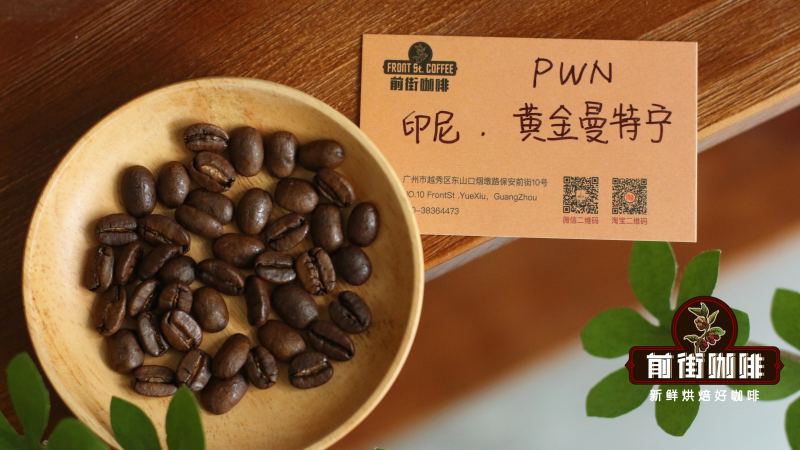
How should Golden Mandheling coffee be brewed at home?
Golden Mandheling is a specialty-grade coffee from Sumatra, Indonesia, produced around Lake Toba in the north-central highlands. It uses the Ateng variety and the wet-hulling processing method, which shape its earthy, low-acid cup. Region, variety, and processing method are the three core elements behind its flavor, and it remains a long-selling bean at Front Street Coffee.
PWN's Golden Mandheling follows specific grade standards, and the roasting process for dark-roasted beans is designed to keep body without pushing bitterness too far. For pour-over, use a slightly coarser grind and water just off the boil, then adjust the ratio to taste. These parameters help beginners and experienced brewers get consistent results from this Indonesian bean.
Golden Mandheling is one of the most representative specialty coffees from the Sumatra region of Indonesia, and also a long-time best-selling star bean at Front Street Coffee. This article will explore this coffee's flavor origins from three dimensions: regional terroir, Ateng variety characteristics, and wet-hulling processing method. At the same time, the article also documents in detail the grade standards of PWN's Golden Mandheling, the design approach for its roasting curve, as well as Front Street's recommended pour-over parameters and brewing techniques for dark-roasted beans. Whether you are a beginner just getting into pour-over or a coffee enthusiast wanting to further understand the Mandheling system, you can gain practical reference information from this article.
For more specialty coffee knowledge, please follow our WeChat official account: FrontStreet Coffee
The specialty coffee market continues to expand, and everyone's enthusiasm for coffee is growing day by day. Many enthusiasts are no longer satisfied with simply ordering a finished cup at a café—they want to brew great-tasting coffee at home themselves. Front Street frequently receives similar questions: how exactly should pour-over coffee be made to taste good? Front Street's answer is: there are so many types of coffee beans, with varying roast levels, plus different equipment, so the details to pay attention to naturally differ as well. Today, let's take Front Street's best-selling Golden Mandheling as an example and talk about how to brew this bean.
Golden Mandheling has always been an extremely high-selling specialty coffee bean at Front Street.
Before getting into the brewing process, let's first get to know this bean itself.
FrontStreet Coffee has mentioned many times: region, variety, and processing method are the three core elements that determine a coffee's flavor. Let's now elaborate on Golden Mandheling from these three perspectives.
Golden Mandheling Coffee
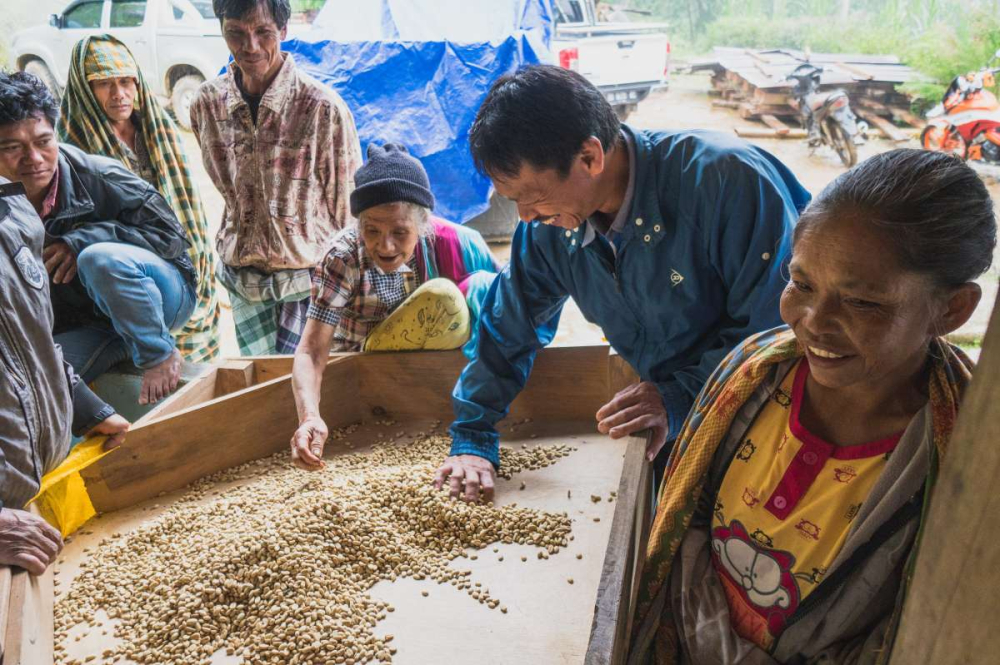
Mandheling is a best-seller in Front Street's everyday drinking bean series and also the representative of Indonesian coffee. Golden Mandheling belongs to the specialty grade within the Mandheling system. Indonesia's Sumatra island is the main source of Indonesian specialty Arabica beans. What is commonly called Mandheling refers to Arabica coffee produced in the area around Lake Toba in north-central Sumatra at altitudes of 900 to 1,200 meters, as well as in the area near Aceh Province at the northernmost tip of Sumatra at altitudes of 900 to 1,600 meters. The suitable altitude combined with a tropical rainforest climate keeps the island's temperature stable year-round between 25 and 28 degrees Celsius, with evenly distributed rainfall and no distinct dry season, providing ideal conditions for coffee tree growth.
So what exactly is Golden Mandheling? Literally, is it a higher grade than regular Mandheling? Front Street wants to correct a common misconception: Golden Mandheling is not a grade name, but a registered trademark held by the Indonesian company N.V. Pawani Medan (abbreviated as PWN). This company was founded in 1957 and deals in the export of Indonesian specialty products such as coffee, rubber, cinnamon, cloves, and patchouli oil. It was the first Indonesian company to export coffee from North Sumatra and the first company to make "Mandheling coffee" famous in Japan. Since 1977, PWN has focused on exporting high-quality Sumatra Arabica Mandheling Grade 1 and Robusta AP-I Grade 2, mainly to Japan, Taiwan, and the United States, with the Japanese and Taiwanese markets combined accounting for over 95% of its export volume. In these markets, "PWN" is almost synonymous with quality assurance.
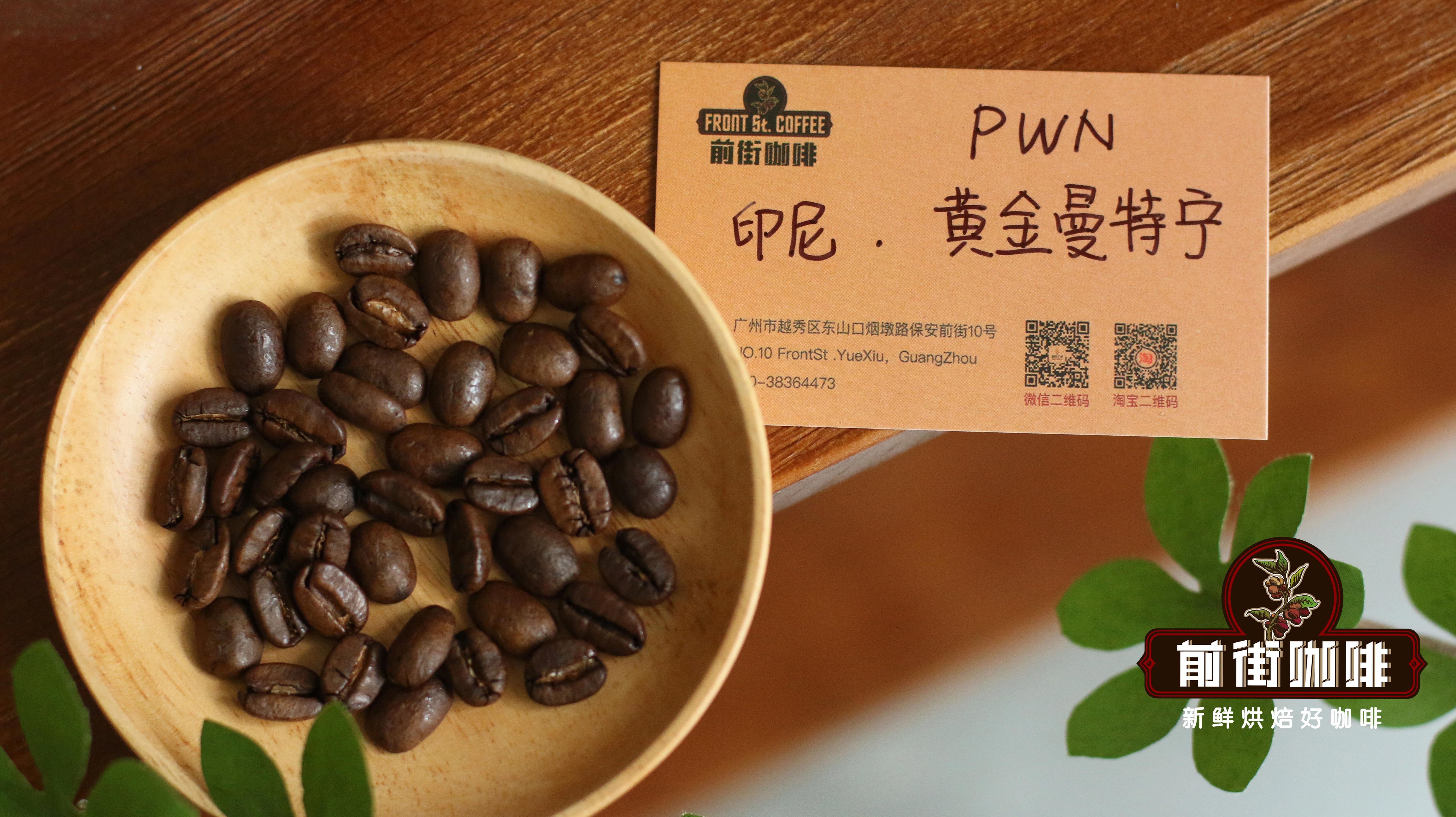
The Golden Mandheling coffee beans currently sold by FrontStreet Coffee come precisely from PWN. The PWN Golden Mandheling selected by Front Street undergoes at least three rounds of purely manual sorting after harvesting and drying, ensuring that the green bean specification reaches 18 mesh or above, with no more than 3 defective beans in a 300-gram sample, belonging to the highest grade G1. PWN Golden Mandheling green beans have a darker green color, neat bean shape, and a flat bean appearance.
Golden Mandheling Coffee Variety
Golden Mandheling belongs to the Ateng variety. Ateng is a hybrid offspring of Arabica and Robusta, with several sub-types under it, widely planted in Sumatra and other Indonesian islands. Tracing its roots, it is actually a branch of Catimor, with Ateng being the local name.
Sumatra Golden Mandheling Coffee Bean Processing Method
The unique flavor of Golden Mandheling is inseparable from the processing method it employs. Front Street has previously explained that the choice of processing method is often constrained by the climate of the producing region. Sumatra experiences frequent rain, frequent typhoons, and year-round humidity, lacking the conditions required for sun-dried processing. Therefore, coffee farmers use the wet-hulling method: first completing fermentation through washing, then after semi-drying, mechanically removing the parchment, and finally performing final drying, with the green beans entering storage completely smooth. It is precisely this seemingly accidental processing method that creates Golden Mandheling's irreplaceable flavor.
What are the considerations for Golden Mandheling's roast level?
According to Front Street's observations, Mandheling green beans have a relatively high moisture content, showing a clear difference in moisture value compared to sun-dried beans, so the dehydration stage requires extra attention. For high-moisture green beans, you can close the airflow damper immediately after dropping the beans, then open it to 3 after 30 seconds of soaking. When the green bean color turns light green or white, adjust the damper to 4. After first crack, open the damper to 5 (maximum).
Simply put, the goal is to roast Golden Mandheling thoroughly from inside out, and on the premise of ensuring proper development, use appropriate roasting techniques to fully express this bean's flavor. The caramelization reaction is the most critical stage affecting coffee flavor: after six to seven minutes of heating, the green beans absorb a large amount of heat energy and trigger pyrolysis, producing the first crack sound. Some sugars convert to carbon dioxide, moisture continues to evaporate, new aromatic compounds gradually form, coffee oils develop, and combine with hundreds of aromatic substances such as nicotinic acid, citric acid, quinic acid, malic acid, acetic acid, and caffeine.
The pyrolysis reaction can continue all the way to second crack. Although caramelization is an important process for awakening aromatic substances, as roasting time extends, some components will also be carbonized, producing unpleasant bitter substances. The key lies in how to maximize the degree of caramelization while minimizing carbonization, avoiding the appearance of defective flavors such as charcoal and tire notes.
Specific roasting operation: drop beans when the drum temperature rises to 200 degrees Celsius, with the damper set to 3. After one minute, adjust the heat to 160 degrees, keeping the damper unchanged. When roasting reaches 5 minutes 40 seconds at 148 degrees, the bean surface turns yellow, the grassy smell completely dissipates, the dehydration stage ends, reduce heat to 140 degrees, and adjust the damper to 4.
At 9 minutes 40 seconds, irregular wrinkles and dark spots appear on the bean surface, and the toast aroma clearly transitions to coffee aroma, which can be regarded as the prelude to first crack. At this point, carefully capture the crack sound of first crack. First crack begins at 9 minutes 54 seconds; immediately reduce the heat to 60 degrees, open the damper fully (be very careful when adjusting heat—do not reduce it so much that you cannot hear the cracking sound), and discharge at 204.5 degrees.
So how should this Golden Mandheling coffee bean be brewed as pour-over?
Front Street has discussed the relationship between roast level and pour-over methods in previous articles. Light-roasted beans and dark-roasted beans differ in suitable water temperature and dripper selection. Golden Mandheling is a dark-roasted bean, so the water temperature should not be too high, and the Kono dripper is recommended. The lower water temperature is to avoid extracting too many off-flavors—FrontStreet Coffee believes that a large amount of aromatic substances has already been released during the dark roasting process, and if you still extract at light-roast water temperatures, over-extraction is likely. The Kono dripper is chosen because the V60 has a relatively fast flow rate and tends to under-extract at low water temperatures; the Kono dripper has fewer diversion ribs concentrated at the bottom, allowing the filter paper to cling closely to the wall, thereby restricting airflow, extending the contact time between water and coffee grounds, allowing the coffee grounds to be more fully extracted, and enhancing body.
Front Street's brewing parameters for Golden Mandheling coffee:
Water temperature 88 degrees Celsius, 15 grams of coffee, 1:15 coffee-to-water ratio, medium-fine grind (70% passing through a No. 20 sieve).
Use staged extraction: first bloom with twice the coffee weight in water, that is, 30 grams of water for 30 seconds. The purpose of blooming is to let the coffee grounds release internal carbon dioxide, making subsequent extraction more stable. Then pour in a small stream in a circular motion until reaching 125 grams, pause the stage, continue pouring until 225 grams and stop, and remove the dripper after all the water in the dripper has dripped through. Start timing from the beginning of pouring; total extraction time is 2 minutes 00 seconds. After completion, swirl the entire cup of coffee to mix evenly, then pour into a cup for drinking.
[Front Street PWN Golden Mandheling Coffee Bean Flavor]: The overall layers are rich and varied, the mouthfeel is full-bodied yet clean, with intense nut and caramel aromas, chocolate notes, a lasting finish, and excellent balance.
FrontStreet Coffee Brewing Suggestions
Regarding brewing, Front Street recommends using freshly roasted coffee beans, as this allows you to experience the coffee's rich flavor layers to the greatest extent. The coffee beans shipped by FrontStreet Coffee are all products within 5 days of roasting, because Front Street deeply understands that freshness has a decisive impact on flavor. Front Street's roasting philosophy is "Freshly Roasted Good Coffee," striving to ensure that every customer who places an order receives coffee in its freshest state. Coffee's resting period is approximately 4 to 7 days, so when customers receive it, it is precisely in the optimal flavor window.
Of course, some customers need Front Street to grind the coffee for them, which can also be arranged, but Front Street needs to remind: once coffee beans are ground into powder in advance, there is no need for the resting process, because the pressure formed by carbon dioxide inside the packaging during transportation can also mellow the flavor, so after receiving the coffee grounds, you can brew directly. However, coffee grounds need to be used up as soon as possible, because after contact with air, oxidation speeds up, flavor loss accelerates, and the taste naturally cannot compare to freshly ground. Therefore, Front Street recommends buying whole beans and grinding fresh before brewing to better taste the coffee's complete flavor.
The above content is compiled by CoffeeHunters, a coffee news website.


