








What does Colombian coffee flavor taste like?
Colombian coffee flavor is defined by a balanced sweet aroma, acidity with a hint of sweetness, and moderate bitterness. That profile lets the beans work as a pour-over single origin that shows terroir, or as part of an espresso blend, where their balanced concentration holds up against milk and other components.
The growing conditions for coffee in Colombia explain much of this character. The crop grows along the Andes at 1,000 to 2,500 meters, with abundant rainfall and temperatures near 18°C year-round, and the country's varied terrain creates multiple harvest seasons. Since 1927 the National Federation of Coffee Growers has promoted quality and international marketing, shaping the classic Juan Valdez image.
Colombian coffee is renowned for its balanced sweet aroma, with acidity carrying a hint of sweetness and bitterness that is moderate. It can be brewed as a pour-over single origin to showcase the terroir, and is also commonly used in espresso blends. The high-altitude growing belt along the Andes Mountains, abundant rainfall, and an average annual temperature of about 18 degrees Celsius provide superior growing conditions for coffee trees. FNC (National Federation of Coffee Growers of Colombia), since its establishment in 1927, has continuously promoted quality improvement and international marketing, shaping the classic image of "Juan Valdez." This article will outline the characteristics of Colombia's main producing regions—Huila, Cauca, Nariño, and Santander—introduce varieties such as Typica, Bourbon, Caturra, and Castillo, analyze washed, anaerobic natural, and anaerobic enzyme-washed processing methods, and provide brewing suggestions and flavor descriptions based on several Front Street Coffee bean offerings.

Colombian coffee has won the favor of many coffee enthusiasts with its sweet aroma characterized by acidity with a hint of sweetness and moderate bitterness. High-quality Colombian beans are often listed on pour-over single origin menus, and their balanced concentration also earns them a place in espresso blends.
Colombian Coffee Cultivation
Colombia is located in northern South America. On the map, the coffee-growing belt extends from south to north along the Andes Mountains, with producing regions mainly concentrated in the western part of the country. Due to the large span of growing areas, geographical conditions and climate characteristics vary from place to place, forming multiple coffee production seasons—it can be said that Colombia harvests coffee year-round.
Colombia's growing altitude is relatively high, ranging between 1,000 and 2,500 meters. The complex terrain of the Andes brings rich microclimates, abundant rainfall, and temperatures that remain around 18 degrees Celsius year-round, which is highly favorable for coffee tree growth. This is also the primary reason for the outstanding quality of Colombian coffee.
In Colombia, 30% to 40% of the rural population depends on coffee production for their livelihood. Local agriculture is operated in a small-farm model, and coffee growing is no exception. Farms are usually not large, about two hectares or so, and farm owners carefully tend to the plants on their land. Locals also plant tall trees or banana trees beside the coffee trees to provide shade.
Colombian Coffee Association FNC
FNC is the largest official organization of coffee producers in Colombia. Its full name is the National Federation of Coffee Growers of Colombia, also translated into Chinese as the Colombian Coffee Growers Federation, founded in 1927.
FNC serves Colombian coffee farmers and is also the largest exporter of local green coffee beans. The association has continuously worked through various actions to improve the living standards of Colombian coffee producers, such as providing technical assistance to growers and optimizing production costs, thereby safeguarding the long-term development of local coffee farmers and making the quality of the entire coffee industry more assured.
With FNC's promotion in the international coffee market, the image of "Juan Valdez" was successfully established. Juan Valdez represents all Colombian coffee farmers. The logo composed of this character and his mule (with the Andes Mountains in the background) has also become the official symbol of the National Federation of Coffee Growers of Colombia, often appearing on major advertising screens. Driven by such promotional efforts, Colombian coffee has become famous worldwide, and Colombia has become the world's third-largest coffee exporter, making locals immensely proud.
Colombian Producing Regions
On FrontStreet Coffee's bean list, Colombian coffee occupies a section, and several coffees are deeply loved by customers. In order to help coffee enthusiasts who are just starting out understand representative classic coffee-producing regions, Front Street has launched seven staple beans including Colombia, allowing everyone to taste the main flavors of the producing regions at an affordable price.
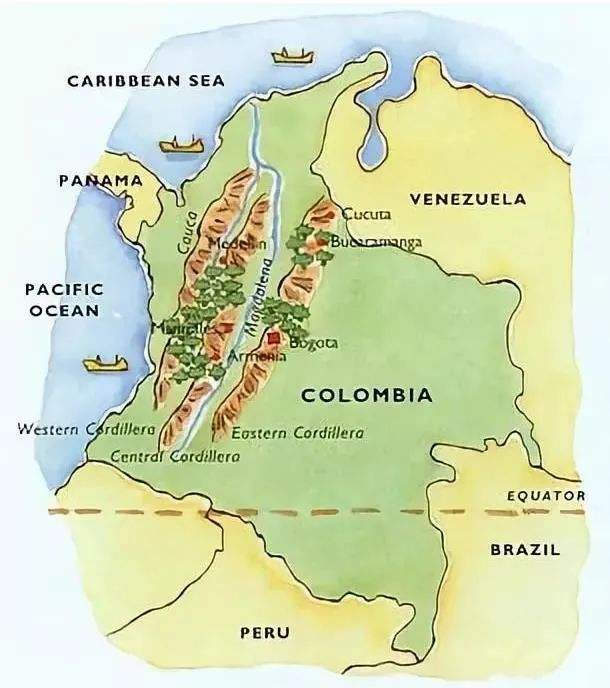
Geographically, Colombia's coffee-growing areas can be divided into three major producing regions: northern, central, and southern, among which, in terms of coffee bean quality, they are mainly distributed in the south. Below, Front Street will discuss a few relatively representative producing regions.
Huila
The Huila producing region is located in southwestern Colombia and is one of the important local specialty coffee-growing areas, accounting for 12% of Colombia's total coffee production. It is surrounded by diverse hills and mountainous terrain, with altitudes above 1,500 meters. The Colombia River converges here, providing abundant water resources for coffee tree growth. Unlike the traditional impression of Colombian coffee's classic mellow flavor, Huila is mostly dominated by micro-lots provided by smallholders. Different microclimates and distinctive green bean processing methods give the coffee unique characteristics. Front Street believes that washed Huila coffee best represents the basic flavor of Colombian coffee, so it has been included in the staple bean series.
FrontStreet Coffee: Colombia Huila Coffee Beans
Region: Huila
Altitude: 1,500-1,800 meters
Processing Method: Washed
Variety: Caturra
Flavor: Nuts, dark chocolate, caramel, soft fruit acidity
Cauca
The Cauca producing region has high-altitude mountainous terrain, with altitudes reaching as high as 2,100 meters. It has suitable rainfall, a large temperature difference between day and night, and volcanic soil, all of which are very suitable for coffee tree growth. The significant day-night temperature difference formed at high altitude is the biggest difference between Cauca and other Colombian producing regions. Coffee beans take longer to mature and can fully absorb nutrients, which also creates Cauca coffee's pleasant sweet-and-acidic characteristics.
Nariño
The Andes run across the entire province of Nariño. Coffee trees are grown at 1,600 to 2,300 meters in a high-altitude, misty environment. Volcanic soil brings rich nutrients, and the coffee produced is of relatively high quality. Although Nariño's production is not high, the special microclimate brought by factors such as altitude, terrain, and soil gives the coffee from this region excellent acidity and unique flavor, along with a high taste grade and excellent texture. In recent years, it has been deeply loved by coffee enthusiasts around the world.
Santander
FrontStreet Coffee has learned that Santander is the province where coffee was first planted in Colombia. Although it is not often mentioned, it is also a very important producing region in Colombia, with coffee production reaching 5% of Colombia's total output. The climate here is dry, and the altitude is relatively low, about 1,400-1,600 meters. A large number of Typica trees are grown here. Most local coffee trees are planted in forests with appropriate shade, which gives the coffee cherries a longer maturation period. Fertile soil and significant temperature differences make the coffee flavor more robust, with a round and balanced mouthfeel.
Coffee Varieties
As one of the world's major producing countries, Colombia naturally has a very diverse range of coffee varieties. In addition to the old varieties Typica and Bourbon, there are also Caturra, the Colombia variety bred by the Colombian Coffee Research Center, and Castillo.
At the end of the 16th century, the Typica variety was introduced to Colombia for cultivation and has a long planting history. Typica has an elegant flavor, with light floral notes and fine sweet acidity, but it has poor disease resistance and therefore low yield, so most coffee farmers choose higher-yielding coffee varieties to grow. Bourbon, a variant of Typica, has a fresher and cleaner acidity in flavor. It was introduced to Colombia relatively late and is not widely planted either.
The popular variety Caturra is a natural mutation of Bourbon, and its flavor is similar to Bourbon. However, Caturra coffee trees do not require shade, have many branches and therefore high yield, and a short tree shape that makes picking convenient. These various advantages have made Colombian coffee farmers more inclined to grow this variety. At present, Caturra has become Colombia's main coffee variety.
In response to leaf rust, Colombia's National Coffee Research Center, Cenicafé, bred a multi-generation backcrossed improved Catimor variety in 1980, which has excellent performance in disease resistance and high yield. However, in cupping, its flavor still cannot compare with Caturra, and it is mostly used for commercial bean exports. There is also Castillo, a new-generation variety jointly bred by FNC and the research center. Due to its strong resistance and continuously optimized flavor quality, the Colombian government is promoting its cultivation.
Green Coffee Processing
Most Colombian green coffee beans are processed using the washed method. Small farms all have machines to remove the coffee skin and pulp. Farmers pour the picked coffee cherries into them, add a small amount of water, then put the parchment beans with a little mucilage into a small tile tank or container, ferment overnight to let the mucilage layer fall off, then rinse with clean water, and place them outdoors to dry naturally. If rainy weather affects this, locals use drying machines, placing the beans in a space kept at a constant 50 degrees Celsius to dehydrate and dry until the moisture content meets requirements, then package and store them.
In recent years, as micro-lot specialty coffee has become increasingly popular, many Colombian farm owners have also begun to adopt newer processing methods in pursuit of diverse flavor types. For example, the Flower Moon Night coffee beans on Front Street's bean list use anaerobic natural processing, which means the coffee fruit is first subjected to anaerobic fermentation and then dried through natural sun-drying. It should be noted that the temperature during anaerobic fermentation must be controlled below 10-15 degrees. In a sealed and clean stainless steel fermentation container, the coffee beans ferment for three days under oxygen-free conditions.
There is also another processing method that makes the coffee's fermentation aroma more prominent: anaerobic enzyme-washed. The selected coffee cherries are placed in a sealed environment, carbon dioxide is injected to expel oxygen, and special enzymes are added during fermentation. In an oxygen-free environment, this slows the decomposition rate of sugars in the coffee mucilage, and the pH also decreases more slowly, extending the fermentation time, thereby developing better sweetness and a more balanced flavor in the coffee. After fermentation is complete, the coffee fruit continues to undergo washed processing.
Brewing Suggestions
To taste Colombian coffee flavors, Front Street brewed three coffee beans with different processing methods: the washed Huila staple bean, the anaerobic natural Flower Moon Night, and the anaerobic enzyme-washed Rose Valley.
FrontStreet Coffee: Colombia Flower Moon Night Coffee Beans
Region: Huila Producing Region, El Descanso Farm
Altitude: 1,500-1,800 meters
Processing Method: Anaerobic Natural
Variety: Caturra
Flavor: Strawberry jam, fermented wine aroma, chocolate

FrontStreet Coffee: Colombia Rose Valley Coffee Beans
Region: Santander Producing Region
Estate: Big Tree Estate
Processing Method: Anaerobic Enzyme-Washed
Altitude: 1,700 m
Variety: Caturra
Brewing Flavor: Rose, peach, liqueur chocolate, cream, cranberry
Rose Valley and Flower Moon Night both have a floral-fruity sweet-and-sour profile, while also carrying a rich fermentation aroma. Therefore, Front Street's roaster uses a medium roast. The Huila staple bean mainly highlights nutty sweetness, so Front Street chooses a medium-dark roast.
As for how to brew a good cup of coffee, Front Street believes that freshly roasted coffee beans are the primary condition. The aroma of coffee beans changes according to the storage environment and time. Once past the optimal tasting period, the coffee's aroma will be lost at an accelerated rate. Front Street knows how important freshness is, so all shipped coffee beans are freshly roasted within 5 days, so that when we receive them, they are just ready to be opened and brewed.
Dripper: V60
Water Temperature: 90 degrees Celsius
Grind Size: 80% passing through a No. 20 standard sieve
Coffee-to-Water Ratio: 1:15
Coffee Dose: 15 grams
Pour the coffee grounds into the V60 dripper, wet the coffee bed with twice the amount of water to form a dome and bloom for 30 seconds, then pour in a thin stream in circles from the inside out until reaching 125 g, pause, and when the coffee bed drops to half the height of the dripper, continue pouring the third pour with the same thin stream to 225 g. After all the coffee liquid has filtered through, remove the dripper. The time is about 2 minutes.
When Front Street tasted these coffees, it found that different producing regions and different processing methods affect the flavor of the coffee beans. The washed Colombian Huila staple bean has obvious chocolate and nut aromas, a wet aroma of caramel, and just the right soft fruit acidity, making it balanced overall. The anaerobic enzyme-washed Rose Valley is a sweet, rich rose, then on the palate it is liqueur chocolate, and as the temperature drops, you can taste the sweet-and-sour dried cranberry. The anaerobic natural Flower Moon Night presents more of the fresh sweetness of cantaloupe, a rich strawberry jam and fermented fruit aroma, and finally a chocolate finish, making it rich in mouthfeel.
For professional coffee knowledge exchange and more coffee bean information, please follow Coffee Workshop (WeChat public account: cafe_style)
For more specialty coffee beans, please add the private WeChat of FrontStreet Coffee: qjcoffeex
The above content is compiled by CoffeeHunters, a coffee news website.


