







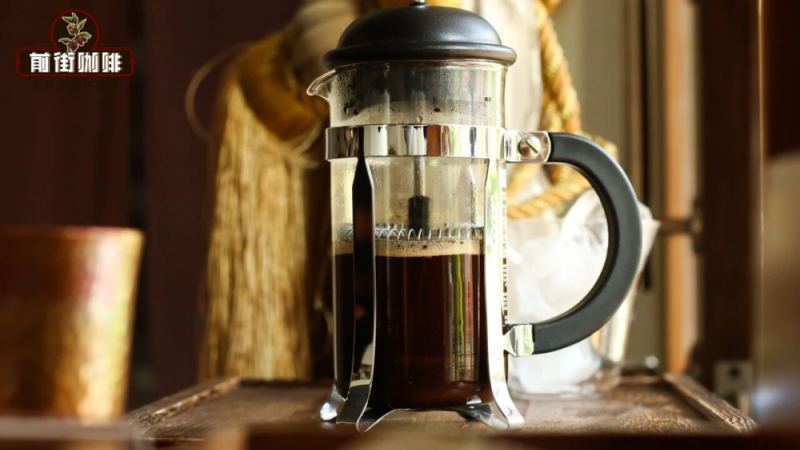
The French press is simple to operate and has an extremely high adoption rate in European and American households, but many people in China only treat it as a tea-making tool. In fact, the body and balance of coffee produced by a French press is no inferior to pour-over, and it can make more than two servings at a time, making it very suitable for daily home use. Front Street Coffee has always listed the French press as one of the top beginner-friendly brewing devices. This article will provide specific parameter suggestions from four dimensions: grind size selection, steeping time, water temperature control, and coffee-to-water ratio. It will also explain which roast types of coffee beans can better leverage the advantages of the French press, and finally include notes on daily cleaning and maintenance to help you consistently make a delicious cup of French press coffee.
For more specialty coffee knowledge, please follow: Frontsteet Coffee
The French press can be called one of the easiest coffee brewing tools to get started with, and it has a broad user base in European and American countries. However, most people in China know it only as a "tea-making device," not realizing that coffee made with a French press can fully rival pour-over coffee in flavor expression. In addition, it can produce two or more servings of coffee liquid at once. For friends who want to easily enjoy coffee at home, Front Street usually recommends the French press first. So what kind of coffee beans are suitable for pairing with a French press? Next, Front Street will analyze them one by one.
French Press Introduction French Press
This device originated in France and has a very simple structure: a cylindrical container plus a lid, with a metal filter rod connected at the center of the lid that can be pushed up and down to separate the coffee grounds from the coffee liquid, thereby controlling the degree of extraction. The working mechanism of the French press is exactly the same as our daily tea brewing—soak the coffee grounds in hot water for a period of time, then press down the plunger and filter out the coffee liquid. Although the operating threshold is extremely low, Front Street has also received feedback from many friends saying that the coffee they brew with a French press is always less than satisfactory.
French Press Usage Parameter Suggestions
If you look through most French press tutorials on the market, they basically all recommend using a coarse grind. Front Street's specific suggestion is: using the Chinese No. 20 standard sieve as a reference, choose a grind size with a 70% passing rate, roughly equivalent to the particle feel of coarse granulated sugar.
Using a coarse grind has two benefits: first, it increases the margin for error during extraction; second, it reduces the extremely fine particles produced during grinding. The metal filter mesh of a French press usually has openings between 80 and 300 microns, and the holes are clearly visible to the naked eye. Fine particles can easily pass through the filter and mix into the coffee liquid, making the final product cloudy. Of course, if you prefer a richer layering, you can also try a finer grind, but be sure to shorten the steeping time accordingly to prevent over-extraction.
Steeping time is the most flexible adjustable variable of the French press. Since the French press does not involve manual stirring like pour-over, the steeping time directly determines the extraction yield. Under otherwise unchanged conditions, the longer the steep, the heavier the coffee's mouthfeel, but it also becomes more prone to over-extraction, producing bitterness, astringency, and even woody off-flavors. With a coarse grind, Front Street's suggestion is: steep medium-light roasted beans for about 4 minutes; medium-dark roasted beans, because they themselves release bitter substances more easily, are sufficiently steeped at 3 minutes 30 seconds. This time range can fully extract the positive flavors while avoiding the unpleasant mouthfeel caused by prolonged steeping.
The water in a French press is poured all at once, and the water temperature will continue to drop throughout the extraction process, so the starting water temperature needs to be slightly higher than for pour-over. If you are brewing a medium-light roasted coffee with acidity, you can use water at 92–94°C; for medium-dark roasted coffee with bitterness, it is recommended to keep it at 89–90°C. In autumn and winter when room temperature is low, you can first preheat the French press with boiling water to slow down heat loss during extraction.
Controlling concentration is naturally inseparable from the coffee-to-water ratio. Front Street usually recommends brewing with a 1:16 coffee-to-water ratio. For example, if you weigh 15 grams of coffee grounds, that corresponds to pouring in 240 milliliters of water. Coffee made at this ratio has a concentration of about 1.1% to 1.2%, which is a very palatable range. If you prefer a stronger taste, you can also tighten it to 1:15.
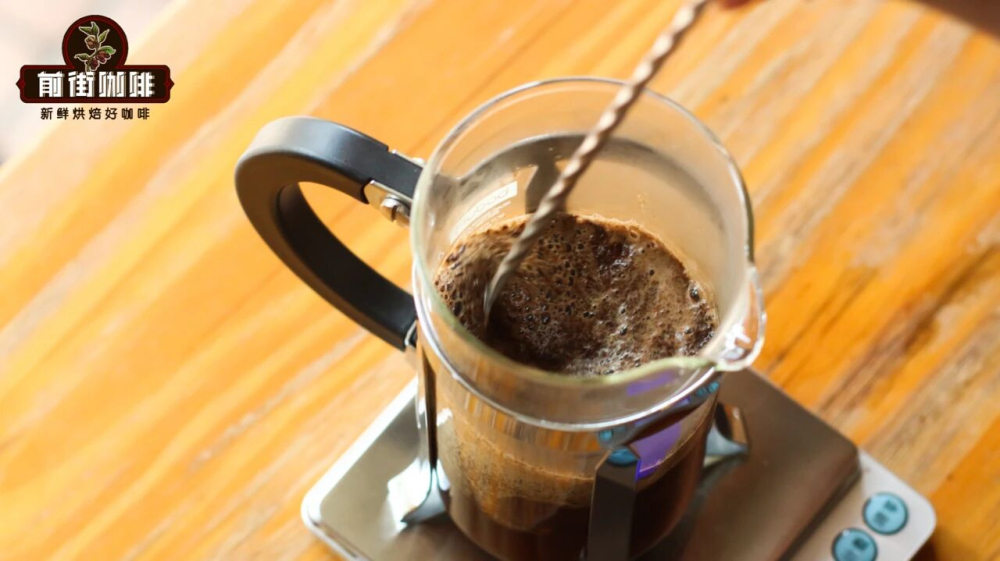
What coffee beans are suitable for brewing with a French press?
After choosing coffee beans, many customers come to ask Front Street whether this bean can be brewed with a French press. In principle, all coffee beans suitable for pour-over can also be brewed with a French press. But considering that the French press is a static immersion extraction method, more coffee oils can be retained in the liquid, giving the coffee a more pronounced heaviness and body, with a flavor profile leaning toward richness and balance, it is therefore more suitable for showcasing coffee roasted at medium or darker levels.
If you cannot quite accept acidity, Front Street recommends several medium-dark roasted beans such as Golden Mandheling, Queen's Estate, Bird of Paradise, and Huilan. They naturally carry flavor tones of dark chocolate, nuts, and caramel. If you can accept a certain degree of acidity, you might try Front Street's Strawberry Candy, Mozart, and Sidra, these medium-roasted coffees with prominent fruity aromas. They can also help you easily make a satisfying cup of French press coffee.
Finally, Front Street would like to remind you of one more point: the metal filter of a French press will absorb and accumulate oils released by the coffee during long-term use. These residues attached to the filter and plunger rod will gradually oxidize and deteriorate, thereby affecting the brewing effect of every subsequent use. Therefore, after using the French press, be sure to clean it promptly. When cleaning, all metal parts need to be disassembled, and the container and parts should be carefully washed with detergent, then thoroughly wiped dry or air-dried before being stored.
The above content is compiled by CoffeeHunters, a coffee news website.


