







How Does Bolivian Java Coffee From Alpaca Estate Taste?
Bolivia grows very little coffee, yet its high-altitude farms produce a specialty bean often described as the taste of heaven. Java coffee from Alpaca Estate in the La Paz region shows pineapple, berry juice, caramel, and a thick sweetness, shaped by mountain terroir and a cacao natural process that dries the cherries slowly with the fruit still attached.
Coffee trees here sit near 2,000 meters, below cities at 3,600 meters, and the cold slows cherry ripening, concentrating sugars in denser beans. Limited coffee production and rough mountain roads mean cherries must reach La Paz quickly for washing, so the article compares Alpaca Estate with Waliki Estate and with Indonesian Java to explain the flavor logic.
Although Bolivia has limited coffee production, its high altitude and unique microclimate nurture a specialty coffee hailed as the "Taste of Heaven." This article by Front Street Coffee focuses on the Java coffee beans from Alpaca Estate in the La Paz region, breaking down everything from the terroir, variety origins, and green bean appearance to the cacao sun-drying processing method, and through cupping and pour-over verification, presenting its pineapple, berry juice, caramel, and thick sweetness. It also compares the differences between Waliki Estate and Indonesian Java, helping coffee enthusiasts fully understand the flavor logic and brewing key points of this rare bean variety.
For more specialty coffee knowledge, welcome to follow our WeChat official account: Front Street Coffee (FrontStreet Coffee)
In South America there is a country with extremely low coffee output, yet it possesses incredibly diverse wildlife resources. Coupled with a high-altitude climate that is extremely favorable for shaping coffee flavor, locals have hailed the coffee beans produced in their country as the "Taste of Heaven." This picturesque nation is exactly Bolivia, which Front Street will introduce to you in this article.
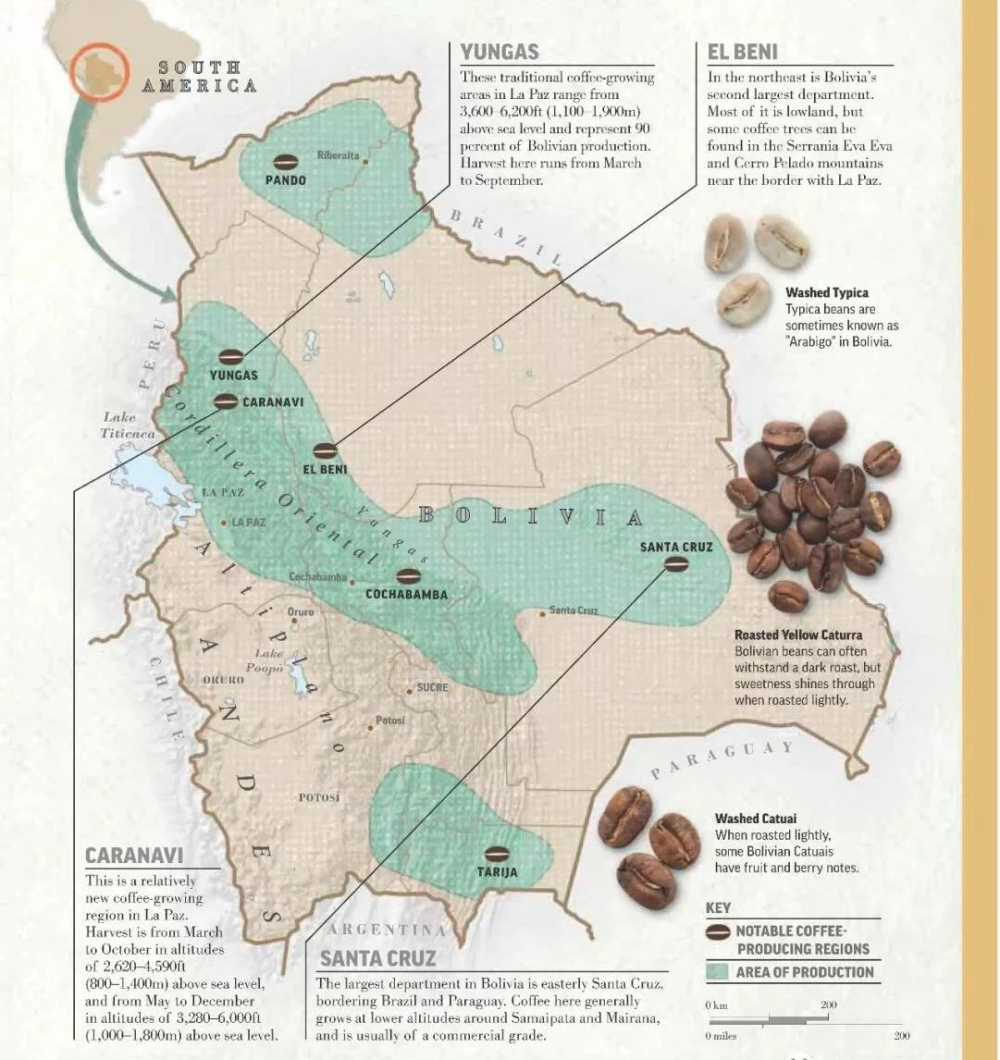
An outstanding coffee bean is often inseparable from terrain, climate, altitude, and processing method. Front Street will discuss Bolivian coffee from these dimensions. Bolivia's coffee-growing regions are at quite high altitudes; coffee farmers must descend from cities at 3,600 meters to areas around 2,000 meters to plant coffee trees. If you look through previous articles on Front Street's official account, you will find that Front Street has repeatedly mentioned that coffee trees are usually planted at higher altitudes, but excessively high altitudes also inhibit coffee tree growth—this is exactly why Bolivian coffee farmers must go to areas over two thousand meters to plant coffee.
However, such high altitudes also bring transportation challenges. After coffee cherries are harvested and simply depulped, they must be bumpily transported along rugged mountain roads to processing plants. Due to weak infrastructure and inconvenient transportation, coffee farmers have to overcome treacherous mountain roads to deliver the beans to the higher-altitude La Paz region for washing. If the coffee cherries fail to reach the processing plant in time, they are highly prone to fermenting and rotting in the humid mountain road environment. In this way, coffee that originally had decent quality may also be ruined.
Recently Front Street acquired a Bolivian Java coffee bean, produced in Caranavi in Bolivia's most renowned La Paz region, with coffee grown at altitudes between 1,600 and 1,900 meters. When Front Street received this Bolivian Alpaca Estate coffee bean, we noticed that the green beans of this Bolivian Java are slender and elongated, with pointed ends; by comparison, Geisha green beans are somewhat shorter and overall rounder.
According to Front Street's understanding, this Bolivian Java coffee bean is not the same lineage as Java from Indonesia. Bolivian Java and Geisha belong to the same lineage, which explains why Java green beans and Geisha green beans look relatively similar. In fact, Bolivian Java originated from the Abyssinia region of Ethiopia and has a different genetic source from Indonesian Java; Indonesian Java varieties are planted at lower altitudes and have long adapted to local low-altitude environments, so their flavor performance is not as outstanding as Bolivian Java coffee beans.
Bolivian coffee beans are rarely listed domestically, which is related to the country's low coffee production. Bolivia's coffee production scale is small and naturally cannot be compared with major exporters like Brazil and Vietnam. Local coffee is basically produced by smallholder farmers and mainly for domestic consumption.
Front Street Coffee (FrontStreet Coffee) has also included a Bolivian Waliki Estate Java coffee. Waliki Estate is extremely small, covering only six hectares, and is mainly located in Caranavi, the core production area of Bolivian coffee. If the altitude is too high, coffee trees will suffer frost damage due to excessively low temperatures. Above 1,660 meters, the climate in this area is cold, so the coffee growing cycle is longer. A prolonged growing cycle is, on the one hand, very beneficial for the accumulation of coffee flavor substances; the sugar in the fruit slowly increases over time, and the sweetness of the brewed coffee becomes more pronounced.
But the Bolivian Java coffee bean introduced in this article by Front Street is not from Waliki Estate, but from Alpaca Estate. Alpaca Estate's Java coffee has a unique flavor, and the coffee beans produced each season are highly sought after. After Front Street obtained this Alpaca Estate coffee bean, we used a light roast during roasting and conducted cupping within 8 to 24 hours after roasting was completed. First weigh 11.3 grams of coffee beans, grind them, and smell the dry aroma. Front Street found that its dry aroma carries a sunflower seed note, with a relatively strong fermented feel. After smelling the dry aroma, pour in 94°C hot water for wet aroma evaluation. The total wet aroma duration is four minutes. The wet aroma of this Bolivian coffee presents orange blossom and nut notes. Then break the crust, skim the grounds, and enter the tasting stage. Through cupping, Front Street judged its overall flavor as: pineapple, berry juice, caramel, thick mouthfeel, and obvious sweetness.
This Bolivian coffee bean is processed differently from conventional methods, using the cacao sun-drying processing method. Of course, "cacao" here does not refer to cacao, one of the world's three major beverages, but rather a type of machine used locally in Bolivia to dry coffee beans. Because Bolivia is at high altitude and has low temperatures year-round, local clever coffee farmers use machines to assist in quickly drying coffee beans. Coffee farmers first spread selected coffee beans on drying beds to sun-dry, turning them once per hour so the fruit dries evenly. After about a week, the coffee cherries are then put into a cacao dryer.
The temperature is then set at around 40°C and left for about 35 hours, turning once every thirty minutes. After drying is completed, the skin and pulp are removed. To ensure coffee bean quality, local coffee farmers also conduct an additional manual sorting. This is the Bolivian coffee bean processing method as understood by Front Street.
Front Street uses pour-over to verify the flavor of this Bolivian coffee again, because pour-over is easy to operate and can fully showcase the characteristics of the production area. Front Street Coffee (FrontStreet Coffee) chose the V60 dripper to brew this coffee bean. The V60 conical dripper has larger holes, and together with its unique spiral curve ribs, it allows air to escape more smoothly, thereby improving extraction quality. The mouthfeel may not be thick enough, but the brightness and distinct aroma brought by high concentration are its highlights. Front Street's brewing parameters are: water temperature 90-91°C, grind size BG#6m (caster sugar size), coffee-to-water ratio 1:15, coffee dose 15 grams.
Front Street's pour-over uses the simplest three-stage method: in the first stage, use 30g of water to fully wet the coffee bed, forming a "hamburger" shape and blooming for 30 seconds; in the second stage, at 54 seconds on the timer, pour water until 125g, then wait for the water level to drop to two-thirds of the coffee bed before pouring the third stage (this stage aims to extract the sweet and sour flavor substances in the coffee grounds); in the third stage, at 1 minute 40 seconds on the timer, pour water until 225g. The total extraction time is 2 minutes 10 seconds. After extraction is complete, gently swirl, and wait until the coffee liquid is fully uniform before tasting.
Brewed flavor of Bolivian coffee: pineapple, berry juice, caramel-like finish, thick mouthfeel, and obvious sweetness.
For more specialty coffee beans, please add private WeChat Front Street Coffee (FrontStreet Coffee), WeChat ID: kaixinguoguo0925
The above content is compiled by CoffeeHunters, a coffee news website.


