







Mandheling is the calling card that brought Indonesian coffee to the world, and Sumatra is the most important origin behind that card. This article will sort through the cultivation history, main producing regions, and varietal differences of Sumatran coffee, introduce the geographical characteristics of Lintong, Lake Toba, Lake Tawar, and the Gayo highlands, and use Front Street Coffee's everyday drinking beans and Golden Mandheling as examples to explain how to make a full-bodied iced americano with espresso and water. Whether you are a beginner just getting to know Indonesian coffee or an enthusiast looking to refine your extraction, you will find useful origin knowledge and operating parameters here.
For more specialty coffee knowledge, please follow the WeChat public account: FrontStreet Coffee
Mandheling coffee can be called the representative of Indonesian specialty coffee and is also the symbol of the country's coffee. In Front Street's brand system, Mandheling has always existed as the face of Indonesian coffee and has been included in the daily drinking-bean list; it is the first bean through which many people come to know Indonesian coffee. Of course, Front Street also has a higher-end Indonesian specialty coffee—Golden Mandheling.
Indonesian coffee beans are usually rather large and firm in texture, with a prominent mouthfeel when drunk. By the way, Mandheling is neither a place name nor the name of a producing region or variety; it comes from a misreading of the name of an ethnic group in Sumatra, "Mandailing." There is also a rather dramatic story behind this name: during World War II, when the Japanese army occupied Indonesia, a Japanese soldier drank a cup of extremely aromatic coffee in a cafe and asked the shopkeeper for the name of the coffee. Because of the language barrier, the shopkeeper mistakenly thought the other man was asking where he was from, so he answered "Mandailing." After the war ended, the soldier recalled the "Mandheling" he had drunk in Indonesia and commissioned a trading company to ship 15 tons of coffee to Japan, where it became hugely popular, and the name Mandheling spread from there.
The Cultivation History of Sumatran Mandheling Coffee
Sumatra is the second-largest island in Indonesia, with a resident population of about 55 million, and it is also one of the country's most important coffee-producing regions. The island's coffee output accounts for about 74.2% of Indonesia's total, while the second-ranked producing region accounts for only 12% nationwide. However, coffee is not a native crop of Indonesia; it was introduced to the island by the Dutch government after the Dutch defeated the Portuguese in the early colonial period. Two centuries later, with World War II raging, a large number of coffee plantations were replaced by crops such as rice, corn, and cassava in order to solve the local food problem. In 1950, local coffee production was only one-eighth of the prewar level. But since then, coffee has gradually grown into an important pillar of the local economy.
Coffee-Producing Regions of Sumatra, Indonesia
Sumatra is not only the largest island in Indonesia but also the sixth-largest island in the world. It is located in northwestern Indonesia and extends from northwest to southeast, with the equator running through its center. The northwestern part of the island is higher in elevation, with the Barisan Mountains running through it; it is dominated by Arabica and is the core producing area of Mandheling. The southeastern part is low and flat, mostly plains or swamps, and mainly grows Robusta. The island has more than 90 volcanoes and numerous volcanic lakes, providing fertile soil for coffee. Influenced by its geographical location, Sumatra has Indonesia's earliest harvest season—from November to March of the following year.
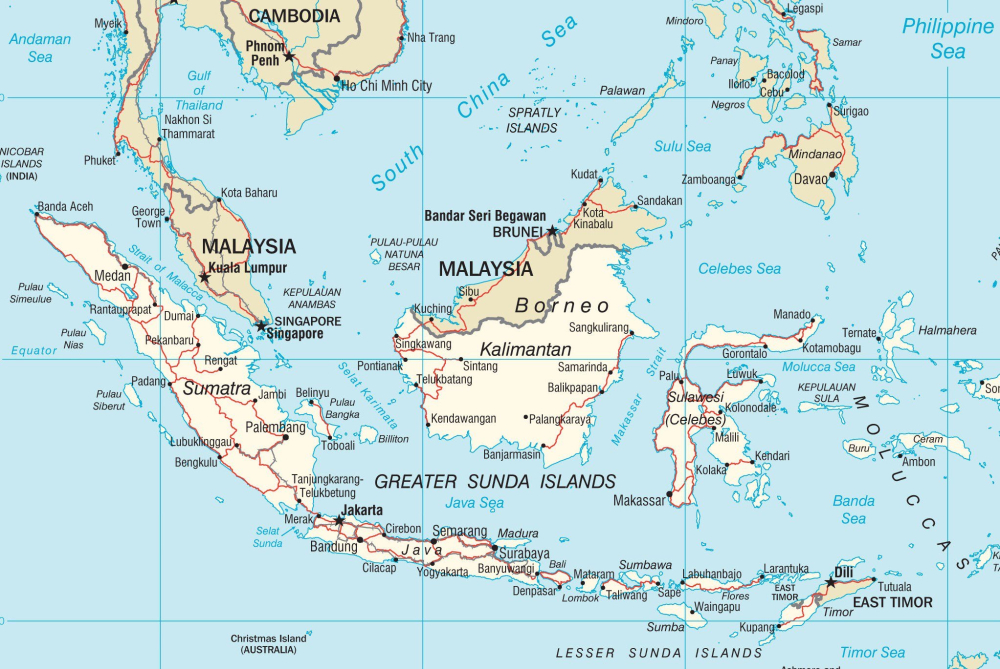
Mandheling coffee comes from Sumatra in Indonesia, Asia, so it is also called "Sumatra coffee." The main producing areas include Java, Sulawesi, and Sumatra, of which about 90% is Robusta. The "Mandheling" produced on Sumatra is the most famous. In northern Sumatra, traditional Arabica coffee of outstanding quality enters the market under the two names Lintong and Mandheling. Strictly speaking, Lintong refers to coffee grown in a small area within the Lintong administrative district southwest of Lake Toba. Local coffee gardens are scattered across high-altitude, undulating, fern-covered clay plateaus. Lintong coffee is not grown under shade and does not use chemicals, and is almost entirely owned by smallholders. Mandheling, by contrast, is a broader designation that covers both Lintong coffee and the similarly conditioned Diari (capital Sidikalang) as well as the producing areas north of Lake Toba.
Lintong Mandheling comes from the Lintong mountain area in north-central Sumatra, near Lake Toba, and belongs to the regular version of Sumatran Mandheling. Front Street's everyday drinking bean Mandheling is Lintong Mandheling.
Lake Toba is located in the central part of North Sumatra Province. In 1888, Dutch colonizers moved "Java Mandheling" north to the Lake Toba area, creating the legend of modern Mandheling.
Lake Tawar is located in the central part of the Special Region of Aceh, at the northern tip of Sumatra, with an area less than one-tenth that of Lake Toba.
At present, the best-quality beans in the Sumatra region come from the Gayo highlands and are mostly grown from old tree varieties. The Gayo Mountains are located in the Aceh producing region of North Sumatra Province, at an altitude of 1,500 to 2,500 meters, and most coffee farmers are local Gayo people. This place has ideal conditions for coffee growing—high altitude, fertile soil, and abundant rainfall; Lake Tawar provides a rich water source, and organic cultivation without chemical fertilizer is also widely used locally, so it is regarded as a green coffee production area in the world. Therefore Gayo coffee is also often called green coffee or Gayo organic coffee.
How Do You Make Mandheling Americano?
If you are trying Mandheling for the first time, Front Street Golden Mandheling is recommended. These beans have undergone multiple hand sortings, are of a higher grade, and use a medium-dark roast, carrying rich flavors like chocolate, caramel, spices, and herbs, with a unique aroma and an extremely full-bodied taste that leaves a deep impression after drinking. If you just want to get a simple sense of Indonesian coffee, you might choose Front Street Lintong Mandheling and experience the classic flavor at an affordable price. Both products can be purchased at the Front Street Taobao store or the Front Street Tmall flagship store.
Americano can be said to be the simplest espresso coffee, because it consists of only two parts: espresso and water, while an iced americano adds ice cubes as well. But do not underestimate it just because the recipe is simple; the simpler the part, the more it tests technique, and americano is often the best way to judge a barista's level in extracting espresso.
Compared with milk coffees such as lattes, americano has no milk interfering with the taste, so it is the best way to taste the flavor of the coffee beans themselves. Many baristas order an americano when visiting other shops, first because it is convenient and quick, and second because it allows them to judge the other side's quality.
Back to the point: earlier we said that americano contains only water and espresso, and in practice you simply pour the espresso into the water. The espresso part should be extracted according to the characteristics of the beans, and different beans correspond to different parameters. For example, the Warm Sun blend used at Front Street Coffee stores—60% Sherry barrel coffee beans plus 40% sun-dried Yirgacheffe—is adjusted by the baristas every day according to the condition of the beans. To highlight the Sherry barrel flavor, they take 20 grams of coffee beans, extract 40 grams of coffee liquid, and control the time at 27 to 28 seconds.
When making a hot americano, first warm the cup with hot water, then pour in hot water, and finally pour in the extracted espresso. The ratio for americano is usually between 1:6 and 1:8. After repeated testing, Front Street Coffee chose 1:6, that is, 40 grams of coffee liquid mixed with 240 grams of hot water.
Making an iced americano follows the same idea: first pre-chill the cup with ice cubes, then pour in water, and finally pour in the espresso. Because ice cubes will be added, Front Street Coffee's iced americano uses a 1:7 ratio, with 40 grams of coffee liquid mixed with 280 grams of ice-water mixture, of which 180 grams is ice cubes and 100 grams is water.
The above content is compiled by CoffeeHunters, a coffee news website.


