







Yirgacheffe is one of Ethiopia's most representative specialty coffee regions, renowned worldwide for its bright floral and fruity acidity and delicate mouthfeel. This article systematically reviews the evolution of the Yirgacheffe region, its unique terroir conditions, the introduction of the washed processing method and its impact on flavor, and provides a detailed introduction to the flavor differences among the many Yirgacheffe coffee beans on Front Street Coffee's bean shelf, including representative products from different processing methods such as Gordin, Red Cherry, Kochere, Konga, and Armelelalo. At the same time, the article also provides Front Street Coffee's medium-light roast profile and V60 brewing parameter recommendations for Yirgacheffe, helping coffee enthusiasts gain a more comprehensive understanding of the terroir charm of this classic African region.
Compared with the expensive Panama Geisha, coffee from Ethiopia in Africa also offers rich, layered floral and fruity acidity. Currently, Africa's total coffee production accounts for only about 12% of the global total, a clear gap compared with Latin American regions. However, as the birthplace of coffee, Africa has always stood at the pinnacle of the world's specialty coffee thanks to its diverse coffee genetics, distinctive floral and fruity notes, and outstanding balance of acidity and sweetness. Ethiopia is even more of a holy land that countless coffee lovers long to visit.
Within Ethiopia, the boundaries between producing regions are not very clearly defined and are adjusted or replaced almost every few years. Examples include regions such as Guji and Bale, which have appeared frequently in competitions such as COE and TOH in recent years. This may be related to Ethiopian authorities' active development of new regions in recent years and their deeper exploration of coffee terroir, forms, and flavor profiles.
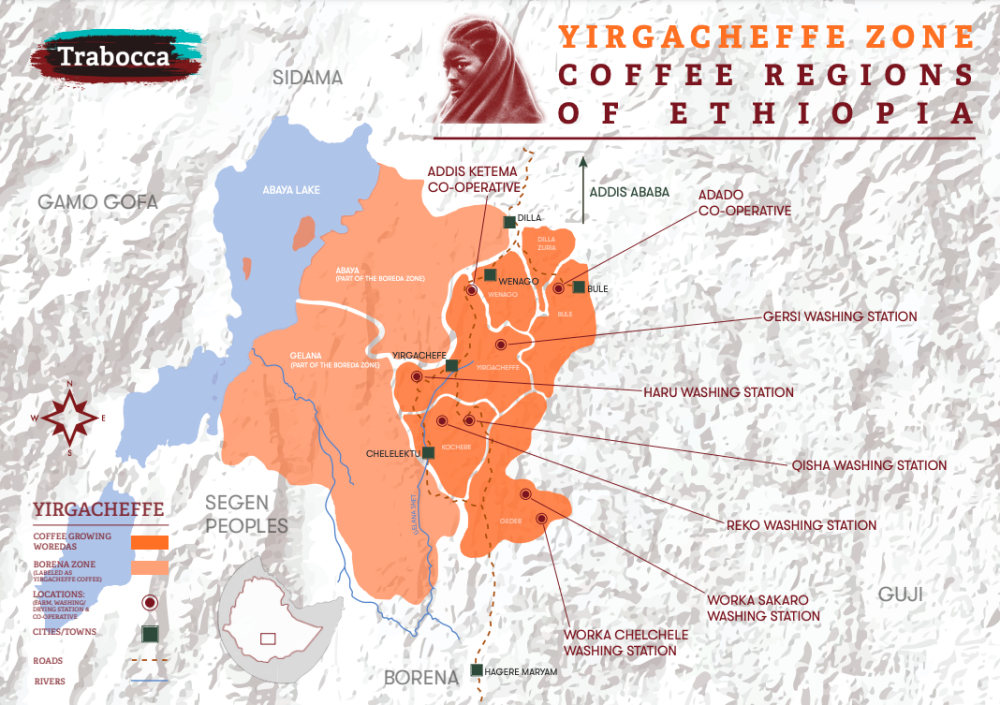
The same is true of the Yirgacheffe region. The growing altitude there is close to 2,000 meters, making it one of the highest coffee-producing regions in the world, and it was once under the jurisdiction of the Sidama region in earlier years. The lakes around the region bring abundant moisture to the coffee-growing areas. In the rift valley areas represented by the Misty Valley, clouds and mist linger all year round, the seasons are mild as spring, and the gentle breeze, cool and humid conditions allow thousands of coffee trees to flourish, creating the unique terroir charm of Yirgacheffe, where floral and fruity aromas blend in endless variation.
In the 1970s, the most advanced washed processing technology of that time from Central and South America was introduced locally, greatly improving the quality of green coffee beans and bringing growers more substantial returns. At the same time, the washed method processes coffee fruit until only parchment beans remain for drying, eliminating the possibility of excess sugars and esters participating in reactions, and thus Yirgacheffe's most authentic coffee terroir was clearly revealed to the world.
The fresh and elegant white jasmine floral aroma in Yirgacheffe coffee beans, along with the delicate and bright mouthfeel among the characteristics of Yirgacheffe coffee beans, makes Yirgacheffe coffee beans stand out from many Sidama coffee beans, and many coffee growers in the Sidama region take pride in labeling their products as Yirgacheffe coffee. Yirgacheffe coffee beans are of outstanding quality and have long accumulated a group of loyal Yirgacheffe coffee lovers. On Front Street Coffee's bean shelf, there are many African coffee beans, and Yirgacheffe coffee beans have always had loyal fans asking about them.
For a long time before Yirgacheffe truly became famous, it was sold under labels bearing the word Sidama. It was not until 1995, when Ethiopia abolished the provincial system and changed to a federal system, and with four revisions and adjustments to the ECX coffee classification table in 2010, 2015, 2018, and 2022, that Yirgacheffe had long since become an independent origin. Today, the Yirgacheffe region covers the Gedeo Zone in the Southern Nations, Nationalities, and Peoples' Region and the West Guji Zone in Oromia.
Among them, the Gedeo Zone governs five coffee woredas: Yirgacheffe, Dilla Zuria, Wenago, Kochere, and Gelana Abaya. It is worth noting that Gedeb, located at the southernmost end of the Gedeo Zone, although not included in the ECX classification table as a Yirgacheffe origin, is already widely regarded within the coffee industry as a Yirgacheffe origin.
Yirgacheffe gives off an extremely complex aroma and displays an exceptionally outstanding mouthfeel that is difficult to describe. On Front Street Coffee's bean shelf, there are 7 daily-drinker beans from different producing regions. This series mostly uses the washed processing method, allowing newcomers to specialty coffee to quickly become familiar with the terroir of various regions at an affordable price. Among them, Front Street Coffee chooses to use Yirgacheffe coffee beans to represent the terroir of African regions with their bright citrus notes.
In addition to the daily-drinker bean series, Front Street Coffee's bean shelf also holds many Yirgacheffe coffee beans. Even though they are all from the Yirgacheffe region, different processing methods and growing areas produce different flavor and mouthfeel expressions. Gordin, Red Cherry, Kochere, Konga, Armelelalo, Dorothy, and so on.
Gordin and Kochere are both washed-process Yirgacheffe coffee beans. Gordin presents citrus, apricot, and green tea; Kochere presents citrus, honey, and black tea.
Red Cherry and Konga are both natural-process Yirgacheffe coffee beans. Red Cherry leans more obviously toward berries, strawberries, and fermented wine aromas; while Konga has citric acidity, a lingering creamy finish, and strong honey sweetness.
Armelelalo and Dorothy, on the other hand, are produced under the fourth wave of specialty coffee using processing methods different from traditional natural and washed methods. Armelelalo uses anaerobic slow natural processing, which deepens the berry acidity; Dorothy uses enzyme washed processing, which gives the finished product a rich peach oolong tea flavor.
Armelelalo, a coffee bean that won the championship in the TOH Ethiopia competition in 2021, uses anaerobic slow natural processing. The whole coffee fruit is placed in a sealed container for anaerobic fermentation for as long as 120 hours, and finally spread evenly to dry for about 5 weeks. This unique processing method deepens the berry flavor of this coffee bean.
After cupping, Front Street Coffee tasted that this coffee bean has a rich berry flavor with a hint of red flower aroma, like drinking white wine, and as the temperature drops slightly, it takes on a flavor like tangerine pu'er tea.
When Front Street Coffee formulates the roast profile for Yirgacheffe coffee beans, in order to preserve the unique floral aroma and rich fruity acidity of Yirgacheffe coffee, it generally adopts a medium-light roast level. Therefore, Front Street Coffee recommends the following brewing suggestions:
Dripper: Hario V60
Water temperature: 90°C
Dose: 15 grams
Coffee-to-water ratio: 1:15
Grind size: 80% passing through a Chinese standard No. 20 sieve
Since Front Street Coffee ships coffee beans freshly roasted within 5 days, by the time they arrive they have gone through a 5- to 7-day resting period. The coffee beans are still relatively fresh and store plenty of gas inside, so it is recommended to perform a bloom during brewing to promote gas release, thereby stably and evenly extracting the flavor compounds from the coffee grounds.
Pour in 30 grams of hot water and bloom for 30 seconds, then pour from the center in a fine stream and slowly circle to 125 grams. When the water level in the dripper drops to the point where the coffee bed is about to be exposed, continue circling and pouring to 225 grams. The total extraction time is about 2 minutes.
For professional coffee knowledge exchange and more coffee bean information, please follow Coffee Workshop (WeChat public account: cafe_style)
For more specialty coffee beans, please add the private WeChat of Front Street Coffee: qjcoffeex
The above content is compiled by CoffeeHunters, a coffee news website.


