







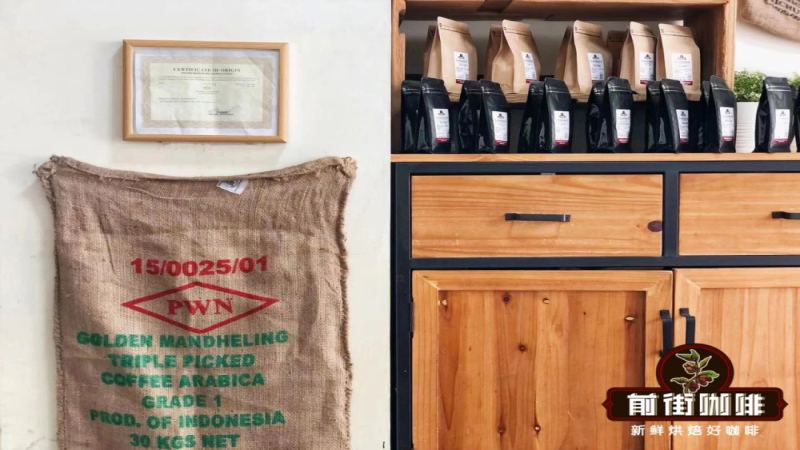
Mandheling is the signature coffee of Sumatra, Indonesia, celebrated for its full-bodied richness, and Golden Mandheling represents its top-tier lots. From the perspective of Front Street, this article traces the origin of the name Mandheling, the growing conditions of Sumatra's two core producing regions (Aceh and Lintong), the evolution of Indonesian coffee varieties, and how the unique wet-hulling process shapes Mandheling's signature flavor. The second half focuses on pour-over practice, introducing Front Street's approach to brewing PWN Golden Mandheling, including the use of the KONO dripper, water temperature and grind parameters, and a three-pour schedule, helping coffee lovers recreate a clean yet layered cup of Golden Mandheling at home.
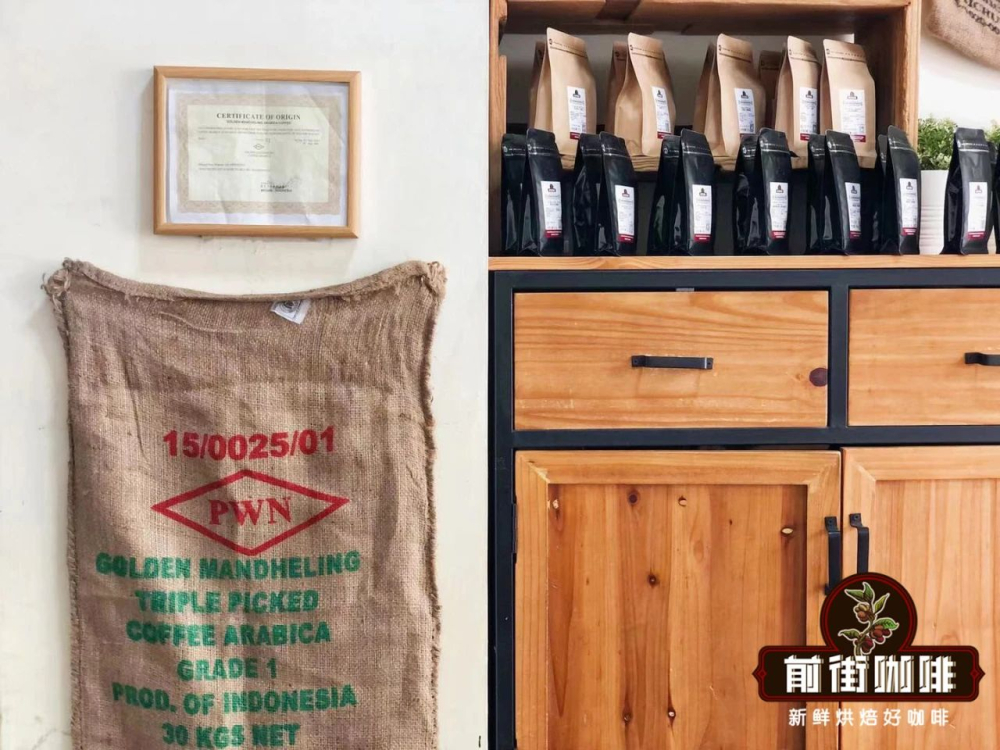
Long before Jamaican Blue Mountain rose to fame, Mandheling was already the representative of full-bodied specialty coffee, capturing the hearts of a large number of coffee enthusiasts. This time, Front Street will walk you through what makes classic Mandheling unique, and how to brew the top-tier Golden Mandheling so it tastes great.
The Origin of the Name "Mandheling"
Although Mandheling comes from Indonesia, it made its name in the Japanese market. Unlike coffees named after producing regions or varieties, such as "Yirgacheffe" and "Geisha," the name Mandheling actually derives from a misreading of the name of the Mandailing ethnic group in northwestern Sumatra, Indonesia.
During World War II, when Japanese forces occupied Indonesia, a Japanese soldier drank an exceptionally rich and aromatic cup of coffee in a certain café and asked the owner what coffee it was. The owner mistook the question for asking where he was from and blurted out "mandheling." After the war, the soldier returned home and, recalling that delicious cup, vaguely remembered it seemed to be called "Mandheling." In 1968, the Nomura Trading Company of Osaka, Japan, found the Indonesian company N.V. Pawani Medan and purchased 15,000 kilograms of Sumatra Mandheling coffee for the Japanese market, where it was overwhelmingly well received. From then on, both Mandheling coffee and the Pawani coffee company became widely famous. Later, people collectively referred to arabica beans produced on the island of Sumatra as Mandheling coffee.
The Growing Conditions of Mandheling Coffee
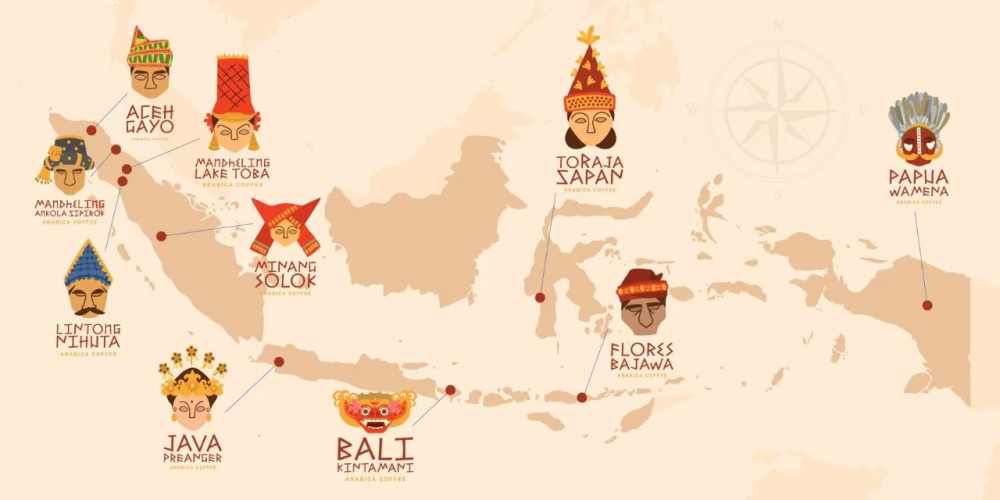
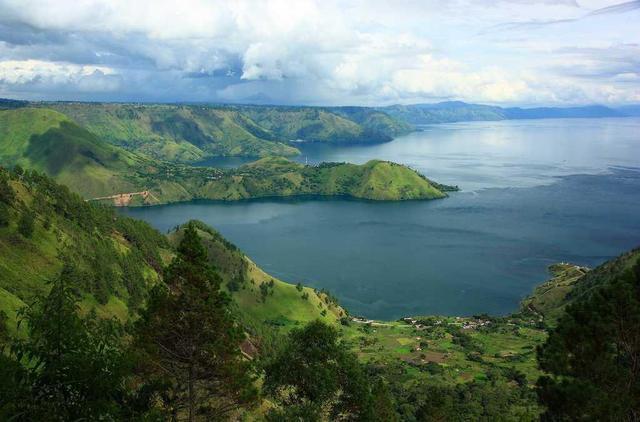
The Sumatra producing region that yields Mandheling consists mainly of the higher-elevation Aceh Province and North Sumatra Province, growing primarily arabica, and is one of the few sources of specialty lots in Indonesia. In the traditional sense, Mandheling comes from the Lintong region around Lake Toba; after peace was restored in Aceh Province in 2005, Mandheling also continued to be cultivated around Lake Tawar in the far north, also known as Aceh coffee. These two origins are collectively called the "Two Lakes, Two Mandheling," and are currently the main sources of Mandheling coffee on the market.
The Aceh and Lintong producing regions have fertile volcanic soil and abundant rainfall, and are rich in agricultural products such as spices, timber, and palm oil—coffee naturally among them. The coffee cherry ripening season runs from September to April each year, and busy farmers can be seen picking throughout the mountains. Traditional Lintong Mandheling is grown by the Mandailing and Batak peoples, while the "rising star" Lake Tawar Mandheling is cultivated by the Gayo people.
Indonesia grows a quite rich variety of cultivars. The coffee variety planted in Indonesia in the early days was the universally recognized excellent-flavored Typica, introduced by the Dutch at the end of the seventeenth century, and known in Indonesia as Bergendal, Sidikalang, and so on. In 1877, coffee trees across Indonesia were almost all severely hit by leaf rust, and large areas of Typica trees withered.
To address this predicament, the Indonesian government introduced more disease-resistant Robusta varieties from Africa and elsewhere, and to this day Robusta remains Indonesia's main variety. To increase coffee production, Indonesia continuously introduced various disease-resistant varieties from other countries, including Caturra, Catimor, Timor, Typica, S288, S795, Sidikalong, and others. Among them, the Robusta-Arabica hybrid Timor varieties Tim Tim and Bor Bor, as well as the Catimor series Ateng, show a distinctive cedar aroma thanks to good disease resistance and adaptation to Sumatra's terroir. At present, Ateng and Tim Tim already account for 70% of Sumatra coffee. Front Street's Indonesian Lintong Mandheling daily-drinker beans are a blend of Tim Tim and Ateng, while Golden Mandheling is selected from Ateng.
The Taste of Mandheling Originates from Wet Hulling
Wet hulling is the most common green bean processing method in Indonesia, and it was actually "forced" out by the local weather. Indonesia's year-round humidity is between 70 and 90%, typhoons come at any time, and annual rainfall even exceeds 2000mm. Under such harsh conditions, it is simply impossible to carry out the 2-to-3-week sun-drying used in Africa; washed processing is not only time-consuming but also has higher labor and water costs, which Indonesia, aiming for mass production, cannot afford. So the locals figured out a unique semi-washed method—wet hulling.
Coffee cherries with the skin and pulp removed are poured directly into a pool for a short fermentation of a few hours; at this point a small amount of mucilage still remains on the parchment, and the mucilage is removed by scrubbing. Then the parchment beans are spread out to dry; the first drying only needs to reach a 30–40% moisture content, about 2–3 days, after which the coffee farmers sell the green beans to collectors. The collectors directly hull the purchased semi-dry parchment beans by machine to obtain the innermost green beans.
Because the huller has relatively high friction, it tears open the parchment layer clinging tightly to the green beans, and at this stage white or green viscous liquid usually flows out. Through prolonged soaking in mucilage and the action of the humid environment, the green beans eventually become soft, pale and swollen, and grayish-green. Under the friction and agitation, the green beans are also more easily crushed or dented, especially at both ends, forming small notches—so-called horse-hoof beans. The "naked beans" with the parchment removed dry extremely quickly, and can be bagged once the moisture content drops to 12–13%.
The increased processing speed also brings a higher defect rate, so before export, defects must be removed by hand sorting to reach Indonesia's G1 grade (fewer than 11 defects per 300 grams of green beans). Usually we see DP (double-picked) and TP (triple-picked); the more rounds of careful screening, the higher the coffee bean quality. Front Street's PWN Golden Mandheling coffee undergoes one machine sorting plus three hand sortings, ensuring the beans are above 18 mesh in size, uniform in color, and extremely clean in overall cup quality.
Pour-Over Golden Mandheling Coffee
Speaking of this, I believe quite a few friends are already eager to try brewing a rich, aromatic cup of Mandheling themselves. Front Street's bean list offers two Mandheling options. The first is the entry-level "Indonesian Lintong Mandheling daily-drinker beans," which, due to wet hulling, carries Mandheling's unique herbal aroma, with a full-bodied taste and a rather rugged Indonesian character. The other is the famous "Front Street PWN Golden Mandheling coffee beans," also a very popular one at Front Street.
The coffee beans shipped by Front Street are all freshly roasted within 5 days, because our roasting philosophy is "freshly roasted good coffee," and Front Street always hopes that the beans delivered into everyone's hands are at their peak flavor window. Please also drink them as soon as possible after receiving them; if stored for more than 40 days, the coffee beans easily lose their aroma and release unpleasant woody notes, thus affecting extraction.
Mandheling is known for its richness, so Front Street accordingly uses a medium-dark roast level. After medium roasting, the internal structure of the beans changes considerably and becomes porous, making the ground powder more absorbent. If the brewing parameters are not properly adjusted, the coffee easily over-extracts and turns bitter. To give the coffee enough aroma without over-extracting, the extraction rate needs to be lowered; Front Street uses a relatively low water temperature and a relatively coarse grind to reduce the release of bitter large molecules.
FrontStreet Coffee's baristas consistently use the KONO dripper to extract coffee beans that express richness. The only exhaust part of the KONO dripper is that quarter of ribs; when the water level rises above the ribs, the water volume inside the dripper keeps rising, increasing pressure through the weight of the water; because the outlet is relatively small, it can extend the contact time between coffee particles and water, and as the water is poured, it more effectively brings out soluble substances, thereby enhancing the coffee's rich, full-bodied taste.
Pour-over parameters: 87–88°C water temperature, medium grind (70% passing rate on the Chinese standard No. 20 sieve), 15 grams of coffee powder, 1:15 coffee-to-water ratio, three-pour schedule.
Three-pour schedule: first pour 30 grams of water and bloom for 30 seconds, then pour from the center point in a thin stream and slowly spiral out to 125 grams; when the water level in the dripper drops to where the coffee bed is about to be exposed, continue spiraling and pouring to 225 grams, with a total extraction time of about 2 minutes.
The pour-over Golden Mandheling is overall rich and full-bodied, with an extremely clean mouthfeel, and its flavor changes in layers as the temperature shifts. Aromas of dark chocolate, nuts, and caramel, with subtle notes of cedar and herbs, a very pleasant sweetness, and a high degree of balance.
For professional coffee knowledge exchange and more coffee bean information, please follow Coffee Workshop (WeChat public account cafe_style)
For more specialty coffee beans, please add the private WeChat of FrontStreet Coffee, WeChat ID: qjcoffeex
The above content is compiled by CoffeeHunters, a coffee news website.


